



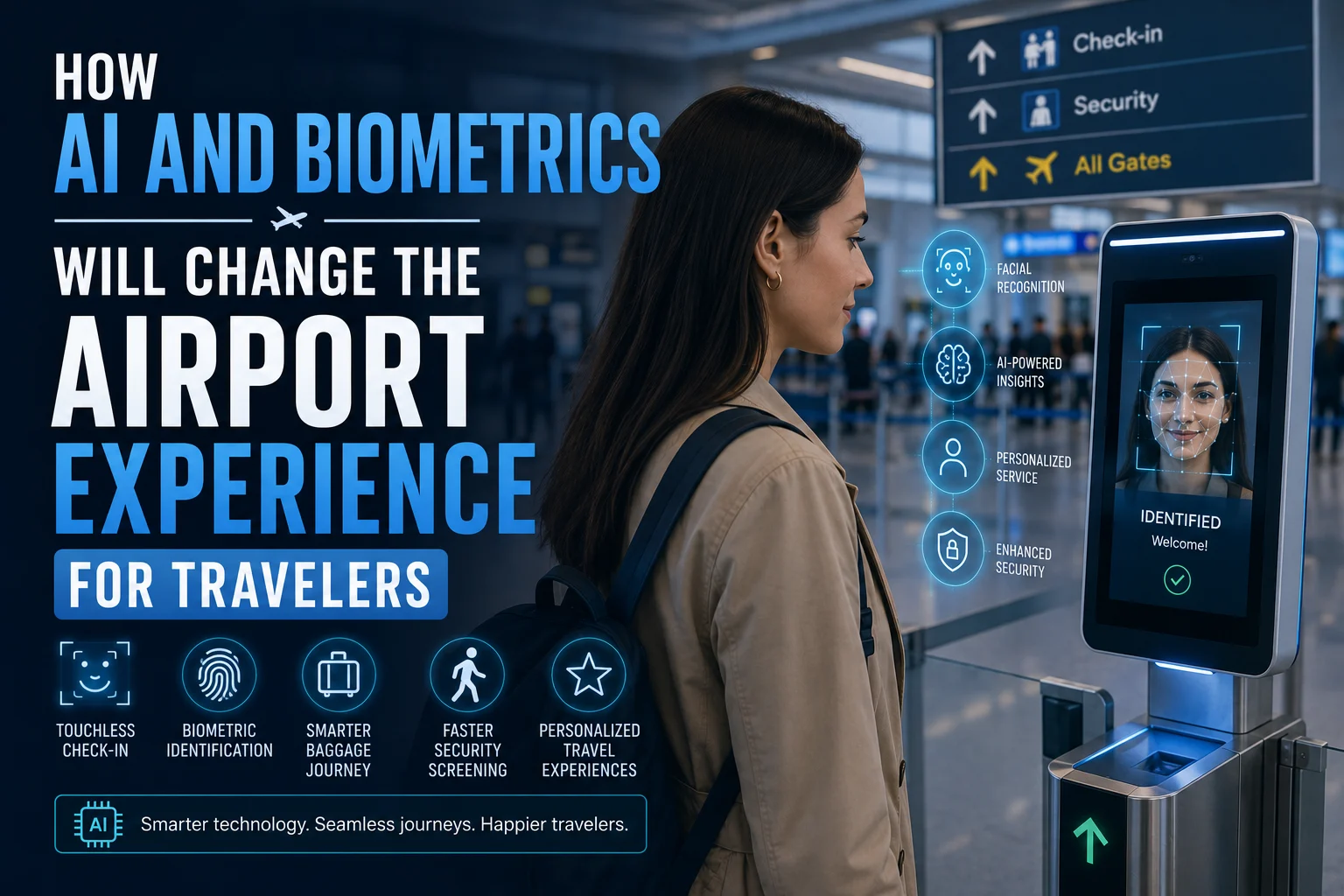
Introduction: The Airport of the Future Is Already Here
For most of the modern aviation era, the airport experience has been defined by one thing above all else: waiting. Waiting in the check-in line. Waiting at the security checkpoint. Waiting at the boarding gate. Waiting for your bag. For millions of travelers, the airport is not so much a gateway to adventure as it is a gauntlet of queues, friction, and frustration — an unavoidable tax on the joy of travel.
That is changing. And it is changing faster than most travelers realize.
Artificial intelligence and biometric technology are quietly — and in some airports, quite visibly — rewriting the rules of the airport experience. Facial recognition is replacing boarding passes. AI systems are screening baggage with greater speed and accuracy than any human inspector could achieve. Predictive algorithms are anticipating crowd surges before they form. Smart cameras and sensors are monitoring terminal environments in real time, flagging anomalies before they become incidents.
The airport of the future is not a speculative concept. Versions of it exist right now at major hubs across the United States, Europe, Asia, and the Middle East. What is coming next is not a leap into the unknown — it is the full, system-wide rollout of technologies that are already proving themselves at the world’s most advanced airports.
This article explores exactly how AI and biometrics are transforming every stage of the airport journey: from the moment you book your ticket to the moment you step off the jet bridge at your destination. The changes are profound, the benefits are real, and the questions they raise — about privacy, equity, and the future of human oversight — deserve serious attention.
What Are Biometrics, and Why Do Airports Want Them?
Biometrics refers to the automated recognition of individuals based on their unique physical or behavioral characteristics. In the airport context, the most relevant biometric identifiers are:
- Facial recognition — using cameras and AI to match a live face to a stored image in a passport or government database
- Fingerprint scanning — capturing the unique patterns of a fingertip
- Iris scanning — reading the complex, unique patterns of the iris
- Voice recognition — identifying individuals by vocal characteristics
- Gait analysis — identifying people by the unique way they walk (emerging technology)
Of these, facial recognition has emerged as the dominant biometric technology in airports because it is passive — it can identify a person without requiring them to stop, remove a glove, or press a finger to a scanner. A camera can capture and match a face as a traveler walks through a corridor, making it uniquely suited to high-volume, fast-moving environments like airport terminals.
The appeal for airports, airlines, and governments is clear. Biometrics can verify identity faster and more accurately than a human agent checking a paper document. They can process thousands of passengers per hour. They never get tired, never have a bad day, and do not require a living wage. And when integrated with AI-powered threat assessment systems, they can do something a human agent fundamentally cannot: process and cross-reference vast databases of information in real time.
Stage 1: Before You Even Arrive — AI in Travel Planning and Booking
The biometric and AI transformation of travel begins long before you set foot in an airport. Airlines and travel platforms are deploying AI at the planning stage in ways that are already changing traveler behavior.
AI-Powered Price Prediction and Personalization
Machine learning algorithms now analyze enormous datasets — historical pricing, demand forecasts, competitor rates, seasonal patterns, fuel cost projections — to predict airfare movements with remarkable accuracy. Tools like Google Flights’ price prediction feature and Hopper’s fare forecasting are powered by these models, helping travelers decide when to book and when to wait.
At the airline level, AI-driven personalization engines analyze individual traveler preferences and histories to surface targeted offers, seat recommendations, and ancillary upgrades. The system learns over time, improving its predictions and recommendations with each interaction.
Predictive Crowd Management Before Departure
Several major airports now use AI systems that analyze historical passenger data, flight schedules, check-in rates, and real-time sensor inputs to predict crowd density at future points in time. This information is used operationally — to allocate staff, open additional security lanes, and route passengers through less congested pathways — but it is also increasingly being shared with travelers directly through airport apps and dynamic signage.
The result: passengers who check the airport app before leaving home see not just their gate information but a prediction of wait times at security and recommendations for the ideal time to arrive. This is a small but meaningful shift that redistributes the burden of queue management from airports to informed travelers.
Stage 2: Check-In and Bag Drop — The Contactless Revolution
For decades, check-in meant standing in a line and handing a document to a human agent. Self-service kiosks began eroding that model in the 2000s. Today, AI and biometrics are poised to eliminate the check-in step as a distinct experience.
Biometric Check-In: Your Face Is Your Boarding Pass
Delta Air Lines, United Airlines, American Airlines, and several international carriers have already deployed facial recognition check-in at multiple airports. The process works like this: a camera at the check-in kiosk captures the traveler’s face, the image is matched against the photo in the traveler’s passport (linked to their booking), and the system confirms identity and generates a boarding pass — all in a matter of seconds, with no physical document required.
At airports like Hartsfield-Jackson Atlanta International, a traveler enrolled in a biometric program can check in, drop their bag, clear security, and board their flight without ever presenting a physical passport or boarding pass. Their face handles every step.
The Customs and Border Protection (CBP) Traveler Verification Service, which underpins many of these systems in the United States, uses a database of photos from passport applications, visa applications, and prior travel records. The matching accuracy rate for current commercial systems exceeds 99% under controlled conditions — significantly higher than the error rate of manual document checking.
AI-Enabled Bag Drop
Automated bag drop stations use AI-powered weight sensors, dimension measurement systems, and tag readers to process checked luggage without agent involvement. The passenger drops the bag, the system verifies its dimensions and weight, prints and attaches the tag, and feeds it into the sorting conveyor — in under a minute.
More sophisticated systems combine biometric identity verification with bag processing, so that dropping your bag requires only your face, not a barcode, boarding pass, or physical interaction with any agent or machine interface.
Stage 3: Security Screening — The Biggest Transformation
Security screening is where the gap between the current experience and the AI-powered future is most dramatic. Today’s security lines are among the most universally frustrating elements of air travel. Tomorrow’s security systems are being designed to eliminate the need for a line.
CT Scanners and AI-Powered Threat Detection
Traditional X-ray baggage screening produces a flat, two-dimensional image that a human operator must interpret. The rate of missed threats in manual screening is well-documented; studies have consistently shown that human screeners miss a significant percentage of prohibited items, particularly when fatigued.
Advanced CT (computed tomography) scanners now produce detailed three-dimensional images of bag contents, allowing screeners to rotate and examine items from any angle. Paired with AI-powered object recognition software, these systems can automatically flag suspicious items — not just based on shape, but based on density, material composition, and spatial relationship to other objects in the bag.
At airports using these systems, the physical requirement to remove laptops and liquids from bags at the checkpoint has been eliminated. The AI can identify these items within the bag and account for them in its threat assessment. This single change alone dramatically accelerates the pace of baggage screening.
TSA has been deploying CT scanners at US airports for several years and is on an ongoing expansion trajectory. International airports in the United Kingdom, the Netherlands, and Singapore have deployed similar technology.
Automated Security Lanes
Beyond better scanners, AI is transforming the physical layout and flow of security checkpoints. Automated security lanes use sensor systems to detect when a bin has cleared the conveyor and return it automatically. Multiple travelers can load bins simultaneously, and the system manages the conveyor speed dynamically based on throughput.
Smart cameras monitor traveler behavior in the security zone, alerting human officers to anomalies — someone who pauses, doubles back, or exhibits patterns that warrant attention — while allowing the routine, compliant majority to flow through without interruption.
The Vision: “Walkthrough” Security
The ultimate destination for AI-powered airport security is a world in which travelers walk through a corridor at normal walking pace while an array of sensors — millimeter-wave scanners, CT imaging, biometric cameras, behavioral analysis systems — simultaneously screen for threats, verify identity, and clear the individual for travel. No bins. No removing shoes. No stopping. Just walking.
This technology is being actively developed and tested. At some airports, early versions are already in limited deployment. Full implementation at scale remains years away for most airports, but the direction of travel is unmistakable.
Biometric Identity Verification at Security
At TSA PreCheck lanes and at international airports with biometric programs, facial recognition is already being used to verify traveler identity at the security checkpoint. Instead of an agent comparing your face to a photo in a passport or on a driver’s license, a camera does the comparison in real time against a trusted database — faster, more accurately, and without requiring you to hand over a physical document.
This eliminates one of the most common sources of checkpoint delay: the time an agent spends examining documents, asking questions, and making a judgment call.
Stage 4: The Terminal Experience — Personalization and Smart Infrastructure
Once through security, the airport experience itself is being reshaped by AI-driven infrastructure and personalization.
AI-Powered Navigation and Wayfinding
Large airports are notoriously difficult to navigate, particularly for infrequent travelers or those with tight connections. AI-powered wayfinding apps and terminal systems now provide dynamic, real-time navigation that accounts for current gate assignments (which change), live security wait times, walking distance calculations, and connection timelines.
Some airports are integrating wayfinding with wearable technology and augmented reality, allowing travelers to follow directional overlays in their phone camera view or receive haptic feedback guiding them toward their gate. AI systems dynamically re-route navigation suggestions based on live conditions — if a corridor becomes congested or a moving walkway is out of service, the system adapts.
Personalized Retail and Dining Recommendations
Airports are investing heavily in AI systems that can provide personalized retail and dining recommendations based on a traveler’s profile, preferences, previous purchases, and available time before departure. These systems draw on loyalty program data, purchase history, and real-time flight information to surface relevant suggestions at the right moment.
A business traveler with 45 minutes before boarding and a history of ordering coffee and sandwiches receives different suggestions than a leisure traveler with two hours and a history of browsing duty-free cosmetics. This hyper-personalization is a significant revenue opportunity for airports and a genuine convenience improvement for travelers who want relevant recommendations rather than generic terminal signage.
AI-Enhanced Accessibility Services
AI technology is enabling meaningful improvements in accessibility for travelers with disabilities. Computer vision systems can detect when a traveler in a wheelchair or mobility device needs assistance and automatically notify airport staff. AI-powered translation systems break down language barriers in real time. Smart navigation systems can provide turn-by-turn guidance optimized for travelers with limited mobility, identifying accessible routes, elevator locations, and accessible restroom facilities along the path.
Some airports are testing AI-powered assistance robots that can escort travelers with disabilities from check-in through boarding, responding to spoken requests and navigating the terminal environment autonomously.
Smart Restroom Management
One of the more unglamorous but genuinely impactful applications of AI in airports is real-time restroom monitoring. Sensor systems track occupancy, usage frequency, and supply levels, automatically alerting cleaning staff when attention is needed. Predictive algorithms analyze flight arrival data to anticipate surges in restroom demand and pre-position staff accordingly. The result: cleaner facilities and shorter waits, especially during peak periods.
Stage 5: Boarding — Frictionless and Fully Biometric
The boarding gate is the last major friction point in the airport journey, and it is being rapidly transformed.
Facial Recognition Boarding
Biometric boarding — where a camera at the jet bridge door confirms your identity and flight authorization by matching your face to a database, replacing the barcode scan entirely — is now operational at hundreds of gates across major US airports and at international hubs worldwide.
The speed improvement is significant. Biometric boarding can process travelers at roughly twice the rate of traditional boarding pass scanning. Airlines have reported boarding time reductions of 30% to 50% at gates using facial recognition, translating to faster pushback and fewer delays caused by the boarding process itself.
For travelers, the experience is elegantly simple: you walk up to the camera, it recognizes you, and you board. No fumbling for a phone, no searching for a paper boarding pass, no awkward scanner angles.
AI-Optimized Boarding Sequences
Beyond biometric identity verification, AI is being used to optimize the sequence and timing of the boarding process itself. Algorithms analyze seat assignments, carry-on bag estimates, passenger mobility levels, and historical boarding data to determine the most efficient boarding order — minimizing aisle congestion and overhead bin conflicts.
Some airlines are experimenting with dynamic boarding invitations, where passengers receive a push notification on their phone telling them the optimal time to approach the gate based on their seat and the current progress of the boarding process. Rather than everyone crowding the gate the moment boarding is announced, travelers are staggered in a sequence that keeps movement flowing smoothly.
Stage 6: Operations and Safety — What Travelers Don’t See
Much of the most consequential AI deployment in airports operates behind the scenes, in systems that travelers never interact with directly but that dramatically affect their experience.
AI-Powered Baggage Handling and Tracking
Lost and delayed baggage is one of the most persistent frustrations in air travel. AI is making significant inroads here. Computer vision systems in baggage handling areas scan and track bags continuously, identifying misrouted items before they board the wrong aircraft. Machine learning models predict baggage handling bottlenecks based on flight load data and can dynamically re-route bags through alternative conveyor pathways.
RFID tracking technology, combined with AI-powered monitoring systems, now allows airlines to track the location of each bag in real time throughout the handling process — and to share that location with passengers through apps. When something goes wrong, the system can identify the issue and initiate recovery processes significantly faster than human-monitored systems.
Predictive Maintenance
Aircraft and airport equipment downtime is a major driver of delays. AI-powered predictive maintenance systems analyze sensor data from aircraft engines, airport jetways, baggage systems, and other critical infrastructure to predict equipment failures before they occur — often days or weeks in advance.
Airlines, including American, Delta, and United, have deployed machine learning systems that monitor real-time data from aircraft sensors during flights, identifying anomalies that indicate developing mechanical issues. This allows maintenance to be scheduled proactively, at a time and location that minimizes passenger impact, rather than reactively when an aircraft goes out of service unexpectedly.
AI-Enhanced Air Traffic Management
While air traffic management has long been a data-intensive field, AI is enabling a new generation of tools that improve efficiency and safety simultaneously. Machine learning models optimize runway sequencing and departure timing, reducing ground delay times. AI systems assist controllers in identifying potential conflicts and suggesting resolution maneuvers. In some applications, AI is being used to optimize flight paths in real time, reducing fuel consumption and emissions without sacrificing schedule performance.
The Privacy Debate: Critical Questions That Demand Honest Answers
No discussion of AI and biometrics in airports is complete without a serious examination of the privacy, civil liberties, and equity concerns these technologies raise.
Who Owns Your Biometric Data?
When a facial recognition system captures your image and matches it to a government database, that biometric data has been processed, stored, and potentially retained. Questions about who owns that data, how long it is kept, who can access it, and under what circumstances it can be shared are not merely theoretical. They are active policy questions with real consequences for civil liberties.
In the United States, CBP has asserted that biometric data collected at the border is subject to standard government data retention policies. Civil liberties organizations, including the ACLU, have raised concerns about the potential for mission creep — data collected for immigration control being used for other law enforcement purposes — as well as the risk of data breaches exposing sensitive biometric information that, unlike a password, cannot be changed.
Accuracy, Bias, and Fairness
Facial recognition systems are not equally accurate across all demographics. Multiple independent studies — including a landmark 2019 study by the National Institute of Standards and Technology (NIST) — have documented significantly higher error rates for people with darker skin tones, particularly darker-skinned women. In the context of airport security, a false negative (failing to match a legitimate traveler) creates a delay and a frustrating experience. A false positive (incorrectly flagging an innocent person as a potential threat) can have far more serious consequences.
The aviation industry and its technology providers have acknowledged these disparities and are actively working to improve model accuracy across demographic groups. But the gap has not been fully closed, and deploying these systems at scale before it is means that the burden of error falls disproportionately on travelers who are already often subjected to higher rates of manual screening.
Opt-In vs. Opt-Out: Who Really Has a Choice?
Most biometric programs in US airports are currently described as voluntary — travelers can opt out and use traditional document-based verification instead. In practice, however, the line between voluntary and effectively mandatory can blur. When biometric lanes are faster, when opting out requires additional steps and agent assistance, and when the social pressure of a queue behind you is palpable, the meaningful voluntariness of the choice is debatable.
As biometric systems become more deeply embedded in airport infrastructure, the practical ability to opt out without significant inconvenience may diminish. This is a policy question that democratic societies need to address proactively rather than retrospectively.
Global Leaders: Airports Already at the Forefront
Several airports around the world are already showcasing what the AI-biometric future of travel looks like at scale.
Changi Airport, Singapore, is consistently ranked the world’s best airport and has been a pioneer in deploying AI across terminal operations, biometric check-in, facial recognition boarding, and automated immigration processing. Changi’s automated border clearance system processes eligible travelers in under a minute.
Dubai International Airport has deployed iris recognition for passport control, allowing UAE-registered travelers to clear immigration through an iris scan alone — no passport presentation required. The airport uses AI-powered monitoring systems across its enormous terminal complex.
Incheon International Airport in South Korea uses facial recognition throughout its entire passenger journey and has set international benchmarks for speed and efficiency in biometric-enabled travel.
London Heathrow and Amsterdam Schiphol are among the European leaders in biometric boarding and AI-powered operational management.
In the United States, Hartsfield-Jackson Atlanta, Dallas/Fort Worth, Los Angeles International, JFK, and Miami International are among the airports with the most advanced biometric programs.
What Travelers Can Do to Prepare
As these technologies roll out more broadly, travelers can take practical steps to be ready:
Enroll in trusted traveler programs. TSA PreCheck, Global Entry, and Clear all offer biometric enrollment that grants access to expedited screening lanes. These programs are the fastest on-ramp to the biometric travel experience available today.
Keep your passport up to date. Biometric verification in most airports matches your live image to your passport photo. An expired or heavily outdated passport photo can affect matching accuracy.
Download your airline and airport apps. The AI-powered features that predict wait times, provide dynamic navigation, and send boarding notifications are delivered primarily through official apps.
Understand your opt-out rights. If you have concerns about biometric data collection, know that at most US airports, you currently retain the right to opt out of facial recognition and use traditional document verification instead. Exercise that right if you choose to.
Stay informed. Privacy policies and data retention practices vary by airport, airline, and program. Reading the terms of any biometric enrollment is a reasonable precaution.
Frequently Asked Questions
Is facial recognition at airports mandatory?
In the United States, biometric screening programs for domestic travel are currently voluntary. Travelers can opt out and use standard document-based verification. For international departures and arrivals, CBP’s biometric exit program is applied more broadly, but opt-out options generally exist for US citizens.
Can airports share my biometric data with other agencies?
Data sharing policies vary by country, airport, and program. In the US, CBP collects biometric data and is subject to federal data governance policies. The potential for data sharing with other law enforcement agencies is a legitimate policy concern that civil liberties organizations continue to monitor and challenge.
How accurate is facial recognition at airports?
Current commercial facial recognition systems used at airports report accuracy rates above 99% for matched pairs under controlled conditions. However, accuracy varies by demographic, lighting conditions, and system quality. Ongoing concerns about higher error rates for people with darker skin tones are being actively addressed by developers, but have not been fully resolved.
What happens if the system does not recognize me?
A failed biometric match does not prevent you from traveling. The system defaults to manual identity verification with a human agent — the same process that has always been standard. You present your passport or ID, an agent confirms your identity, and you proceed normally.
Are children subject to biometric screening?
Policies vary by program and country. In many programs, children under a certain age (typically 14 in US programs) are exempt from biometric capture.
Conclusion: A Faster, Smarter Journey — With Eyes Wide Open
The AI and biometric transformation of airports represents one of the most significant shifts in the travel experience since the introduction of commercial jet aviation. The benefits are tangible and substantial: faster check-in, more accurate security screening, shorter lines, smoother boarding, fewer delays, and a personalized experience that treats travelers as individuals rather than bodies to be processed.
For the hundreds of millions of people who pass through airports every year — often under time pressure, often stressed, often navigating unfamiliar environments — these improvements are not trivial. They represent real time saved, real frustration avoided, and real safety gains from more accurate threat detection.
But the transformation also demands clear-eyed attention to the risks. Biometric data is uniquely sensitive — it cannot be reset like a password, and its misuse has consequences that extend far beyond a missed flight. The accuracy disparities in facial recognition across demographic groups are real and must be resolved before these systems become a universal infrastructure. The question of meaningful consent in environments where biometric scanning is becoming the default deserves a serious and ongoing democratic conversation.
The airport of the future will be dramatically better for travelers. Ensuring that it is also fair, safe, accountable, and respectful of the fundamental right to privacy is the responsibility of the governments, corporations, and civil societies that are building it. Travelers who stay informed and engaged in that conversation are not just passive beneficiaries of progress — they are participants in shaping what that progress looks like.
In another related article, How to Build the Perfect Carry-On Packing List: Airline Rules and Smart Strategies