


Introduction: A Battle as Old as Commercial Aviation Itself
Every time a traveler books a flight, one of the first decisions they face — sometimes even before choosing an airline — is deceptively simple: window or aisle?
For most people, this choice is made in seconds, almost reflexively. Yet beneath this seemingly trivial decision lies a fascinating landscape of psychology, personality traits, physiological needs, social behavior, and deeply held values. Researchers, psychologists, and behavioral scientists have spent considerable time studying what drives this preference, and what they have uncovered is surprisingly rich.
The window-versus-aisle debate is not merely about comfort or convenience. It is a window — pun intended — into how we process the world, how we relate to other people, how much control we need over our environments, and even how we manage fear, anxiety, and uncertainty. Your seat preference, it turns out, can reveal quite a lot about who you are.
This article explores the psychology of window vs. aisle seat preference in extensive detail, covering everything from personality science and anxiety research to cultural differences and the neurological basis of spatial comfort. Whether you are a dedicated window-seater who would never give up the view, or an aisle loyalist who breaks into a cold sweat when trapped by the wall, there is a psychological story behind your choice — and it is worth exploring.
The Data: What Travelers Actually Choose
Before diving into the psychology, it helps to understand the landscape of preference. Surveys and booking data from major airlines and travel platforms consistently show that the majority of travelers — typically between 55% and 65% — prefer the aisle seat when given a free choice. The window seat comes in second, while the middle seat is almost universally dreaded and chosen last.
A 2019 survey by travel platform Skyscanner found that aisle seats were the top preference globally, with roughly 60% of respondents choosing them. However, this preference is not uniform — it shifts considerably based on age, travel frequency, trip length, gender, and cultural background. Younger travelers and occasional flyers tend to prefer window seats at a higher rate, while frequent business travelers overwhelmingly gravitate toward the aisle.
Understanding why these patterns exist requires us to examine the psychological drivers at play on both sides.
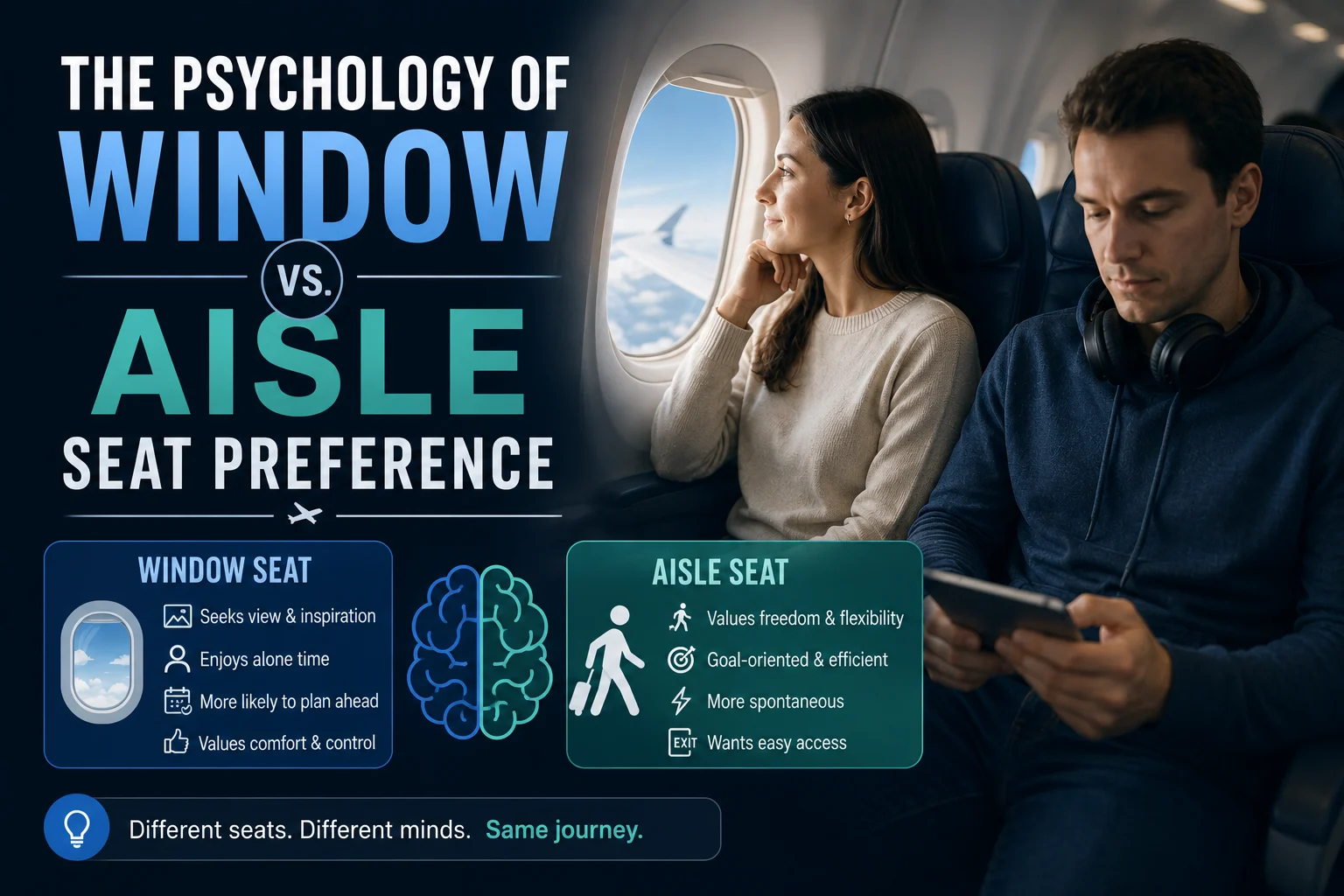
The Psychology of the Window Seat: Dreamers, Introverts, and Control-Seekers
The Desire for Containment and Safety
At first glance, the window seat seems like the more vulnerable position — you are pressed against the wall of a metal tube hurtling through the atmosphere, furthest from the exit. And yet, for millions of travelers, this is precisely the appeal.
Psychologists refer to this phenomenon through the lens of bounded spaces and the comfort of enclosure. Research in environmental psychology shows that many people — particularly introverts — feel most at ease when they are in a contained, defined space with a clear boundary on at least one side. The aircraft wall provides exactly this. There is no ambiguity about where your territory ends. You have a wall, a window, and a defined personal space that no one can encroach upon from one direction.
This feeling is similar to why many people prefer to sit in corner booths at restaurants, or choose seats against the wall in a waiting room. Evolutionary psychologists link this to an ancient preference for positions that offer a view of the environment while keeping your back protected — a survival instinct that has translated into modern spatial comfort preferences.
The Introvert’s Sanctuary
Perhaps the strongest psychological predictor of window seat preference is introversion. Numerous studies on introversion and social behavior suggest that introverts are far more likely to prefer window seats than their extroverted counterparts.
The reasoning is straightforward: the window seat minimizes unwanted social interaction. Seated against the wall, an introvert does not need to get up when their row neighbors need to pass. They do not serve as the de facto gatekeeper of the aisle. They can plug in their headphones, curl toward the window, and construct an invisible social boundary that is almost physically enforced by the aircraft structure itself.
Dr. Brian Little, a personality psychologist at Cambridge University who has written extensively on introversion, notes that introverts consistently seek to create what he calls “personal projects of restoration” — environments and conditions that allow them to recharge after social stimulation. The window seat, particularly on a long-haul flight, serves as exactly such a project. It is a self-constructed cocoon.
For introverts, the minor inconvenience of having to ask roommates to move when nature calls is a small price to pay for hours of uninterrupted peace.
The View as Emotional Regulation
For many window seat lovers, the actual view — the cloud formations, the city grids below, the curvature of the horizon, the sunrise at 35,000 feet — is not incidental. It is the entire point.
Research in environmental psychology, including seminal work by Rachel and Stephen Kaplan on Attention Restoration Theory (ART), shows that viewing natural and expansive environments has measurable restorative effects on the human mind. Looking out at the sky and clouds from an airplane window activates the same psychological mechanisms as gazing at a natural landscape — it reduces cognitive fatigue, lowers stress hormones, and promotes a state of gentle, effortless attention.
For anxious flyers, the window can serve a particularly important function: it provides environmental anchoring. When you can see clouds passing, feel the visual reference of the horizon, and watch the world below, your brain has external information to work with. This reduces the catastrophizing that often fills the void when you are surrounded by an opaque cabin wall with no sense of where you are or what is happening outside.
Window seats also serve travelers with a strong sense of wonder and curiosity — people who score high on the personality trait of openness to experience. These travelers are drawn to the view not as a coping mechanism but as a source of genuine delight. For them, seeing the Alps from above or watching a storm system spiral in the distance is one of the profound pleasures of air travel, worth any amount of inconvenience.
A Sense of Control Through Observation
There is a nuanced but important psychological point here: the window seat offers illusory control through observation. You cannot pilot the aircraft. You cannot alter its course. But by being able to see what is happening outside — to observe the weather, to watch the ground, to see other aircraft at altitude — you feel more informed, and therefore more in control of your situation.
This matters enormously for anxious travelers. A key driver of flight anxiety is not danger per se, but unpredictability and lack of information. When you cannot see outside and cannot understand what a bump or noise means, your threat-detection system fires rapidly. The window seat gives anxious flyers something to look at — a source of real-time environmental data that, for many, is calming simply because it exists.
The Psychology of the Aisle Seat: Pragmatists, Extroverts, and the Freedom-Seekers
The Need for Freedom of Movement
The defining psychological characteristic of aisle seat preference is a deep need for autonomy and freedom of movement. Aisle-seat lovers, when asked why they choose that position, most commonly cite the ability to get up whenever they want without inconveniencing anyone, stretch their legs, and feel less physically restricted.
This preference maps strongly onto what psychologists call reactance theory — the psychological resistance that arises when people feel their freedom is being constrained or threatened. People with high reactance sensitivity experience genuine discomfort when they feel trapped, and an airplane seat — with its limited legroom, tight quarters, and physical proximity to strangers — is one of the more reliably constricting environments in modern life.
The aisle seat is a direct response to this discomfort. By choosing the aisle, a traveler retains what they experience as maximum autonomy: the freedom to stand, to move, to exit the row at any moment without negotiation, apology, or reliance on others.
Control Over the Environment
Paradoxically, while window-seat travelers seek control through observation, aisle-seat travelers seek control through agency. The distinction is important: one group manages anxiety by watching; the other manages it by doing.
Aisle travelers often exhibit higher levels of what psychologists call an internal locus of control — a belief that they, rather than external forces, are the primary agents in their lives. People with a strong internal locus of control consistently choose options that preserve their ability to act. The aisle seat is the seat of action: you can respond to any situation by simply standing up and moving.
For frequent business travelers — a group notoriously dominated by aisle-seat preferences — this aligns perfectly with the high-agency, high-autonomy professional identity many of them carry. Business travelers are accustomed to making rapid decisions and executing them. Being hemmed in by a window and two row-mates is antithetical to that identity.
Social Openness and Extroversion
Just as introverts tend toward windows, extroverts tend to gravitate toward aisles — though the relationship here is more nuanced than a simple reversal.
Extroverts derive energy from social interaction, and the aisle seat positions them as more socially accessible. They are visible, approachable, and able to make eye contact with the crew and passing passengers. They are not hidden behind a wall and a neighbor. Studies on extraversion and spatial preferences show that extroverts more readily choose seats that expose them to environmental stimulation and social possibility — and the aisle delivers exactly that.
There is also a status dimension at play. In many cultures, particularly in business travel contexts, the aisle seat carries subtle connotations of seniority and competence. The experienced traveler who knows exactly what they are doing prefers the aisle. It signals familiarity with the system, efficiency, and purposefulness.
Physiological Factors: Bladder, Claustrophobia, and Circulation
Beyond the psychological, there are significant physiological reasons people choose aisle seats, and these physical realities have their own psychological dimensions.
Frequent bathroom use is one of the most commonly cited practical reasons for aisle preference, but the psychology behind it is more interesting than it first appears. For many people, the anxiety of potentially needing to ask strangers to move — of being a social burden, of disrupting others’ peace — is itself a significant source of stress. By choosing the aisle, they preemptively eliminate this anxiety. They are not just solving a practical problem; they are managing a social stress.
Claustrophobia is another major driver. Claustrophobia exists on a spectrum, and many people who would not clinically qualify as claustrophobic still experience significant discomfort in confined spaces. The aisle seat provides psychological relief: even if the aircraft cabin is objectively the same size regardless of where you sit, being adjacent to the open corridor creates a subjective sense of spaciousness. The open aisle to your side sends constant signals to your nervous system that you are not sealed in.
Circulation concerns — particularly deep vein thrombosis (DVT) on long-haul flights — are a legitimate medical reason many travelers choose aisle seats. The ability to stand and walk periodically is genuinely protective. But here again, psychology is intertwined: awareness of DVT risk and the anxiety it can generate in health-conscious travelers amplifies the perceived importance of aisle access far beyond its actual medical necessity in most cases.
How Personality Traits Predict Seat Preference
The Big Five personality model — the most widely validated framework in personality psychology — offers a useful lens for mapping seat preferences onto stable character traits.
Openness to Experience: High scorers tend to prefer window seats. They are drawn to the view, curious about what lies below, and more likely to experience flight itself as an adventure rather than a commute.
Conscientiousness: High scorers show mixed preferences but slightly favor aisles, correlating with their tendency toward efficiency, planning, and practical decision-making. They choose the aisle because it is the more functional, controllable option.
Extraversion: Strong predictor of aisle preference, as discussed. The aisle offers social accessibility, visibility, and stimulation.
Agreeableness: Interestingly, highly agreeable people show a moderate preference for window seats. Their discomfort with the idea of repeatedly inconveniencing row-mates by climbing over them may actually make the window seat more appealing — once seated, they do not need to disturb anyone.
Neuroticism: The relationship here is complex. High neuroticism (tendency toward anxiety and emotional instability) correlates with both window and aisle preferences, depending on the nature of the traveler’s anxiety. Those whose anxiety centers on social interaction prefer windows; those whose anxiety centers on confinement and loss of control prefer aisles.
Gender Differences in Seat Preference
Research consistently shows modest but real gender differences in seat preference. Women, on average, tend to prefer window seats at a slightly higher rate than men, while men show a stronger average preference for aisle seats.
Several explanations have been proposed. One relates to safety perception: multiple studies on gender and spatial behavior show that women are more likely to prefer positions that minimize exposure to strangers — particularly unknown males in close proximity. The window seat, which places a person against the wall rather than adjacent to the open aisle and the stream of passing passengers, fulfills this function.
Another explanation relates to social dynamics: women may be more sensitive to the social discomfort of repeatedly asking strangers to move, leading them to prefer the self-contained window position.
Men’s aisle preference, conversely, may relate to the status and control dimensions discussed earlier — the aisle as a signal of experience, authority, and agency.
It is important to note that these are population-level tendencies with significant individual variation. Gender alone is a weak predictor of seat preference; personality, travel frequency, and trip purpose are far stronger determinants.
Cultural Dimensions of Seat Preference
Seat preference does not occur in a cultural vacuum. Cross-cultural psychology reveals interesting variations in how different populations approach the window-aisle choice.
Cultures that score high on individualism — the United States, Australia, the United Kingdom — tend to show stronger aisle preferences. This aligns with individualistic values of personal freedom, autonomy, and self-reliance. The aisle seat is the individualist’s seat: it prioritizes your own comfort and convenience above the collective of the row.
Cultures that score higher on collectivism — many East Asian, South Asian, and Latin American cultures — show comparatively stronger window preferences or at least less strong aversion to the window’s social constraints. In collectivist cultures, the awareness that you might impose on others by repeatedly climbing over them can actually push people toward the window as an act of social consideration rather than self-interest.
Japanese travelers, for instance, are frequently cited by cabin crew and aviation researchers as notably considerate about minimizing disruption to others — a cultural value that can translate into accepting the window seat’s constraints as socially appropriate behavior.
Uncertainty avoidance — another key dimension in cross-cultural psychology — also plays a role. High uncertainty-avoidance cultures tend to show a stronger preference for the aisle, as it provides more options and greater flexibility in an unpredictable environment.
The Psychology of Anxiety, Control, and the Fear of Flying
Fear of flying — aviophobia — affects an estimated 25 to 40 percent of the global population to some degree, with about 2.5 to 5 percent experiencing a clinically significant phobia. Understanding how this anxiety interacts with seat preference reveals some of the most clinically interesting psychology in the entire window-aisle debate.
Anxious flyers are not a monolith. Their anxiety clusters around different core fears, and each cluster predicts a different seat preference.
Fear of confinement (claustrophobia-driven anxiety): These travelers desperately want the aisle. Their primary source of distress is the sensation of being trapped, sealed in, unable to escape. The aisle seat, with its open corridor and easy egress to bathrooms and exits, provides meaningful psychological relief. Studies show that claustrophobic flyers who choose aisle seats report significantly lower anxiety scores during flight than those forced into middle or window positions.
Fear of the unknown (information-anxiety): These travelers want the window. Their anxiety is driven by uncertainty — not knowing what is happening outside, what each sound means, what the weather looks like. The window provides a stream of environmental information that, for these travelers, is genuinely calming. Seeing clouds, seeing the horizon, seeing that everything looks normal outside gives their threat-detection systems something real to work with rather than filling the void with catastrophic imagination.
Social anxiety: Travelers with significant social anxiety show a strong window preference, motivated by the desire to minimize social exposure and interaction — particularly with strangers in the enforced intimacy of an aircraft cabin.
Control-driven anxiety: This group can go either way. For some, control means watching (window); for others, control means the ability to act and move freely (aisle). The specific flavor of their control needs determines the direction.
Behavioral therapists working with flight-anxious patients frequently incorporate seat selection as a therapeutic tool, matching seat choice to the patient’s specific anxiety profile to reduce distress during exposure therapy flights.
Frequent Flyers vs. Occasional Travelers: How Experience Reshapes Preference
One of the most consistent findings in aviation preference research is that flight experience dramatically shifts seat preference over time.
First-time and occasional travelers show a strong window preference. The novelty, wonder, and sense of adventure associated with flight make the view a primary priority. There is something almost childlike — in the best sense — about pressing your nose against the aircraft window and watching your city shrink to a grid of blocks and then disappear into clouds.
As travel frequency increases, this novelty erodes. By the time a traveler is flying 50 or more times per year, the view from 35,000 feet has lost most of its wonder. What remains is the practical calculus of comfort, efficiency, and control. And on that calculus, the aisle wins decisively.
Business travelers — typically the most frequent flyers — show the strongest aisle preference of any group, often exceeding 75% in surveys. For them, the aircraft is not a vehicle of wonder but a mobile office and resting capsule. The aisle seat optimizes for the things that matter to them: laptop access without disturbing others, easy bathroom access, quick deplaning, and the preservation of physical space.
This evolution of preference mirrors a broader psychological pattern: as novelty fades, pragmatism and comfort take over as the dominant drivers of decision-making.
What Middle Seat Avoidance Tells Us
No discussion of seat preference psychology would be complete without examining the middle seat — the almost universally reviled option that nobody chooses when alternatives exist.
The hatred of the middle seat is not simply about physical comfort, though the physical discomfort is real. It is about a profound violation of multiple psychological needs simultaneously:
Lack of control: You have no wall to lean against and no aisle for easy escape. You are entirely dependent on strangers on both sides.
Territorial invasion: The middle seat is the only seat where you are guaranteed to be flanked on both sides by strangers. Research on proxemics — the psychology of personal space — shows that humans maintain invisible territorial zones around themselves, and having those zones violated on both sides simultaneously creates measurable physiological stress.
Social ambiguity: The middle seat creates constant micro-social negotiations: whose armrest is it? Who moves for whom? These small but repeated interactions create a sustained low-level social stress that accumulates over long flights.
Identity: Experienced travelers rarely willingly choose the middle seat. Being assigned one is, in a subtle way, a marker of inexperience or poor planning — a slight against one’s identity as a competent traveler.
The extreme aversion to middle seats illustrates, by contrast, exactly what window and aisle seats provide: each offers at least one dimension of psychological relief — a wall, a view, or an escape route — that the middle seat cannot.
How Airlines Leverage Seat Psychology
Airlines have become increasingly sophisticated in understanding and monetizing the psychology of seat preference. The rise of seat selection fees, premium economy configurations, and dynamic pricing of “desirable” seats is not accidental — it is built on a detailed understanding of what travelers psychologically value.
Airlines know, for instance, that:
- Window seats command premium pricing on scenic routes (Alaska, Switzerland, New Zealand corridors), where the view itself is a product.
- Aisle seats in exit rows — offering maximum legroom and ultimate freedom of movement — consistently fetch the highest upgrade premiums.
- The first few rows of economy, which offer early deplaning, are dominated by experienced aisle-seat travelers willing to pay for the efficiency they provide.
- Families overwhelmingly gravitate toward window seats for children, building in guaranteed revenue from parents willing to pay for seat selection to ensure their children have that position.
Some airlines have experimented with preference-based seat recommendation engines that ask travelers a handful of lifestyle questions and recommend window, aisle, or specific rows based on their responses. The psychological data underlying these systems is, in essence, a commercial application of the personality research discussed throughout this article.
The Future of Seat Psychology: New Aircraft, New Choices
As aircraft design evolves, the psychology of seating is evolving with it. Several emerging trends are worth considering:
Windowless cabins: Some concept aircraft designs replace physical windows with high-definition screens displaying real-time external views. If implemented at scale, this would fundamentally disrupt the window-seat calculus. The view — previously exclusive to window seats — becomes available to all. How would this reshape preference? Psychologists suggest that the containment and physical enclosure of the window seat would remain desirable, but the unique selling proposition of the actual window would diminish.
Private pod configurations: Business and first class increasingly offer enclosed pods that provide extreme autonomy and containment regardless of physical seat position. These configurations essentially resolve the window-aisle tension by providing both privacy and mobility.
Ultra-long-haul flights: As routes extending beyond 18 hours become more common, the psychological demands of seat position intensify. The stakes of a suboptimal seat choice are much higher on a 19-hour flight than on a 90-minute hop. Airlines catering to these routes report extreme selectivity in seat preference among their passengers and are investing heavily in design solutions that reduce the psychological cost of confinement.
Conclusion: Your Seat Is Your Story
The choice between a window and an aisle seat is, at its core, a choice between two ways of being in the world.
Window-seat travelers are, broadly, people who seek containment, beauty, and the comfort of observation. They manage the challenges of flight — and perhaps of life — by looking outward, by finding meaning in the view, by creating a private sanctuary where the world is held at bay.
Aisle-seat travelers are, broadly, people who manage those same challenges through agency, mobility, and control. For them, freedom is not about what you can see but about what you can do. The ability to stand, to move, to choose — even when constrained at 35,000 feet — is what makes the difference between comfort and distress.
Neither preference is superior. Both are psychologically coherent strategies for navigating the genuinely challenging experience of air travel — a human activity that asks us to accept radical confinement, surrender of control, and intimate proximity to strangers in exchange for the extraordinary miracle of crossing continents in hours.
The next time you book a flight and feel that automatic pull toward the window or aisle, take a moment to notice it. That preference is not trivial. It is a small but authentic expression of who you are — how you process the world, what you need to feel safe, and what kind of traveler — and person — you have become.
Key Takeaways
- Window preference correlates with introversion, openness to experience, the need for visual anchoring, and a desire for a contained personal space.
- Aisle preference correlates with extraversion, internal locus of control, high autonomy needs, frequent travel, and claustrophobia.
- Flight anxiety predicts seat preference based on the type of anxiety: confinement anxiety pushes toward the aisle; information anxiety and social anxiety push toward the window.
- Cultural background influences preference, with individualistic cultures showing stronger aisle bias and collectivist cultures showing more window preference.
- Travel experience reshapes preference over time, shifting most frequent travelers from window to aisle as novelty fades and pragmatism takes over.
- Airlines actively leverage seat psychology for revenue optimization, with premium pricing reflecting the psychological value travelers assign to preferred positions.