


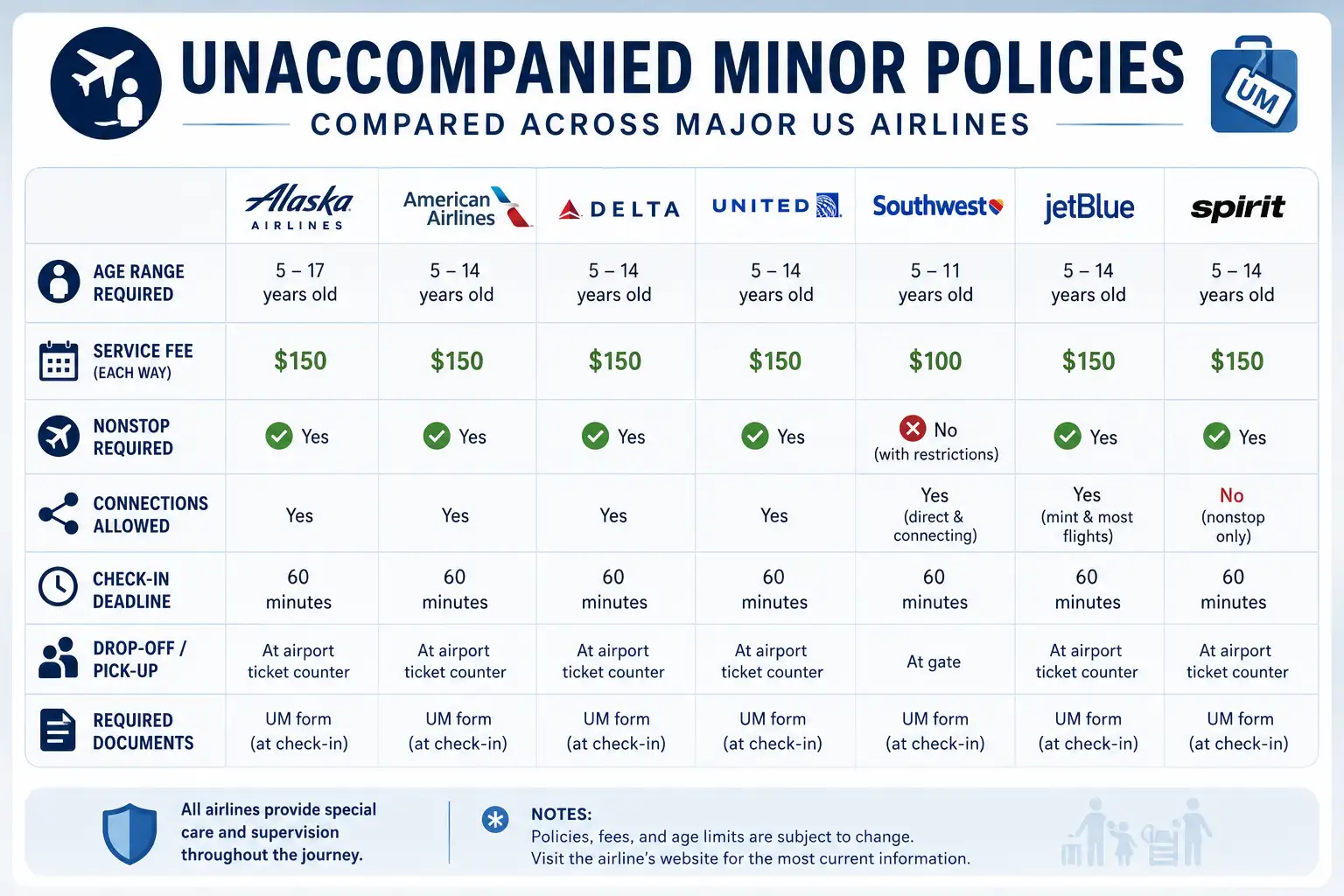
There is no federal law that standardizes how airlines handle children flying alone. No federal regulation governs airline unaccompanied minor programs, so every carrier writes its own rules, which means the same 10-year-old can be an automatic “unaccompanied minor” requiring a paid escort program on one airline, and a non-issue requiring nothing at all on another. For parents booking a child’s first solo flight, that inconsistency is the single biggest source of confusion, and it’s exactly where this comparison starts.
What Is an Unaccompanied Minor, and Why Does the Definition Keep Changing?
An unaccompanied minor (UM) is a child traveling on a commercial flight without a parent, guardian, or accompanying adult. Airlines have different thresholds for when the UM designation kicks in and what it requires, but in general, children below a certain age are automatically enrolled in a paid supervision program when they fly alone. What that age cutoff actually is, however, is where every airline diverges. Some airlines don’t accept unaccompanied minors at all, others require the service until a child turns 14, and others stop offering it once a child turns 12, regardless of whether the parent is willing to pay for it.
The Department of Transportation’s own consumer guidance captures just how firm the floor is on the youngest end: children under the age of 5 must always be accompanied by someone at least 12 years old flying in the same cabin, and on some airlines, that escort must be at least 18; no U.S. airline allows children under 5 to fly alone under any circumstances. On the older end, the DOT notes that once a child reaches age 12, or age 15 on some airlines, the carrier begins treating them as a “young adult” passenger who can typically fly without any UM enrollment at all, though parents can usually still request and pay for the service voluntarily.
Why This Comparison Matters More Than It Seems
The financial stakes are higher than most parents expect going in. As of 2026, the biggest legacy carriers — American, United, and Delta — charge parents a $300 roundtrip fee just to let a child fly alone, even on a simple domestic nonstop, until the child’s 15th birthday. That’s often more than the price of the child’s actual ticket. And the rules aren’t just about cost: booking the wrong airline for your child’s age can mean discovering at the gate that the itinerary isn’t eligible at all, or that an airline simply has no program your child can use, regardless of how much you’re willing to pay.
American Airlines Unaccompanied Minor Policy
American Airlines requires children ages 5 to 14 traveling alone to use its unaccompanied minor service, and makes the service optional, but available for the standard fee, for teens aged 15 to 17. The fee is $150 each way plus applicable taxes, and importantly, this single fee covers additional siblings traveling on the same flight — a meaningful detail that separates American from carriers that charge per child.
Where America gets strict is on routing. American requires unaccompanied minors to fly nonstop or direct whenever possible; if no nonstop option exists, connecting flights may be allowed, but only on American-operated flights, never on codeshare or partner-airline legs. American also won’t allow an unaccompanied minor itinerary that requires a ground transfer between two separate local airports, such as flying into LaGuardia and connecting out of JFK, and UM service is not available on the last flight of the day to a given destination, specifically to avoid stranding a child overnight if something goes wrong.
Booking isn’t self-service. Parents must call American Airlines Reservations directly rather than book online, since the airline needs to verify route eligibility and collect contact details for both the drop-off and pickup adults. At check-in, parents need to provide a birth certificate or passport as proof of the child’s age, along with the adult’s own government-issued photo ID showing a current address, and children aged 5 to 7 are restricted strictly to nonstop flights with no plane changes, while those 8 to 14 can connect, but generally only through major American hubs like Dallas-Fort Worth, Charlotte, or Chicago O’Hare.
Delta Air Lines Unaccompanied Minor Policy
Delta’s structure closely mirrors American’s on age, but differs in a way that can save families real money. Children 5 to 14 must use Delta’s UM program, while those 15 and older may fly without it, though the service remains available on request for a fee. Crucially, Delta charges $150 each way per journey rather than per child, so if two siblings travel together on the same itinerary, the fee is still $150 each way total — a structure that can cut the cost roughly in half for families sending multiple kids on the same flight, compared to a per-child fee model.
Delta requires nonstop flights for children under 8, while kids 8 to 14 may be permitted on connecting itineraries, but only on Delta-operated flights, and only when no nonstop option exists. Delta also prohibits unaccompanied minors from being booked on the last connecting flight of the day unless it’s the only daily flight to that destination, and separately blocks unaccompanied minors from red-eye departures in the late evening window. Bookings must be made by phone rather than online, through Delta’s reservations line.
United Airlines Unaccompanied Minor Policy
United Airlines’ unaccompanied minor service applies to children 5 to 14, with a fee of $150 each way that covers every 2 children traveling together on the same reservation. Teens aged 15 to 17 can fly as standard passengers, though parents can opt into the paid program voluntarily for extra peace of mind. United allows unaccompanied minors on both domestic and international itineraries, provided the routing stays nonstop on United or United Express. As with American and Delta, younger children face tighter routing limits than older ones — generally, the youngest eligible age band is restricted to nonstop flights only, while children in the 8-to-14 range gain access to connecting itineraries as long as every segment stays on United or its regional partner.
Children using the service receive a wristband, special bag tags, and an envelope containing their unaccompanied minor paperwork, along with early boarding and a complimentary snack after takeoff. A United representative meets the child at the gate on arrival and hands them off directly to the pre-authorized pickup adult.
Southwest Airlines: A Different Age Structure Entirely
Southwest breaks from the legacy-carrier pattern in a way that genuinely changes the calculus for families with tweens. Southwest allows children ages 5 through 11 to travel as an Unaccompanied Minor, bookable online, by phone, or at the ticket counter, and charges a service charge for each direction of travel. That’s notably lower than the 5-to-14 cutoff used by American, Delta, and United — Southwest’s UM age ceiling is 11, not 14, which differs from the legacy carriers.
What happens to kids 12 and up is the more interesting wrinkle. Children aged 12 or older cannot use Southwest’s unaccompanied minor program at all and must travel independently, though there is a separate “Young Traveler” framework for ages 12 through 17. Critically, Young Travelers are not covered under the same supervision policies as unaccompanied minors — there’s no escort, no continuous monitoring commitment, and no formal handoff procedure. A Young Traveler is expected to demonstrate sufficient maturity to independently handle checking in, clearing security, boarding, deplaning, and retrieving luggage without airline assistance.
On routing, Southwest does not permit unaccompanied minors on international destinations, itineraries with connecting flights that require a change of planes, or Getaways by Southwest vacation packages — only nonstop flights, or flights with a stop that doesn’t require switching aircraft, are eligible. This is more restrictive on connections than American or Delta, which at least allow same-airline connections for older children.
Alaska Airlines: Junior Jetsetters
Alaska Airlines runs its unaccompanied minor program under the name Junior Jetsetters, covering kids ages 5 to 17 on both domestic and international flights. The branding reflects a generally more flexible, perk-forward approach than the legacy carriers. Junior Jetsetters receive a lanyard and wristband for staff identification, early boarding, a safety briefing covering emergency protocol, and a complimentary main cabin meal on flights longer than two hours.
Pricing is also where Alaska stands out. Supervision for the entire journey costs $50 on nonstop flights, while kids 8 to 17 can book a more complex connecting itinerary for $75 — both well below the $150 each-way fee charged by American, Delta, and United. Junior Jetsetter fees are waived entirely for families with Atmos Rewards Silver, Gold, Platinum, or Titanium elite status, making Alaska a clear value play for frequent flyer families. Alaska also offers a free companion app called Fly for All, designed specifically for minors, first-time flyers, and travelers with cognitive or developmental disabilities, which is a feature no other major US carrier currently matches.
JetBlue Airways Unaccompanied Minor Policy
JetBlue allows unaccompanied minors between the ages of 5 and 14 to travel alone, with tickets bookable online and a fee of $150 per person each way. Unlike Delta’s per-itinerary fee structure, JetBlue charges per child, which makes it considerably more expensive for families sending multiple kids together. JetBlue limits each flight to a maximum of 3 unaccompanied minors, and those children cannot occupy Mint or Even More Space seats; instead, seats A, B, and C in the plane’s last row are reserved for unaccompanied minors so the crew can easily assist. Only nonstop flights are eligible, including some international routes, though service to the U.K. and Europe is not currently available. On the plus side, unaccompanied minors can bring a carry-on at no extra charge even on JetBlue’s restrictive Blue Basic fare, and drop-off requires a photo ID and three copies of a completed unaccompanied-minor form, while the pickup guardian listed on the form must be at least 18 and present ID.
Frontier Airlines: No Program at All
This is the detail that catches the most families off guard, and it’s worth stating plainly because it directly contradicts how most people assume budget carriers operate. Effective November 1, 2018, Frontier Airlines stopped accepting children traveling alone under the age of 15; any child younger than 15 must be on the same reservation as an accompanying adult. There is no fee, no escort, no supervision tier to opt into — the service simply doesn’t exist on Frontier at any price. Teens 15 to 17 fly as ordinary adult passengers, with no special paperwork, but anyone younger cannot fly Frontier solo under any circumstances, no matter how independent or well-traveled they are.
This makes Frontier the single biggest trap in unaccompanied minor planning: a parent comparing fares and seeing a cheap one-way ticket for a 10-year-old can book it without realizing the airline will refuse to let the child travel alone at all.
Hawaiian Airlines Unaccompanied Minor Policy
Hawaiian Airlines offers unaccompanied minor service with requirements that vary by age and final destination: the service costs $35 per segment on flights between the Hawaiian islands, and $100 per segment on flights between Hawaii and the continental United States, for up to 2 children from the same family. Children 5 to 11 are considered unaccompanied minors and must use the paid service, while it’s optional for kids 12 to 17, and unaccompanied minors are not permitted on international flights. Notably, a child aged 5 to 11 traveling with a companion who is at least 15 can avoid the unaccompanied minor designation and fee entirely — a workaround unique to Hawaiian among the major carriers.
What Happened to Spirit Airlines?
Spirit is worth addressing directly because older comparison articles still list its policy as active. Spirit Airlines ceased operations on May 2, 2026, which means its previous unaccompanied minor program — which had covered ages 10 to 14 on domestic nonstop flights for $150 each way — is no longer relevant for booking purposes. Families researching budget options should remove Spirit from consideration entirely rather than relying on archived policy pages.
Side-by-Side Comparison Table
| Airline | Mandatory UM Ages | Optional Ages | Fee Structure | Connections Allowed? |
| American | 5–14 | 15–17 | $150 each way, covers siblings | Yes, ages 8–14, AA-operated only |
| Delta | 5–14 | 15–17 | $150 each way per itinerary (not per child) | Yes, ages 8–14, Delta-operated only |
| United | 5–14 | 15–17 | $150 each way, covers up to 2 children | Yes, on United/United Express only |
| Southwest | 5–11 | None (12–17 use “Young Traveler,” no escort) | ~$50–$100 each way | No — nonstop or same-plane only |
| Alaska | 5–17 | N/A (single program, all ages) | $50 nonstop / $75 connecting; waived for elite status | Yes, ages 8–17 |
| JetBlue | 5–14 | None published | $150 each way, per child | No — nonstop only |
| Frontier | None — no program exists | N/A | No fee; under-15s simply cannot fly alone | N/A |
| Hawaiian | 5–11 | 12–17 | $35 interisland / $100 Hawaii–mainland, up to 2 children | No — UM not allowed on international routes |
How Connections and Delays Are Handled
Regardless of airline, a few principles hold consistently across nearly every major carrier’s fine print. In order of desirability, the safest unaccompanied minor itinerary is a nonstop flight, followed by a direct or “through” flight that has a stop but no plane change, then an online connection on the same airline, and lastly an interline connection involving two different airlines, with most airlines refusing to allow children under 8 to take connecting flights at all. The logic is straightforward: every additional connection is another point where a delay, gate change, or misconnection could leave a child alone and confused in an unfamiliar terminal.
When things do go wrong, airlines generally take on direct responsibility for an enrolled unaccompanied minor until they’re handed to the authorized adult — but parents shouldn’t assume “the airline will figure it out” covers every contingency. It’s worth confirming, route by route, what your specific carrier’s overnight-delay protocol actually looks like, since this is exactly the scenario the “no last flight of the day” rules common to American and Delta are designed to prevent in the first place.
Real-Number Example: Cost Comparison for a Family of Two Children
Take a hypothetical case: two siblings, ages 9 and 12, flying round-trip on a single connecting itinerary.
On American: $150 each way covers both children together (since the fee covers siblings), for a round-trip total of $300.
On Delta: Same structure — $150 each way per itinerary regardless of headcount, for $300 round trip.
On United, $150 each way covers up to two children on one reservation, for $300 round trip — identical to American and Delta in this scenario.
On JetBlue: Because JetBlue charges per child rather than per itinerary, the cost doubles: $150 each way × 2 children × round trip = $600.
On Alaska: At $75 each way for a connecting itinerary, two children would be charged separately per Alaska’s structure, totaling $300 round trip — though families with elite Atmos Rewards status could see this fee waived entirely.
On Southwest: Not bookable as written, since Southwest doesn’t permit connecting unaccompanied minor itineraries at all — the family would need a nonstop routing or a different airline.
On Frontier: Not bookable under any circumstances for the 9-year-old, since Frontier’s minimum solo-travel age is 15.
This example illustrates why “cheapest fee” and “cheapest total cost for my actual family” can produce two completely different answers depending on how many children are traveling and whether a connection is unavoidable.
Tips for Preparing a Child for Unaccompanied Travel
A few practices show up consistently across airline guidance and frequent-flier parent accounts as the difference between a smooth trip and a stressful one. Walking through the full itinerary with the child beforehand — including what a gate agent looks like, what to do if a flight is delayed, and who specifically will be waiting at arrival — reduces anxiety more than any in-flight perk the airline offers. Packing snacks is worth doing regardless of the airline, since food and drink service for unaccompanied minors is typically limited. Attaching an ID card and contact information directly to a child’s carry-on bag or jacket, fully charging any devices before departure, and writing down emergency phone numbers on paper (not just stored in a phone that could run out of battery) are all small steps that meaningfully reduce risk. Finally, arriving at the airport well ahead of the airline’s stated minimum check-in window matters more for unaccompanied minors than for any other passenger category, since filling out the unaccompanied-minor form, clearing security, and reaching the gate in time for pre-boarding all take longer than a standard check-in.
Which Airline Is Best for Unaccompanied Minors?
There isn’t a single universal answer, because the right choice depends heavily on the child’s age and the route. For a younger child (5–7) needing a nonstop flight, Alaska’s $50 fee and elite-status fee waiver make it the strongest value among carriers that actually offer a structured program. For a tween needing a connecting itinerary, American, Delta, and United are functionally similar in both price and structure, though Delta’s per-itinerary (rather than per-child) fee gives it a real edge for families sending two or more kids together. For a teenage 15 to 17-year-old who’s reasonably independent, Southwest’s no-fee “Young Traveler” framework and Frontier’s straightforward “treated as an adult” policy both avoid UM fees entirely — though Frontier’s hard 15-and-up cutoff makes it a non-option for anyone younger. The worst outcome in every case is the same: booking based on price alone and discovering the airline’s age or routing rules at the airport, rather than the booking page.
Frequently Asked Questions
What is the youngest age a child can fly alone in the US? Every major US airline that offers an unaccompanied minor program sets the floor at age 5; no carrier allows a child younger than 5 to fly alone under any circumstances.
Which major US airline has no unaccompanied minor program? Frontier Airlines does not offer any unaccompanied minor service. Children under 15 must be booked on the same reservation as an accompanying adult who is at least 15.
Does the unaccompanied minor fee cover siblings traveling together? It depends on the airline. Americans’ fee covers additional siblings on the same flight, and Delta charges per itinerary rather than per child. United’s fee covers up to two children per reservation. JetBlue, by contrast, charges its fee per child rather than per itinerary or family.
Can a 15-year-old fly alone without paying a fee? On most major carriers, yes — once a child reaches 15 (12 on Southwest), unaccompanied minor service becomes optional rather than mandatory, and a parent who chooses not to enroll the teen in the program pays no UM fee at all.
Can unaccompanied minors take connecting flights? This varies significantly by airline and by age. American, Delta, and United generally allow connections for children 8 and older, but only on flights operated by that same airline — never on partner or codeshare flights. Southwest and JetBlue require nonstop itineraries with no exceptions.
What happened to Spirit Airlines’ unaccompanied minor policy? Spirit Airlines ceased operations on May 2, 2026, so its previous unaccompanied minor program is no longer applicable for booking.