


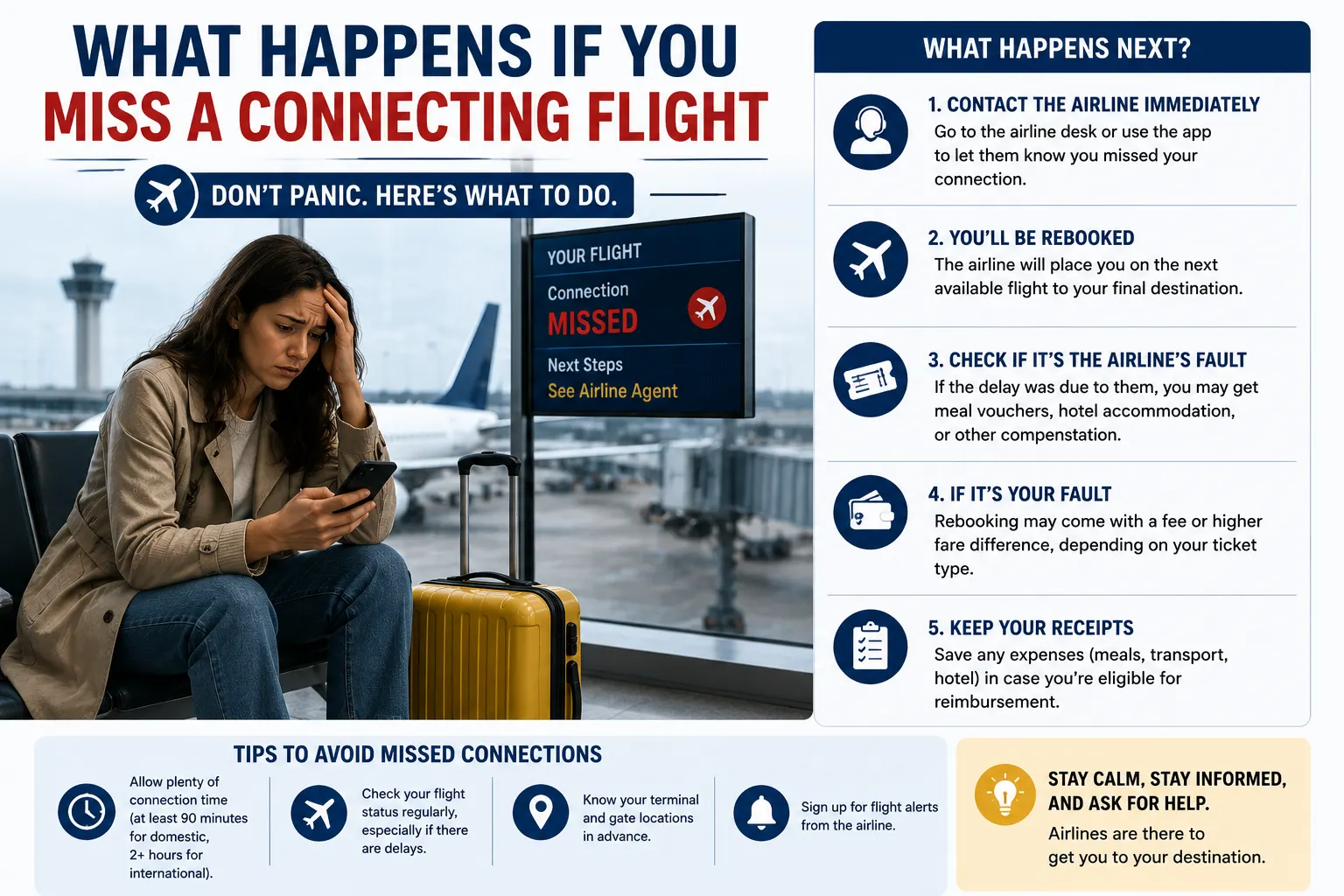
Standing at a gate watching your connecting flight push back without you is one of travel’s most stomach-dropping moments. But here’s what most travelers don’t realize in that panicked moment: what happens next depends almost entirely on one question — whose fault was it?
Miss a connection because your inbound flight was delayed by a mechanical issue, and you’re generally entitled to free rebooking, possibly meals, possibly a hotel. Miss the same connection because you lingered too long at an airport bar, and you could be looking at a full-price new ticket with no help from anyone.
This guide breaks down exactly what you’re entitled to in each scenario, how airlines actually determine fault, what to say to maximize your chances of a good outcome, and the booking habits that prevent this nightmare from happening in the first place.
1. The Single Question That Determines Everything
Before anything else, ask yourself: did the airline cause the delay that made me miss my connection, or did I?
Every airline’s contract of carriage draws a fundamental line between delays caused by the airline itself — mechanical issues, crew scheduling problems, a late-arriving aircraft — and delays the airline attributes to factors outside its control, like weather, air traffic control, or security events. That line determines almost everything that follows: whether you get rebooked for free, whether you get a hotel, whether you get meal vouchers, and whether you have any leverage to push back if the airline tries to give you less than you’re owed.
There’s a second, equally important question: are all your flights on one ticket, or did you book separate tickets? This affects your rights just as much as fault does, and it’s covered in detail in Section 5.
2. Scenario A: The Airline’s Fault
If your first flight was delayed or canceled because of something within the airline’s control — a mechanical problem, a crew scheduling issue, an IT outage, or a late-arriving aircraft that pushed your departure back — you’re in the strongest possible position.
What you’re entitled to
Free rebooking on the next available flight. If you booked every leg of your journey with one airline and that airline caused your missed connection, it should rebook you onto the next available flight at no extra cost. This applies whether the next flight is in twenty minutes or the next morning.
Rebooking on a partner or competing airline, if needed. If the next outbound flight isn’t until the following morning, the airline should either book you on a different carrier entirely or provide accommodations and meals in the meantime — though it’s worth noting this is generally a voluntary customer-service practice rather than something mandated by federal law for domestic itineraries.
Meals and hotel accommodation, in many cases. When your connection was missed because your previous flight was delayed or canceled, you’ll typically be rebooked free of charge, and the airline is also expected to provide care — food, refreshments, and access to communication — with a hotel and transport to and from it in many overnight situations. The airline will rebook you at no cost and, depending on what caused the delay, provide meals and hotel accommodation while you wait.
A path to compensation, in specific circumstances. For airline-caused delays that result in a missed connection, U.S. carriers are generally obligated under their own policies — and often DOT guidance — to rebook you for free, cover hotel accommodations if you’re stuck overnight, and provide meal vouchers. On domestic itineraries, though, this typically stops short of a cash payout for your inconvenience. If you miss your connection on a U.S. domestic flight because of a delay the airline caused, you are not entitled to fixed cash compensation the way you might be in Europe (more on that distinction in Section 6).
A subtlety worth knowing
Mechanical problems are almost always treated as controllable, even though airlines sometimes try to frame them as unforeseeable and therefore outside their responsibility. If a gate agent tells you a “mechanical issue” was unavoidable and therefore they can’t help with a hotel, that framing is worth pushing back on — a mechanical failure is squarely within the category of controllable delays under how most carriers define their own policies.
Regulatory momentum is building
The Department of Transportation has signaled intent to propose rules that would require airlines to provide compensation to passengers affected by delays and cancellations within the airline’s control, aimed specifically at easing the financial burden on stranded passengers who have to find their own accommodations, meals, and transportation. As of now, this remains a rulemaking in progress rather than settled law, so current entitlements still rest largely on each airline’s own customer service commitments rather than a uniform federal mandate — check for updates, since this area is actively evolving.
3. Scenario B: Your Fault
This is the scenario nobody wants to be in, and it’s worth understanding clearly so you know exactly how much (or how little) leverage you have.
What counts as “your fault”
If something within your control causes you to miss your connecting flight — arriving late because of traffic, booking too tight a connection, or getting distracted browsing the airport shops and missing a boarding announcement — you’re largely on your own.
What you’re entitled to
Nothing, as a legal matter. When the passenger is directly at fault for missing a connection, there’s no compensation entitlement from the airline whatsoever — you’ll need to work directly with the airline (or a different one) to find alternative flights on your own.
Possible goodwill rebooking, but not guaranteed. The airline will almost certainly try to help you rebook, but it’s under no obligation to do so, and you may have to pay both a change fee and any fare difference between your original ticket and the new one. You may incur a fee specifically because you’re at fault for missing the connection — for example, if you simply didn’t allow enough time to get to the airport.
How to improve your odds anyway
Even when you’re technically at fault, airlines have discretion, and gate and phone agents can waive fees if you’re polite, honest, and it’s a slow day for standby seats. A few things that help:
- Be upfront rather than making excuses. Agents deal with this constantly and can usually tell when a story doesn’t add up. A simple, honest explanation gets more goodwill than an elaborate one.
- Ask specifically about standby. Even on a fare that doesn’t include free changes, asking to be added to the same-day standby list for the next flight is often free or low-cost.
- Check for status-based waivers. If you hold elite loyalty status or a premium credit card with travel benefits, same-day change or standby fees are frequently waived automatically or on request.
- Mention if it was borderline (for example, a security line that moved unusually slowly, or a shuttle bus that broke down). It’s not the airline’s legal responsibility, but agents sometimes extend grace for situations that were plausibly out of your immediate control even if not airline-caused.
4. The Gray Zone: Weather and “Uncontrollable” Delays
Weather sits in an important middle ground — not your fault, but also not treated the same as an airline-caused delay.
If you miss a connection because of weather, the airline should still book you on the next available flight, but you usually won’t receive compensation because airlines aren’t considered responsible for delays caused by dangerous weather conditions. Even when inclement weather is what causes your missed connection, the airline will typically help you rebook but likely won’t offer compensation for meals or accommodations.
For weather-caused delays, airlines are legally obligated to get you rebooked at no charge, but they’re generally not required under U.S. law to cover a hotel or meals — this is the single most important piece of fine print most travelers don’t realize. Delays caused by forces genuinely outside the airline’s control — severe weather, air traffic control directives, airport operational failures, security threats — get treated differently: the airline still has to rebook you on its next available flight for free, but it’s far less likely to cover meals or a hotel room since the delay wasn’t caused by anything it did.
Practical takeaway: don’t assume “weather” as an explanation automatically means you have zero leverage. Ask anyway — many airlines provide meal vouchers as a customer-service courtesy even for weather delays, particularly if the delay stretches into many hours or overnight, even though it’s not legally required.
5. One Ticket vs. Two Separate Tickets: Why It Changes Everything
This is the distinction that trips up the most travelers, especially those who book flights piecemeal to save money.
One itinerary, one ticket (even across two airlines via a codeshare or interline agreement)
If you booked all legs of your journey together and the responsible airline caused your missed connection, it should rebook you onto the next flight at no extra charge, potentially including overnight accommodation and food vouchers if the next flight isn’t until the next day.
Two separate tickets
This is a fundamentally different situation, and it catches a lot of people off guard. If you booked separate legs of your journey with different airlines or as separate tickets, you may have to pay to rebook your connecting flight or purchase an entirely new one yourself — and in this case, you’ll also need to collect your luggage from the carousel and check in again from scratch, since the airlines aren’t tracking your bags or your onward connection as a single trip. Airlines generally won’t assume any responsibility for a missed connection when the two legs were booked on two separate tickets, even if the first flight’s delay wasn’t remotely your fault.
There is one narrow exception worth knowing: if you booked separate tickets and the first airline was clearly at fault for the delay that caused you to miss your second, separately-booked flight, you may be able to claim compensation from that first airline — though you’ll still likely be on your own for rebooking the second leg.
Why this distinction exists
Airlines only take responsibility for connections they control. If they issued you a single itinerary — one confirmation number covering both flights — they’re implicitly promising that connection will work, and they own the consequences if it doesn’t. If you stitched two unrelated bookings together yourself to save money (a common strategy sometimes called “self-connecting”), no single airline made that promise, so no single airline is obligated to fix it when it breaks.
If you frequently self-connect to save money, budget extra buffer time (several hours, not the standard minimum connection time) and strongly consider travel insurance that explicitly covers missed connections on separately ticketed itineraries.
6. International Connections and EU261
If any part of your journey touches Europe, the calculus changes substantially, and often in your favor.
If you’re traveling to or from Europe, EU Regulation 261 may protect you, and if you miss a connecting flight due to a delay, cancellation, or being denied boarding, you could be entitled to as much as €600 (roughly $650) in compensation. This is a meaningfully stronger protection than what’s available on a typical U.S. domestic itinerary. This right kicks in when your flight is delayed by five hours or more, when it’s canceled outright, or when you’re denied boarding due to overbooking — and under this regulation, you can request both a return flight to your original point of departure and a refund for the portion of the journey you never completed.
In the EU, you also generally have the right to be rebooked for free on the next available flight if you missed a connection through no fault of your own, alongside the right to request a refund and return flight to your starting point if the missed connection effectively ruins your travel plans.
Key eligibility point: EU261 typically applies when you’re departing from an EU airport on any airline, or arriving into an EU airport on an EU-based carrier — so a connection routed through, say, Amsterdam or Paris, even on a non-European airline, may still trigger these protections depending on the specific routing and ticketing.
7. What to Do in the First 10 Minutes After Missing a Connection
Whether it’s the airline’s fault or yours, speed and the right approach in the first few minutes shape everything that follows.
Step 1: Go straight to the nearest gate agent or transfer desk, not the general customer service line. At major hub airports, airlines usually staff a dedicated “rebooking” or “transfer” desk near connecting gates specifically for this situation — it’s almost always faster than the main ticket counter.
Step 2: Simultaneously call or use the app. Passengers who call the customer service line while also standing in the gate agent line effectively double their odds of getting rebooked quickly, since whichever channel resolves first wins.
Step 3: State clearly whether the delay was airline-caused, and why. Don’t assume the agent automatically knows or will volunteer the more generous outcome. If your inbound flight was delayed for a mechanical issue or crew problem, say so directly: “My connection was missed because of [airline]’s mechanical delay on flight XXX. I’d like to be rebooked on the next available flight at no charge, and I’d like to ask about meal and hotel accommodation.”
Step 4: Ask about partner and interline options if your airline’s own next flight is far out. If the airline’s own next flight isn’t until the next morning, ask directly whether they can book you on a different carrier instead — this option exists but isn’t always offered proactively.
Step 5: If you’re at fault, be upfront and ask about standby and fee waivers rather than assuming there’s nothing to be done.
Step 6: Retrieve or track your checked luggage status (see Section 10) — this becomes urgent if you’re being rerouted through a different airport or onto a different carrier.
Step 7: Document everything. Screenshot your original itinerary, the delay notification for your first flight, and any rebooking confirmation. This documentation matters if you later need to pursue EU261 compensation, a credit card claim, or a formal complaint.
8. Minimum Connection Times and How to Avoid This Entirely
Every airport has a Minimum Connection Time (MCT) — the shortest amount of time officially considered sufficient to make a connection, accounting for taxiing, gate distance, and (for international connections) immigration and security. Booking systems generally won’t sell you a connection shorter than the MCT, but “technically bookable” and “comfortably makeable” are very different things.
Why MCT-length connections are risky
- MCTs assume both flights are on time, with zero buffer for delay
- They don’t account for gate changes, which can add a 15–20 minute walk (or a full terminal change requiring a shuttle or train)
- International connections often require re-clearing security or immigration, which MCTs sometimes underestimate, especially during peak travel periods
- Airport-specific operational constraints can shrink your margin further — for instance, FAA-imposed operational limits at O’Hare have been in effect through October 2026, meaning a tight connection through that hub leaves less room to recover from any delay.
How to protect yourself when booking
- Add buffer time beyond the MCT whenever possible — at least 90 minutes for domestic-to-domestic connections, and 2–3 hours for international connections involving immigration or a terminal change.
- Book connections on a single ticket, not as separate bookings, so you’re covered by the airline’s rebooking obligations if something goes wrong (see Section 5).
- Check whether your connecting airport has a history of congestion or weather delays — some hub airports are simply riskier than others for tight connections.
- Use a flight-tracking tool or airline app notification to get alerted the moment your inbound flight shows signs of delay, so you can start working rebooking options before you’ve even landed.
9. The “Flat Tire Rule” and Other Airline Grace Policies
Even when you’re technically at fault for missing a flight, some airlines maintain informal or semi-formal grace policies worth knowing about.
Several airlines, including American Airlines, maintain what’s known as a “flat tire rule” — if you arrive late and miss your flight due to circumstances out of your control, like a literal flat tire on the way to the airport, you can often be placed on another flight the same day at no additional cost.
This isn’t a universal, formally published policy at every airline, and it’s typically applied at an agent’s discretion rather than guaranteed. It generally works best when:
- You arrive only shortly after the door closed, not hours late
- There are open seats on a same-day flight
- You can offer a plausible, honest explanation
- You ask politely rather than demanding it as a right
How to invoke it: simply ask, “Do you have any same-day flexibility for a situation like this?” rather than citing the “flat tire rule” by name, since not every agent recognizes that specific term even where the underlying practice exists.
10. What Happens to Your Checked Luggage
This is one of the most overlooked parts of a missed connection.
If you’re on a single itinerary and the airline is rebooking you: your checked bags are typically automatically re-tagged to follow your new routing. You don’t need to retrieve them yourself in most cases — confirm this with the agent handling your rebooking, since it varies by situation.
If you’re being rerouted to a different airline or a significantly different itinerary: ask the airline how to retrieve your checked luggage, since a change of carrier can sometimes require your bags to be pulled and re-checked rather than automatically transferred.
If you booked two separate tickets: you’ll need to collect your luggage from baggage claim yourself and check in again for your next flight, since separate tickets mean the airlines aren’t coordinating your bag handling as a single continuous trip.
If your bag ends up separated from you (arrives at your original destination while you’re rerouted, or vice versa): file a mishandled baggage report immediately at the airport before you leave, and get a claim number — this is what allows the airline to forward your bag to wherever you actually end up.
11. How Loyalty Status Affects Your Rebooking Priority
An uncomfortable but important reality: not every passenger on a canceled connection gets treated identically.
When many passengers from the same missed connection are competing for limited seats on the next available flight, elite status passengers are typically processed first — for example, a top-tier loyalty member and a basic economy passenger with no status, both on the same missed connection, are not treated the same, with the status holder’s rebooking generally going through first.
This doesn’t mean non-status travelers are out of options, but it does mean:
- Acting fast (working the app and phone simultaneously) matters more if you don’t have elite status, since you’re competing for a shrinking pool of remaining seats
- Politely mentioning any status or premium credit card travel benefits you do have is worth doing, since it can occasionally unlock priority handling or fee waivers even at lower tiers
- If you’re rebooked several flights out because higher-status passengers got the earlier options, it’s reasonable to ask about being placed on a standby list for any earlier flight in case a seat opens up
12. Travel Insurance and Credit Card Protections
If you miss your flight and simply choose not to rebook, your airline generally won’t refund you, since it’s not the airline’s fault you missed it — though a small number of carriers make exceptions for documented medical emergencies, and policies vary significantly by airline.
This is where two additional layers of protection become valuable:
Travel insurance
Travel insurance typically covers missed flights under specific, defined circumstances — commonly including things like a covered illness, a documented traffic accident, or a covered event (like a family emergency) that caused the miss. It generally does not cover simple personal error like running late for no covered reason. If you frequently book tight connections or self-connect on separate tickets, a policy that explicitly names “missed connection” coverage is worth the extra premium.
Credit card travel protections
Premium travel credit cards often include trip delay or missed connection benefits as a card perk, sometimes covering:
- A same-day new ticket if you’re stranded and the airline won’t rebook you for free
- Meals and incidentals during the wait
- A hotel room if you’re stuck overnight
Check your specific card’s benefits guide, since coverage thresholds, eligible causes, and dollar limits vary considerably between cards and issuers.
13. Common Mistakes Passengers Make
- Assuming the airline owes you nothing just because it wasn’t the airline’s fault. Even in weather scenarios, you’re still typically entitled to free rebooking — just not necessarily meals or a hotel.
- Not asking about interline/partner rebooking. Agents don’t always volunteer this option; you often have to ask directly.
- Booking connections at exactly the airport’s minimum connection time to save a few dollars or an hour. This looks fine on paper and turns into a nightmare the moment anything runs even slightly late.
- Self-connecting on two separate tickets without understanding the risk. It can save real money, but it also means you’re entirely on your own if something goes wrong.
- Not mentioning loyalty status or premium card benefits when asking for help. Even modest status can occasionally unlock waived fees or faster processing.
- Giving up after one “no” from a single agent. Policies are often applied inconsistently agent to agent; a different representative (via phone, app chat, or a different airport desk) may give you a better outcome.
- Forgetting to check EU261 eligibility on international itineraries. Many travelers don’t realize a European connection point can trigger meaningfully stronger compensation rights than what’s available domestically.
14. Step-by-Step Checklist
- Determine immediately: was this the airline’s fault, weather, or your own delay?
- Check whether all your flights are on one ticket or separate tickets.
- Go directly to the nearest transfer/rebooking desk while simultaneously calling or using the app.
- State clearly what caused the missed connection and what you’re requesting (free rebooking, meal vouchers, hotel if overnight).
- Ask specifically about partner/interline rebooking if the next same-airline flight is far out.
- If at fault, be honest and ask about standby options and fee waivers rather than assuming there’s no flexibility.
- Confirm what’s happening with your checked luggage before leaving the gate area.
- Screenshot your original itinerary, the delay notice, and your rebooking confirmation.
- If your itinerary touches Europe, separately check EU261 compensation eligibility.
- Check whether travel insurance or a credit card travel benefit applies to your situation.
- If the airline denies something you believe you’re entitled to, ask for a supervisor or follow up in writing citing the airline’s own customer service or contract of carriage terms.
15. Frequently Asked Questions
If my first flight was only a few minutes late and that’s what caused me to miss my connection, does that still count as the airline’s fault? Yes — fault isn’t measured by how long the delay was, but by what caused it. Even a short delay counts as airline-caused if it stemmed from a mechanical issue or a crew scheduling problem.
Can I get cash compensation for a missed domestic connection in the U.S.? Generally no — missing a domestic U.S. connection due to an airline-responsible delay does not entitle you to cash compensation under current federal rules, though you are typically owed free rebooking and, depending on the airline, meals or a hotel for overnight situations.
Does travel insurance cover a missed connection caused by my own late arrival at the airport? Usually not, unless the lateness was due to a covered circumstance named in your specific policy (documented illness, accident, etc.). Ordinary personal timing errors are typically excluded.
What if I self-connected on two separate tickets and the first airline caused the delay? You may be able to claim compensation from the first airline for causing the delay, but you will likely still need to rebook and pay for your second flight yourself, since the second airline has no relationship to or knowledge of your first flight’s delay.
Is a “controllable” delay the same thing as “the airline’s fault”? Essentially yes — airlines and regulators generally use “controllable” to mean the cause was something within the airline’s operational control (mechanical, crew, scheduling), as opposed to “uncontrollable” causes like weather or air traffic control restrictions.
Will the airline automatically arrange a hotel for me, or do I have to ask? You should always ask directly and specifically, rather than assuming it will be offered. Many airlines provide hotel accommodation for controllable overnight disruptions as policy, but it’s rarely offered proactively without a passenger requesting it.
Does elite loyalty status guarantee I’ll get rebooked before non-status passengers? It generally gives you priority in the rebooking queue when many passengers are competing for the same limited seats, though it’s not a guarantee in every situation.