



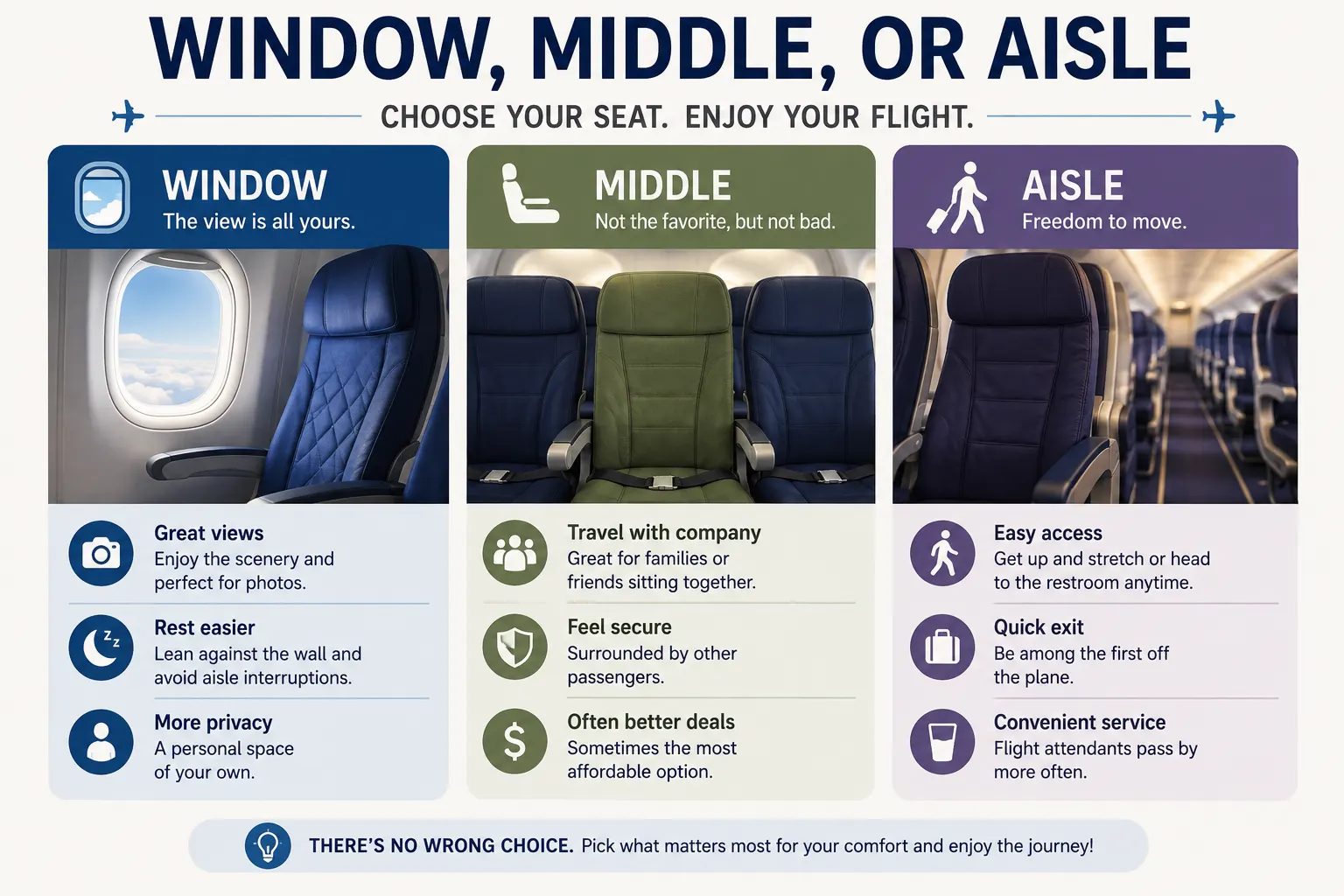
Introduction: A Question Every Traveler Has Silently Argued With a Seatmate About
Anyone who’s ever sat in a window seat, watching the aisle passenger two rows up take four full minutes to retrieve a rolling bag from the overhead bin while eleven people stand frozen behind them, has had the same thought: there has to be a faster way to do this.
The window-versus-aisle debate usually gets settled with vague intuition. Aisle seats feel faster because you can just… walk out, right? Window seats feel slower because you’re boxed in by two people and their bags. But intuition and actual elapsed time are two different things, and airline researchers, university engineering departments, and aviation consultants have spent real effort quantifying exactly how seat position affects both boarding and deplaning time — because for airlines, every minute a plane spends at the gate is a minute it’s not earning revenue in the air.
This article digs into what that research actually shows: which seat position gets you physically off the plane fastest, why the answer changes depending on whether you’re looking at boarding or deplaning, how row position interacts with seat position in ways that matter more than most people realize, and the practical tactics — beyond just picking a seat letter — that actually shave real minutes off your travel time.
Part 1: Boarding and Deplaning Are Different Problems With Different Answers
The first thing worth separating clearly: “getting off the plane fastest” and “getting through boarding fastest” are not the same question, and the seat that helps you with one doesn’t necessarily help with the other.
Boarding is primarily a bottleneck problem caused by luggage stowage — the process of one passenger blocking the aisle while lifting a bag overhead affects everyone behind them, and your seat position determines how many of those blocking events happen before it’s your turn to sit down.
Deplaning is primarily a sequential-release problem — passengers exit row by row, and within a row, the outermost (aisle) passenger typically exits before the two passengers inboard of them, unless there’s a coordinated row-by-row standing pattern, which in practice happens inconsistently.
Because these are different mechanical processes, we’ll look at them separately, then combine the findings into an overall picture.
Part 2: The Boarding Research — Why Middle and Window Seats Have an Underappreciated Advantage
The Core Finding: It’s Less About Seat Letter, More About Boarding Group
Multiple studies on airline boarding efficiency — including simulation research from aviation engineering researchers and internally tested boarding methods from major airlines — converge on one central finding: your boarding group and boarding sequence matter far more to your total boarding time than whether you’re in a window, middle, or aisle seat within that group. If you board in Group 1, you’ll be seated in roughly the same amount of time regardless of seat letter, because you’re not fighting through a crowded aisle full of people already stowing luggage.
That said, within any given boarding wave, seat position does create a measurable, if secondary, effect — and it cuts in a direction that surprises most people.
Why Window and Middle Seats Can Actually Board Faster Than Aisle Seats
Here’s the counterintuitive part: if you’re boarding in the same wave as your row-mates, an aisle seat passenger boarding after a window or middle seat passenger causes a second stowage delay for the row, because the aisle passenger has to get out of the way, let the inboard passengers in, and then load their own bag — versus a window or middle passenger who, when seated first, can stow their bag and sit down without needing to negotiate space with someone already seated in the row.
Airline-commissioned boarding simulations (Boeing has published research on this, along with several academic aviation studies) consistently find that the most time-efficient boarding pattern for a full flight is outside-in and back-to-front simultaneously — window seats first, then middle, then aisle, combined with loading the back of the plane before the front. This is precisely the logic behind boarding methods like the “reverse pyramid” or WilMA (Window-Middle-Aisle) boarding, which some airlines have tested and partially implemented specifically because it reduces the number of times a seated passenger has to stand up and re-block the aisle to let a later-boarding passenger into an inboard seat.
The Real Bottleneck: Luggage, Not People
Research consistently identifies the same primary bottleneck in modern boarding: passengers loading carry-on luggage into overhead bins. As checked-bag fees have pushed more passengers to carry on larger bags, the time each passenger spends standing in the aisle lifting a bag overhead — sometimes needing to shift it to fit, or walking further down the aisle because the nearest bin is full — has become the dominant driver of total boarding time, far outweighing the effect of seat letter alone.
This means the honest answer to “which seat boards fastest” is less about window/middle/aisle and more about how many carry-on-heavy passengers board before you, and how full the overhead bins are by the time you reach your row. A window seat passenger boarding in an early group, before the bins fill up, will generally have a faster, smoother boarding experience than an aisle seat passenger boarding in a later group who has to search multiple rows for bin space.
Practical Boarding Data: Average Time Added Per Blocking Event
While exact figures vary by study and aircraft type, aviation engineering research on single-aisle boarding has found that each instance of a seated aisle or middle passenger needing to stand and let another passenger into an inboard seat adds a meaningful, non-trivial delay to the row — commonly cited estimates put each “stand-and-let-pass” event at somewhere in the range of 10–30 seconds when you account for the passenger standing, moving into the aisle, waiting for the incoming passenger to settle, and re-seating. Multiply this across dozens of rows on a full flight, and it’s a major contributor to overall boarding time, which is exactly why airlines have experimented so heavily with boarding order.
Part 3: The Deplaning Research — Where Aisle Seats Have a Clear, Consistent Advantage
Deplaning tells a much clearer story than boarding, and it consistently favors one seat type.
Aisle Seats Win Deplaning, By a Meaningful Margin
Unlike boarding, where seat letter is a secondary factor behind boarding group, deplaning is almost entirely determined by your physical position relative to the aisle and your row’s position relative to the exit door, because deplaning happens row by row, front to back (or, on planes with rear exits used, sometimes with a split flow), with each row waiting for the row ahead to clear before moving.
Within your row, if all three passengers are trying to exit at the same general time, the aisle passenger is mechanically first out — they don’t have to wait for anyone to move out of their way. Middle and window passengers, by contrast, are dependent on their row-mates: they can’t move until the aisle passenger (and, for the window passenger, the middle passenger too) has physically stepped out of the row and into the aisle.
Row Position Matters More Than Seat Letter for Deplaning
Aviation deplaning studies and airline operational data consistently show that your distance from the exit door is the single largest factor in total deplaning time — more significant than your seat letter within the row. A window seat in row 4 will typically deplane faster in absolute terms than an aisle seat in row 28, simply because of the sequential row-by-row release pattern.
This creates a two-factor reality for anyone trying to optimize deplaning time:
- Row position (how close to the front, or to whichever exit is being used) — the dominant factor
- Seat letter within the row (aisle beats middle beats window) — a secondary but real factor
The “Aisle Seat, Back of Plane” Trap
One counterintuitive scenario worth flagging explicitly: an aisle seat in the back third of the plane often deplanes slower than a window seat in the front third, because the sequential front-to-back release pattern means back-of-plane passengers, regardless of seat letter, are waiting for 20+ rows to clear before their row even starts moving. This is a common point of confusion — people assume an aisle seat automatically means “fast to deplane,” but it only provides its advantage relative to your own row-mates, not relative to passengers in more forward rows.
Part 4: Combining the Two — A Practical Framework by Priority
Given that boarding and deplaning favor different things, here’s how to think about seat selection depending on what you’re actually optimizing for.
If You Care Most About Fast Deplaning (Tight Connection, Eager to Get Off)
Priority 1: Book the most forward row available to you. This has a larger impact than seat letter. Priority 2: Within that row range, choose aisle. This gives you the secondary advantage of not waiting on row-mates. Combined approach: An aisle seat in the first 5–10 rows of economy (or in premium economy/business if available to you) is close to the optimal deplaning position on the aircraft, short of the exit row itself.
If You Care Most About Smooth Boarding (Avoiding the Aisle Shuffle Dance)
Priority 1: Board as early as your fare class or loyalty status allows. This matters more than seat letter. Priority 2: If boarding in a mid-to-late group, consider a window seat, since you avoid the awkward re-negotiation of space with row-mates who board after you, and you can settle in without needing anyone to move for you.
If You Care Most About Comfort During the Flight (Most Travelers’ Actual Priority)
This is a separate question from boarding/deplaning speed entirely, and worth naming honestly: for most travelers, total time saved by optimal seat selection amounts to a few minutes at most across an entire flight, while seat comfort (window for sleeping and looking out, aisle for bathroom access and stretching, middle rarely anyone’s first choice) affects the entire flight duration. If you’re optimizing for time savings on a short-haul flight of under two hours, the practical difference is often genuinely small enough that comfort preference should reasonably take priority.
Part 5: Real Numbers — Estimated Time Differences by Scenario
Based on aviation boarding/deplaning research and typical single-aisle narrow-body aircraft data (the most common domestic configuration), here’s a reasonable estimate of the time ranges involved. These are illustrative, drawn from general patterns in published boarding/deplaning studies rather than a single definitive source, since exact timing varies by aircraft type, load factor, and passenger behavior.
| Scenario | Estimated Deplaning Time From Seat to Jet Bridge |
| Aisle seat, row 3 (near front) | ~1–3 minutes |
| Window seat, row 3 (near front) | ~2–4 minutes (waiting on row-mates) |
| Aisle seat, row 15 (middle of cabin) | ~5–9 minutes |
| Window seat, row 15 (middle of cabin) | ~6–10 minutes |
| Aisle seat, row 30 (near rear) | ~9–15 minutes |
| Window seat, row 30 (near rear) | ~10–16 minutes |
The pattern that jumps out: the gap between aisle and window at the same row position (1–2 minutes) is consistently smaller than the gap caused by row position alone (often 5+ minutes difference between front and back). This reinforces the core finding — if minimizing deplaning time is genuinely your priority, spend your seat-selection effort and any available upgrade budget on row position first, seat letter second.
Part 6: Why Airlines Actually Care About This (And What They’ve Tried)
This isn’t a purely academic question — airline turnaround time directly affects profitability, since an aircraft only generates revenue while flying, not while sitting at the gate. Faster boarding and deplaning mean tighter, more reliable schedules and more flights per aircraft per day.
Boarding Methods Airlines Have Tested
- Back-to-front (traditional zone boarding): Simple to communicate to passengers but research has generally found it less efficient than alternatives, since it still creates aisle congestion as later zones from the front sections mix with ongoing boarding.
- WilMA (Window-Middle-Aisle): Loads all window seats across the whole plane first, then all middle seats, then all aisle seats, minimizing the “stand and let someone in” problem described earlier. Simulation studies have generally found this among the more time-efficient methods, though it’s logistically harder to enforce than zone-based boarding and can feel confusing to passengers, since it doesn’t correlate with row position at all.
- Reverse pyramid / outside-in hybrid: Combines back-to-front with window-to-aisle logic, boarding window and middle seats from the back of the plane first. Some airlines have piloted variations of this.
- Random/no-assigned-seat boarding: Somewhat counterintuitively, some studies (and some low-cost carriers’ operational data) have found that fully random boarding order can perform comparably to or better than traditional zone boarding, because it naturally distributes window/middle/aisle passengers throughout the aisle rather than clustering same-letter passengers together in ways that create bottlenecks.
Why Most Airlines Still Use Simpler Methods
Despite research favoring more complex boarding sequences, most airlines still use variations of zone or group boarding tied to fare class and loyalty status, not pure efficiency logic — because boarding order is also a revenue and loyalty tool (priority boarding as a perk for premium fares and elite status members), and a purely efficiency-optimized method would conflict with that business incentive. This is worth understanding as a traveler: the boarding process you experience is a compromise between operational efficiency and revenue/loyalty priorities, not a pure optimization for speed.
Part 7: Practical Tactics Beyond Seat Letter That Actually Save Time
Since seat letter alone is a secondary factor, here are the moves that make a bigger practical difference.
For Boarding
- Board as early as your status allows, and don’t dawdle in the jet bridge. Group number matters more than seat letter — if you have any status or early-boarding perk, use it.
- Use a bag that fits easily and quickly, and know your stowage plan before you reach your row. A large portion of individual boarding delay is one passenger struggling with an oversized or awkwardly shaped bag — don’t be that passenger, and you’ll move through your own stowage faster.
- Gate-check proactively if bins look full, rather than searching multiple rows for space, which delays you and everyone behind you.
For Deplaning
- Prioritize row position over seat letter when you have the choice and connection time is tight. As shown in Part 5, this has the larger effect.
- Have your bag ready before the seatbelt sign turns off — much of the “why isn’t this row moving” delay is passengers only beginning to gather belongings once it’s their turn, rather than being ready in advance.
- If you have a genuinely tight connection, tell a flight attendant before landing. Many airlines will make an announcement asking other passengers to let tight-connection travelers deplane first, or will proactively help you get off quickly — this can outweigh any seat-selection strategy entirely.
- Consider paying for an exit row or front-cabin seat when a connection is truly at risk, since the row-position effect is large enough that this is often worth the cost when a missed connection is the alternative.
Part 8: The Middle Seat — Worth a Specific Word
The middle seat consistently comes out as the least time-efficient position for deplaning (you’re waiting on both row-mates) and situationally mixed for boarding (fine if you board and settle in early; more awkward if you’re boarding into an already-partially-filled row). Combined with being most people’s least preferred seat for comfort reasons, there’s little upside to the middle seat from a pure time-efficiency standpoint — it’s consistently at or near the bottom of both boarding and deplaning comparisons. If you’re assigned a middle seat and value speed, your best lever is row position and being ready to move the instant your row’s turn comes, since you can’t control your row-mates’ pace.
Part 9: Does Aircraft Type Change Any of This?
Most of the research and general findings above are based on single-aisle narrow-body aircraft (the Boeing 737 and Airbus A320 families), which make up the large majority of domestic flights. Wide-body, twin-aisle aircraft (used on many international and some domestic long-haul routes) change the picture somewhat:
- Twin aisles reduce the “one blocked aisle stops everyone” problem during boarding, since passengers can potentially be routed through either aisle, somewhat reducing (but not eliminating) the impact of a single slow passenger.
- Deplaning on wide-body aircraft often uses multiple doors simultaneously (front and sometimes rear or over-wing, depending on gate configuration), which changes the simple “row position from the front” calculation — on these aircraft, proximity to whichever active exit is being used matters more than proximity to the front specifically.
- Seat configuration itself is different — many wide-body economy cabins use a 3-3-3 or similar layout with more middle seats overall, and premium cabins often have direct aisle access from every seat (particularly in business class), which effectively eliminates the aisle-seat advantage for those cabins.
If you’re flying a wide-body aircraft, checking the specific exit configuration (available on seat maps for many airlines, or via aircraft-specific seat review sites) is more useful than applying the general narrow-body row-position logic directly.
Frequently Asked Questions
Is an aisle seat always faster for deplaning, even in the back of the plane? Not necessarily in absolute terms — an aisle seat’s advantage is relative to your own row-mates, not to passengers in more forward rows. A window seat near the front will typically deplane faster in total elapsed time than an aisle seat near the back, because row position (sequential front-to-back release) has a larger effect than seat letter within a row.
Does choosing a window seat actually help me board faster? It can, modestly, particularly if you’re boarding in a mid-to-late group — a window seat lets you settle in without needing row-mates to move for you. But your boarding group has a much larger effect on total boarding time than your seat letter within that group.
Why do airlines still use boarding methods that research shows are less efficient? Boarding order also functions as a loyalty and revenue tool — priority boarding is a perk tied to fare class and elite status — so airlines often balance operational efficiency against these business incentives rather than optimizing purely for speed.
If I have a tight connection, is picking a specific seat the best strategy? Row position (as close to the front, or to the exit that will actually be used, as possible) is the strongest seat-selection lever, but proactively telling a flight attendant about a tight connection before landing is often more effective than seat selection alone, since crews can facilitate priority deplaning.
Does the middle seat have any speed advantage at all? Not meaningfully — it’s consistently at or near the least efficient position for deplaning (waiting on both row-mates) and offers no particular boarding advantage over window or aisle. Its only lever for speed is being fully ready to move the instant the row’s turn comes.