

Introduction: The Moment Everything Got Quieter
Picture a transatlantic flight in the early 1990s. You are seated in a narrow economy seat, somewhere over the middle of the Atlantic Ocean, nine hours into a twelve-hour journey. The engines roar at a relentless 85 decibels — roughly the noise level of a busy city street, sustained without pause. The cabin hum vibrates through your seat, through your armrests, and directly into your skull. The baby three rows ahead has been crying for forty minutes. The man beside you is snoring with championship-level commitment. You press the thin foam airline earplugs deeper into your ears. They help almost not at all.
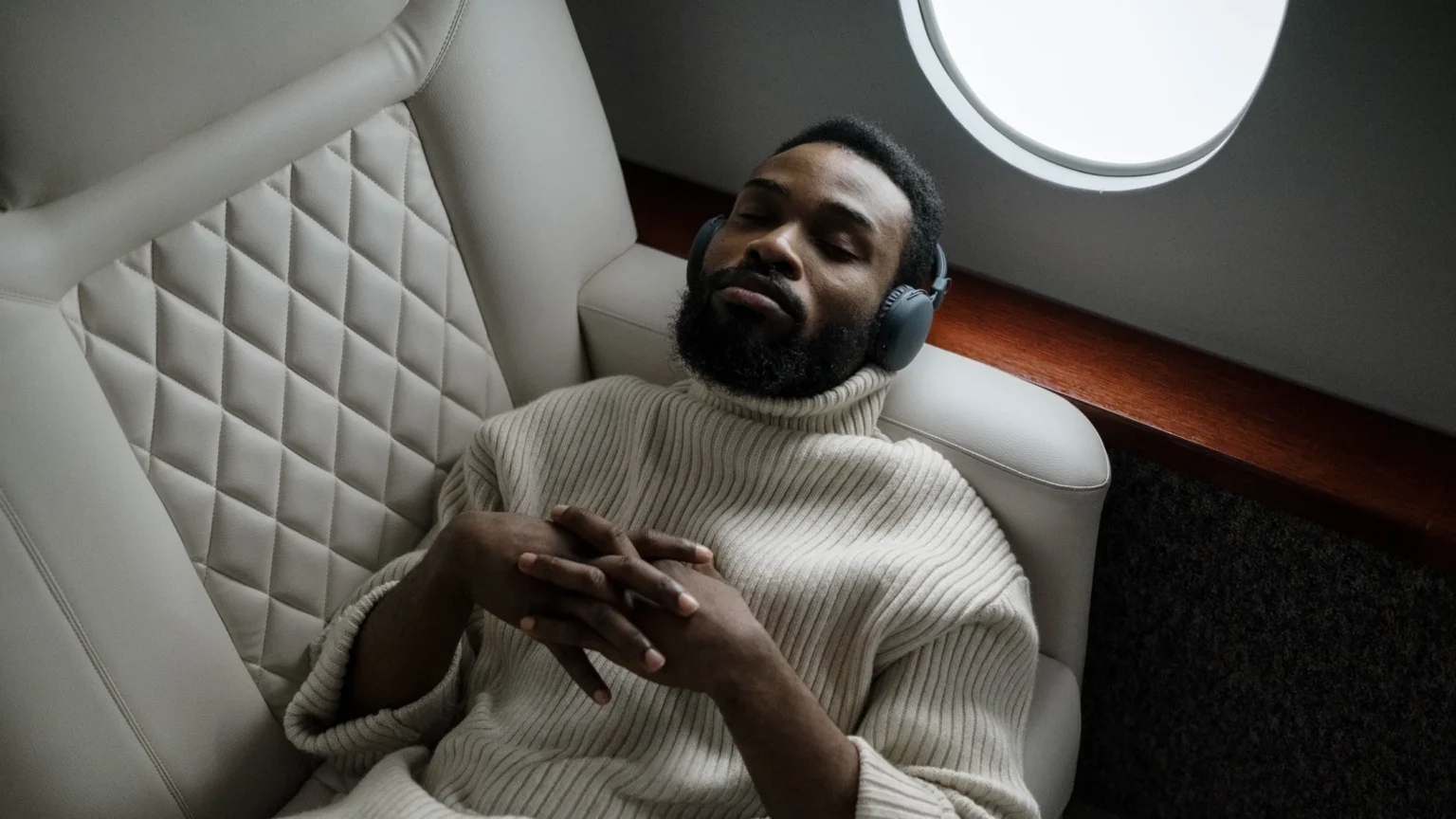
Now, picture the same flight today. You slide a pair of premium noise-canceling headphones over your ears, press the power button, and the world performs a kind of acoustic miracle. The engine roar drops away. The cabin hum dissolves. The crying and snoring recede to something distant and manageable. What remains is your music, your podcast, your movie — or simply silence, clean and restorative, at 35,000 feet.
This transformation did not happen by accident. It is the product of decades of engineering, a fascinating origin story rooted in military aviation, and a consumer revolution that placed one of the most sophisticated pieces of personal audio technology in the hands of everyday travelers worldwide.
Noise-canceling headphones have not merely improved the flying experience — they have fundamentally changed what it means to travel by air. This article tells the full story: the science behind the technology, the history of its development, the ways it has reshaped airline travel culturally and physically, and a practical guide to choosing the best pair for your next flight.
The Science of Silence: How Noise-Canceling Technology Actually Works
To appreciate how revolutionary noise-canceling headphones are, it helps to understand the elegance of the technology behind them. There are two distinct approaches to blocking unwanted sound, and premium headphones typically use both together.
Passive Noise Isolation
The first method is passive noise isolation — the physical blocking of sound waves through the design of the headphone itself. Over-ear headphones with thick ear cups, dense padding, and a snug seal around the ear create a physical barrier between the outside world and your ear canal. This approach works particularly well for high-frequency sounds — voices, hisses, and higher-pitched ambient noise. Think of it as the acoustic equivalent of closing a heavy door.
Passive isolation alone, however, is limited. It struggles with low-frequency sounds — the deep, constant drone of jet engines, the low-frequency vibration of the fuselage, the rumble of turbulence-induced cabin movement. These sound waves have long wavelengths that pass through physical barriers relatively easily. To defeat them, you need something smarter.
Active Noise Cancellation (ANC)
Active Noise Cancellation — the technology that defines modern noise-canceling headphones — is a masterpiece of applied physics. It works on a beautifully counterintuitive principle: to eliminate a sound wave, you generate an identical sound wave that is precisely inverted — flipped 180 degrees out of phase with the original.
When two sound waves of equal amplitude and opposite phase meet, they cancel each other out in a phenomenon called destructive interference. The result is silence, or something very close to it.
Here is how it happens inside your headphones:
Step 1 — Sensing: Tiny microphones built into the ear cups continuously sample the ambient sound in your environment. On a plane, these microphones are detecting the constant low-frequency roar of the engines, the hum of the air conditioning system, and the structural vibration of the aircraft.
Step 2 — Processing: A dedicated digital signal processor (DSP) chip inside the headphones analyzes the captured sound wave in real time — measuring its frequency, amplitude, and phase — and instantly calculates what an opposing, mirror-image sound wave would look like.
Step 3 — Generating: The headphones produce this anti-noise wave through the same speaker drivers delivering your audio. The anti-noise wave is fed into your ear canal simultaneously with your music or content.
Step 4 — Cancellation: The original ambient noise wave and the anti-noise wave meet inside the ear cup and cancel each other out through destructive interference. What reaches your eardrum is the ambient noise minus itself — effectively zero.
The entire cycle — sense, process, generate, cancel — happens thousands of times per second, continuously adjusting to changes in the acoustic environment. Modern ANC chips from companies like Qualcomm and Apple’s H-series process these calculations with latency measured in microseconds.
Why Airplane Noise Is Ideal for ANC
Here is an important nuance that makes noise-canceling headphones uniquely effective in aviation: the technology works best against steady, predictable, low-frequency noise — and jet engine noise is almost exactly that. The consistent roar of turbofan engines at cruising altitude produces a predictable, low-frequency drone that ANC algorithms can model, predict, and cancel with exceptional efficiency.
This is why noise-canceling headphones that perform only adequately in a busy café can feel almost magical on a long-haul flight. The acoustic environment of a cruising aircraft is, paradoxically, one of the most ANC-friendly sound environments that exists.
A History Written in Altitude: The Origins of Noise-Canceling Technology
The story of noise-canceling headphones begins not in a consumer electronics lab, but in the cockpit of a military aircraft — and it starts with one man’s discomfort on a long flight.
The Bose Origin Story
In 1978, Dr. Amar G. Bose — the MIT-trained engineer and founder of Bose Corporation — was on a long transatlantic flight when the airline provided him with a pair of small audio headphones. He plugged them in, pressed play, and found the experience deeply disappointing. The noise of the aircraft was so overwhelming that the music was barely audible at any reasonable volume.
Being an engineer, he did not simply complain. He pulled out a notepad and began calculating whether it would be physically possible to cancel ambient noise electronically. By the time his plane landed, he had the mathematical foundation for what would become active noise cancellation.
It took nearly a decade of research and development, but by 1986, Bose had developed the first operational noise-canceling headset — and the initial application was military. The U.S. military and commercial airline industry were the first beneficiaries of the technology, using early Bose noise-canceling headsets to protect pilots from the damaging effects of prolonged cockpit noise and to improve communication clarity in high-noise environments.
From Cockpits to Cabins
Throughout the late 1980s and early 1990s, noise-canceling technology remained largely the domain of professional aviation. Military pilots, commercial airline cockpit crews, and helicopter operators used the technology as a safety and communication tool. The headsets were large, expensive, and industrial in character — not something a leisure traveler would carry through an airport.
The pivot to consumer aviation came in 1989, when Bose developed a version specifically for airline passengers — initially made available through first-class cabin programs on select airlines. The concept was revolutionary, but the price was prohibitive, and consumer adoption was slow through the 1990s.
The Consumer Revolution
The turning point came in 2000, when Bose launched the QuietComfort headphones — the first noise-canceling headphones designed and marketed directly to consumers, specifically positioned around the air travel use case. At $299 at launch, they were expensive by the standards of the time, but the experience they delivered was so dramatically different from anything available that early adopters were evangelical about them.
Frequent business travelers — who spent significant portions of their professional lives on airplanes and understood the toll of long-haul noise viscerally — adopted them rapidly. The QuietComfort became a status symbol in airport lounges and business class cabins. Other manufacturers took notice.
Sony, Sennheiser, Plantronics, and dozens of other audio companies entered the ANC market throughout the 2000s. But it was the arrival of Apple in the space — first with the AirPods Pro in 2019, and then with the AirPods Max in 2020 — that truly democratized the technology. Apple’s marketing machine and the AirPods Pro’s accessible $249 price point introduced ANC to an entirely new generation of travelers who might never have considered a dedicated pair of over-ear headphones.
Today, the global noise-canceling headphone market is valued at billions of dollars and growing rapidly, with options spanning from $25 budget models to flagship $400+ pairs that represent the current pinnacle of consumer audio engineering.
The Measurable Impact: What Noise-Canceling Headphones Do to Your Body and Mind
The improvement that noise-canceling headphones deliver is not merely subjective — it is measurable in physical and psychological terms that have been documented by researchers, medical professionals, and the aviation industry itself.
Hearing Protection at 35,000 Feet
Aircraft cabin noise is genuinely damaging over long exposure. The ambient noise level in a typical commercial aircraft cabin cruises between 75 and 85 decibels, with spikes during takeoff that can exceed 90 decibels. The World Health Organization identifies 85 decibels as the threshold above which prolonged exposure begins causing permanent hearing damage.
Frequent flyers — business travelers who may log 100,000 or more miles per year — accumulate significant cumulative noise exposure across their careers. Research published in aviation medicine journals has found measurable high-frequency hearing loss in long-serving airline crew members and frequent business travelers, consistent with the type of damage caused by extended low-level noise exposure.
Quality noise-canceling headphones reduce perceived cabin noise levels by 20 to 30 decibels — bringing the effective noise exposure into a range that is safe for extended periods. For the frequent traveler, this is not a luxury consideration — it is a long-term hearing health investment.
Fatigue Reduction and the Energy Cost of Noise
One of the most significant and least-discussed effects of aircraft cabin noise is fatigue. The human nervous system processes ambient noise even when the conscious mind is not focusing on it. Background noise at 80+ decibels keeps the nervous system in a state of low-level activation — a mild but continuous stress response that depletes cognitive and physical energy over time.
This is why passengers often feel disproportionately exhausted after long flights, even when they slept for several hours. Part of what they are recovering from is not just the travel itself, but the sustained neurological cost of processing hours of relentless noise.
Studies on cognitive performance in noisy environments consistently show that noise at aircraft cabin levels impairs memory, concentration, reading comprehension, and complex decision-making. For business travelers trying to prepare for meetings, read briefing documents, or make important calls during a flight, the cognitive tax of unmitigated cabin noise is a real and measurable productivity drain.
Noise-canceling headphones interrupt this cycle. By removing the primary stressor, they allow the nervous system to downshift — reducing the hormonal stress response, lowering heart rate, and freeing cognitive resources. Travelers who use quality ANC headphones consistently report arriving at their destinations feeling more rested, more alert, and more capable of transitioning directly into work or activities.
Sleep Quality on Long-Haul Flights
For travelers crossing multiple time zones on overnight flights, sleep is not optional — it is the primary defense against jet lag and the key to arriving functional. Sleep quality on aircraft is profoundly influenced by noise.
Human sleep cycles are interrupted by sudden or sustained loud sounds. The snoring of a neighbor, the crying of an infant, the clatter of the beverage cart, the periodic announcements — all of these are disruptions that fragment sleep architecture, reducing the proportion of restorative deep sleep and REM sleep that a traveler achieves.
Noise-canceling headphones address this directly. By flattening the ambient soundscape, they create a more consistent acoustic environment that the brain does not need to monitor for potential threats or interruptions. Many travelers combine ANC headphones with sleep-promoting audio — white noise, brown noise, binaural beats, or dedicated sleep music — to create an in-flight sleep environment that mimics what they might achieve at home far more closely than the raw cabin environment allows.
The result, reported consistently by long-haul travelers, is faster sleep onset, fewer mid-sleep awakenings, and a greater sense of restored energy upon landing.
Anxiety and Stress Reduction
For travelers who experience flying anxiety — a condition affecting an estimated 25% of the flying public to some degree — cabin noise is a significant stressor. The relentless roar of the engines can be interpreted by an anxious nervous system as a warning signal, maintaining hypervigilance and making relaxation nearly impossible.
The acoustic quieting effect of noise-canceling headphones has a measurable calming influence on anxious flyers. By removing the primary sensory trigger of the engine noise, the technology helps break the cycle of environmental hypervigilance that drives flight anxiety. Frequent flyers with mild-to-moderate flying anxiety report that ANC headphones are among the most effective tools in their management toolkit — not as a cure, but as a meaningful reducer of in-flight stress.
How Airlines Responded: The Business Class Arms Race
The transformation that noise-canceling headphones brought to the passenger experience did not go unnoticed by airlines. Their rapid adoption among premium travelers — precisely the high-value customers airlines work hardest to retain — forced a competitive response in the premium cabin experience.
Airline-Provided Noise-Canceling Headsets
In the mid-2000s, premium airlines began transitioning their business and first-class cabin headphone offerings from passive noise-isolating designs to full ANC headsets. Airlines including Singapore Airlines, Emirates, Qatar Airways, Lufthansa, and British Airways began offering branded or co-branded ANC headphones as part of their premium cabin experience — recognizing that the quality of in-flight entertainment was directly tied to audio quality, which was directly tied to ambient noise management.
Today, a high-quality noise-canceling headset in business or first class is considered a baseline expectation among frequent premium travelers, and airlines that fail to provide one face visible criticism in reviews and loyalty surveys.
The In-Flight Entertainment Upgrade Cycle
The proliferation of noise-canceling headphones among passengers also drove a parallel upgrade cycle in in-flight entertainment systems. As travelers arrived with their own premium headphones and connected them to IFE systems, the inadequacy of older analog audio outputs became apparent. Airlines responded by upgrading audio systems, adding Bluetooth connectivity to newer aircraft, and improving the breadth and quality of their content libraries.
The traveler’s headphones, in a very real sense, raised the standard of the entire in-flight audio and entertainment ecosystem.
The Rise of the Personal Device Ecosystem
Perhaps the most profound structural change that noise-canceling headphones catalyzed in aviation is the shift from airline-provided entertainment to personal device ecosystems. As travelers invested in premium personal headphones, they increasingly preferred to consume their own content — downloaded movies, custom playlists, podcasts, audiobooks, and streaming services — rather than whatever the airline’s IFE system offered.
This shift has reshaped how airlines think about IFE investment. Some budget and ultra-low-cost carriers have eliminated seat-back screens, providing instead robust power outlets, USB ports, and Wi-Fi connectivity — effectively outsourcing the entertainment to the passenger’s own device and headphone combination.
The Cultural Shift: Headphones as Social Signal and Personal Sanctuary
Beyond the technological and physiological effects, noise-canceling headphones have had a fascinating cultural impact on how people interact — and choose not to interact — in the airplane cabin.
The Universal “Do Not Disturb” Signal
In the social grammar of modern air travel, a pair of over-ear noise-canceling headphones has become the single most universally understood “do not disturb” signal. More powerful than a sleep mask, more definitive than a book, and more socially accepted than a blunt verbal request for quiet, the headphones communicate — without a single word — that the wearer is in their own world and prefers to stay there.
This social function has been enthusiastically embraced by introverts, business travelers, solo explorers, and anyone who simply wants to control their social environment on a flight. The headphones serve as a portable, personal sanctuary — a psychological bubble that the wearer carries onto the plane.
This has materially reduced the frequency of unwanted conversations and social interactions on flights. The excessive talker who might previously have engaged a captive seatmate for hours now encounters a socially impenetrable barrier in the form of two ear cups and a padded headband.
The Democratization of Premium Travel Experience
There is also a meaningful story of democratization in the noise-canceling headphone revolution. Before the technology became widely affordable, the experience of truly comfortable long-haul travel was largely the province of business and first class passengers — whose ticket prices covered not just seat upgrades but also the superior noise environment of quieter forward cabins, better headphones, and more effective audio systems.
The widespread availability of consumer-grade ANC headphones — particularly following Apple’s entry into the market and the subsequent price competition it triggered — means that an economy class passenger with a $250 pair of Sony WH-1000XM5s or AirPods Pro can create an acoustic environment during a long-haul flight that rivals or exceeds what business class passengers experienced a decade ago.
This is a genuine democratization of travel comfort — technology making a meaningful quality-of-life improvement accessible across income levels, not just to those at the top of the cabin.
Choosing the Right Noise-Canceling Headphones for Flying: A Practical Buyer’s Guide
With dozens of excellent options on the market, selecting the right pair of noise-canceling headphones for air travel comes down to a handful of key criteria.
ANC Performance
For flying specifically, ANC performance — particularly in the low-frequency range where engine noise lives — is the primary consideration. The current benchmark leaders in pure ANC performance for aviation are the Sony WH-1000XM5, the Bose QuietComfort Ultra, and the Apple AirPods Max. All three deliver exceptional low-frequency cancellation that transforms the long-haul experience.
Battery Life
A transatlantic flight can run 8–10 hours. A transpacific flight can exceed 14 hours. Your headphones need to outlast your journey. Look for at minimum 20 hours of ANC-on battery life. The Sony WH-1000XM5 offers up to 30 hours, the Bose QuietComfort Ultra delivers around 24 hours, and the AirPods Max provides approximately 20 hours — all sufficient for the longest commercial routes.
Comfort for Extended Wear
Comfort over a multi-hour flight is non-negotiable. Over-ear designs with generously padded ear cups, adjustable headbands, and lightweight construction are essential. The best travel headphones distribute weight evenly, avoid clamping pressure that causes ear fatigue, and use breathable materials that do not overheat during long wear. The Sony WH-1000XM5 weighs just 250 grams and is widely praised for all-day comfort. The AirPods Max, at 385 grams, is heavier but offset by exceptional padding quality.
Foldability and Portability
A premium pair of headphones is useless if it does not fit in your carry-on. Over-ear ANC headphones vary widely in how compactly they fold. The Bose QuietComfort series has long been praised for its exceptionally flat-folding design. Sony and Apple’s designs fold but less compactly. Check that your chosen headphones come with a protective case — preferably a hard-shell case — to survive the rigors of travel.
Wired vs. Wireless
All modern premium ANC headphones are primarily wireless via Bluetooth. However, for airline use, the ability to connect via a 3.5mm cable to the seat-back IFE system is a meaningful advantage — particularly for long international flights where IFE content may be preferable to downloaded content. Most premium over-ear ANC headphones include a 3.5mm cable option. Note that the AirPods Max connects via a USB-C to 3.5mm adapter, which works but is less elegant. A dual-pin airplane adapter is also recommended for older IFE systems still using two-pin 3.5mm jacks.
Price Tier Guide
Budget ($30–$80): Anker Soundcore Q45, TaoTronics SoundSurge 90. Meaningful ANC at an accessible price, though comfort and premium sound quality are limited.
Mid-Range ($100–$200): Jabra Evolve2 55, Sennheiser Accentum. Strong ANC performance, good comfort, suitable for regular travelers.
Premium ($250–$400): Sony WH-1000XM5, Bose QuietComfort Ultra, Apple AirPods Max. Best-in-class ANC, premium comfort, and audio quality that justifies the price for frequent flyers.
The Future of Noise-Canceling Technology in Aviation
The evolution of noise-canceling headphones shows no sign of slowing. Several emerging technologies promise to push the experience even further in the years ahead.
Personalized ANC
The next frontier in ANC technology is personalization — algorithms that learn the specific shape of your ear canal and the acoustic characteristics of your personal hearing to optimize the anti-noise wave precisely for you. Sony has already introduced ear measurement features in their companion apps, and deeper personalization is the clear direction of travel for the premium segment.
AI-Driven Adaptive Noise Cancellation
Current ANC systems respond to ambient noise reactively — sampling, processing, and canceling in near-real-time. Next-generation systems using machine learning will be predictive — recognizing environments like aircraft cabins and preemptively configuring their cancellation profiles for maximum effectiveness before the noise even becomes an issue.
Spatial Audio Integration
Spatial audio — which creates a three-dimensional soundscape that feels like the sound is coming from around you rather than inside your head — is increasingly being integrated with ANC technology. Apple’s AirPods Max already offers cinematic spatial audio for supported content. As in-flight entertainment systems adopt spatial audio formats, the integration with ANC headphones will create a first-class cinema experience accessible to any seat on the plane.
Bone Conduction Hybrid Systems
Emerging hybrid designs combine traditional ANC with bone conduction audio delivery — transmitting sound directly through vibration in the skull bones rather than through air. This eliminates the residual “pressure” sensation that some users experience with conventional ANC, while maintaining full cancellation of ambient noise. Commercial versions are still maturing, but the technology represents a compelling next step for long-haul travel comfort.
Frequently Asked Questions
Are noise-canceling headphones safe for your ears? Yes — in fact, they are better for your ears than the alternative. By reducing ambient noise, they allow you to listen to audio at lower volumes than you would need to use to overcome cabin noise. This reduces, rather than increases, cumulative hearing exposure.
Do noise-canceling headphones help with ear pressure during takeoff and landing? ANC headphones do not directly address ear pressure, which is caused by changes in cabin air pressure affecting the middle ear, not by sound waves. However, some travelers report that the reduction in sensory input from ANC helps reduce the perception of discomfort during pressure changes.
Can I use noise-canceling headphones throughout the entire flight? Yes. Unlike portable electronic devices that were once subject to restrictions, headphones — including wireless ANC headphones — can be used during all flight phases on virtually all commercial airlines, including during takeoff and landing. Always check with your specific airline, though this is now standard policy industry-wide.
Do I still need noise-canceling headphones in business or first class? Yes, even in premium cabins. While business and first-class seats are positioned further from the engines and benefit from somewhat quieter environments, cabin noise in even the most premium cabins remains significant enough to benefit from active noise cancellation.
Conclusion: A Small Device That Changed Everything
It is remarkable to consider that a technology born in a military cockpit, developed over decades by a determined MIT engineer, and refined through successive generations of consumer electronics competition, has so fundamentally altered the subjective experience of one of the 20th century’s defining technologies.
Noise-canceling headphones did not merely improve flying. They redefined what flying could feel like. They turned screaming engines into silence, turned chaotic cabins into personal sanctuaries, and gave ordinary travelers a level of comfort and control over their acoustic environment that was previously available only to pilots and premium cabin passengers.
They changed how we sleep on planes, how we work on planes, how we interact — or choose not to interact — on planes. They changed what airlines offer, how IFE systems are designed, and what travelers expect. They democratized premium comfort and gave the introverted, the anxious, the exhausted, and the hard-working a tool that makes one of the most physically demanding common experiences of modern life significantly more bearable.
The best pair of noise-canceling headphones you can afford is, for any regular airline traveler, among the highest-return-on-investment purchases available. The noise was always there. Now, for the first time in the history of aviation, you have the power to make it disappear.
In another related article, How to Handle a Difficult Seatmate: The Ultimate Guide for Airline Travelers