


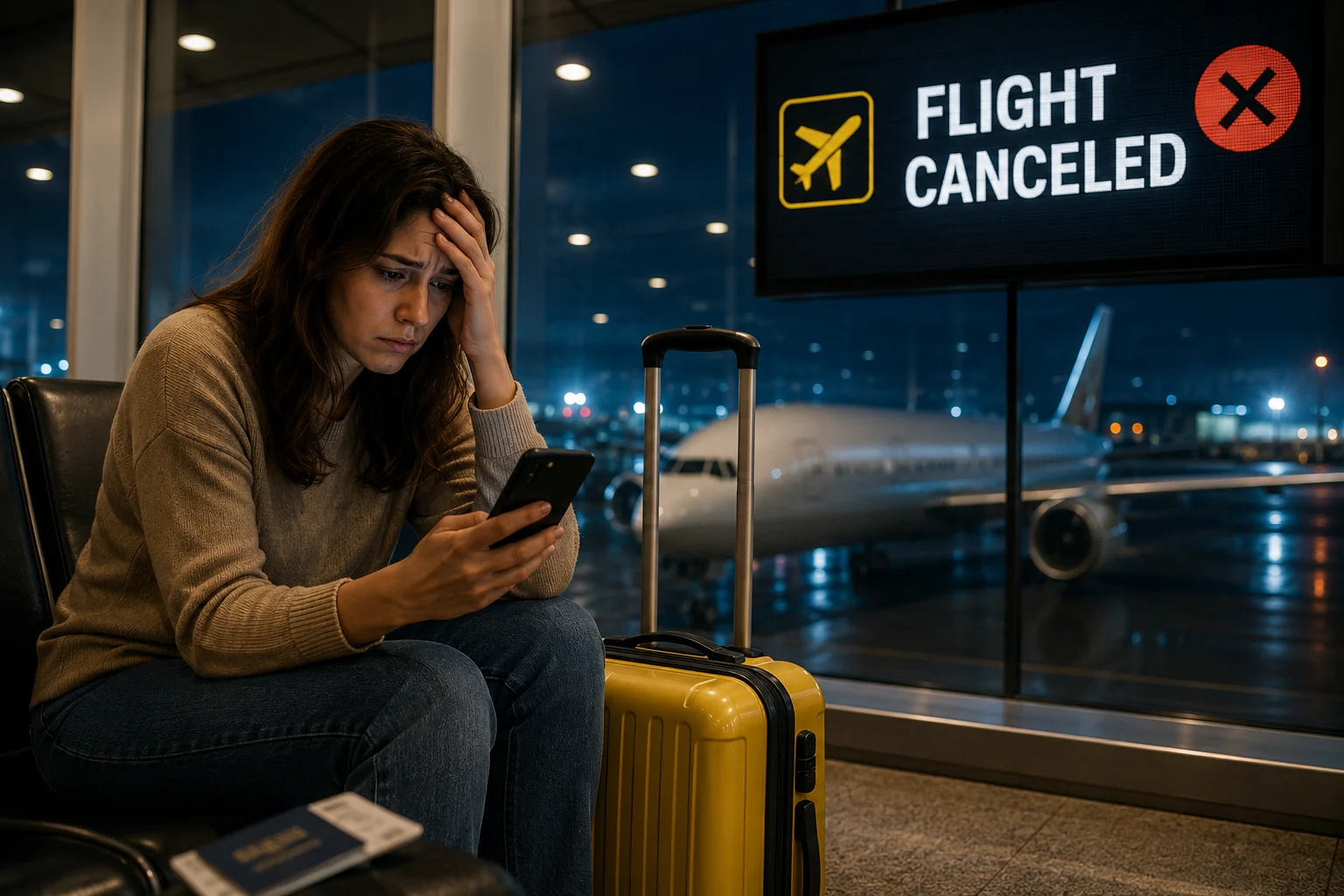
Few travel emergencies feel as disorienting as an 11 PM notification that tomorrow’s flight no longer exists. You’ve packed. You’ve arranged your ride to the airport. Maybe you have a wedding, a funeral, a business meeting, or a cruise departure that won’t wait. And now you’re staring at a cancellation email with no idea what happens next.
The good news: airline cancellations are common enough that there’s a well-established playbook for handling them, and the rules protecting you have gotten meaningfully stronger in the past two years. The bad news: airlines are not going to walk you through those rules unprompted. Gate agents and phone reps are often trained to offer the option that’s cheapest for the airline first — a travel credit instead of a refund, a rebooking three days later instead of one that gets you there on time. Knowing exactly what you’re entitled to, and exactly what to say, changes the outcome.
This guide walks through the first hour after a cancellation, your legal rights in the U.S. and internationally, how to get rebooked fastest, when the airline owes you a hotel, and the mistakes that cost travelers money and time every single day.
1. The First 15 Minutes: What to Do Immediately
When a cancellation notice lands the night before departure, speed matters more than almost anything else you’ll do in this process. Every other passenger on that canceled flight just got the same notice, and rebooking seats on the next available flights is limited. Here’s the order of operations that gives you the best shot at a workable outcome.
Step 1: Don’t call first — try the app or website simultaneously. Phone hold times after a mass cancellation can run two, three, even five hours. Most major airlines now let you rebook directly through their app or site, often faster than a human agent can. Open the app immediately and see what alternate flights are offered before you do anything else.
Step 2: Call the airline at the same time, using an international number if possible. While you’re working the app, also call. A trick seasoned travelers use: dial the airline’s reservation line for a different country (often listed at the bottom of the airline’s contact page). Wait times on a foreign-language or international line are frequently far shorter than the domestic line, and agents there can access the same reservation system.
Step 3: Get in the DM/chat queue on social media. Airline social media teams (X/Twitter, Facebook Messenger) are often staffed with agents who can rebook you and who see less volume than the phone lines during a mass cancellation event. Send a message with your confirmation code immediately — treat it as another parallel channel, not a replacement for the app or phone call.
Step 4: If you’re already at the airport or nearby, walk to the gate or ticket counter. In-person agents can sometimes see rebooking options that don’t show up in the app, particularly interline agreements with partner airlines that automated systems don’t always surface.
Step 5: Screenshot everything. Take a screenshot of the cancellation notice, the original itinerary, any rebooking offer, and the timestamp. If you end up filing a DOT complaint or a credit card dispute later, this documentation is what makes your case.
The goal in this first quarter-hour isn’t to make a final decision — it’s to gather every option available to you (alternate flights, refund eligibility, hotel offers) so you can make an informed choice rather than a rushed one.
2. Understanding Why Your Flight Was Canceled (and Why It Matters)
Not all cancellations are created equal under the law, and the reason behind yours can affect what you’re owed.
Controllable cancellations
These stem from something within the airline’s control: mechanical issues, crew scheduling problems, IT outages, or staffing shortages. Under U.S. rules, a controllable cancellation is what triggers the airline’s cash refund obligation and, at several carriers, additional care like hotel and meal vouchers.
Uncontrollable cancellations
Weather, air traffic control ground stops, security incidents, and similar events outside the airline’s operational control. You’re still entitled to a refund if you decline the rebooking, but airlines are not federally required to provide hotel or meal accommodation for weather-driven cancellations, though several do so voluntarily as a customer-service matter.
Why this matters for you: if your cancellation notice or the gate agent tells you the cause, note it. It affects whether you push for hotel compensation and shapes how you frame your requests.
3. Your Legal Rights: U.S. DOT Rules in 2026
This is the part most travelers get wrong, because the rules changed substantially in the last two years and many blog posts and even some airline reps are still operating on outdated information.
The automatic refund rule
As of 2026, the Department of Transportation’s automatic refund rule is in full effect. Airlines operating in the United States must automatically issue a cash refund when your flight is canceled and you choose not to accept the rebooking offered, and this applies no matter what caused the cancellation — weather, mechanical problems, or staffing.
The critical shift: airlines are legally required to initiate this refund on their own — you shouldn’t have to call, submit a claim form, or negotiate with a chatbot. Before this rule, airlines routinely defaulted to issuing travel credits instead of cash, and many travelers simply accepted them without realizing cash was owed.
You’re entitled to a refund whenever the airline cancels your flight for any reason, and you choose not to travel or accept the credits, vouchers, or other compensation the airline offers instead. The same right applies to a significant schedule change or delay that you decline to accept.
What counts as a “significant” delay
DOT defines a significant delay as three or more hours for domestic flights and six or more hours for international flights. The refund right can also be triggered by a change in your departure or arrival airport, an added connection you didn’t originally book, or a downgrade in cabin class, if you decline the revised itinerary.
Refund timing
Once you decline the rebooking and request your refund, the airline is on the clock. Refunds to a credit card must be issued within seven business days, while refunds for cash or other payment types must be returned within twenty calendar days.
A wrinkle worth knowing: the flight renumbering pause
In late 2025, DOT paused enforcement of one specific piece of the rule. As of December 5, 2025, the Department paused, until June 30, 2026, enforcement of the refund requirement for flights that are simply reassigned a different flight number than the one you originally purchased — as long as your itinerary otherwise sees no significant change or delay. In plain terms: if an airline swaps your flight number for an internal operational reason (say, moving your flight from mainline to a regional partner) but you still depart and arrive around the same times, that alone doesn’t count as a cancellation entitling you to a refund. This exception exists because airlines had told DOT that flight renumbering is often just logistical housekeeping — for instance, switching between mainline and regional service — with no real impact on the passenger. If your flight was genuinely canceled (not renumbered) — meaning it doesn’t operate at all under any number close to your original time — this pause doesn’t apply to you, and your refund right stands.
Ancillary fees: bags, seats, Wi-Fi
You’re also entitled to a refund of fees you paid for extras like seat selection or Wi-Fi if the airline canceled the flight or the service was unavailable through no fault of your own. On baggage specifically: if your checked bag is delayed more than 12 hours after a domestic arrival, the airline must refund the fee you paid to check it, provided you file a mishandled-baggage report. Note this refunds the fee, not the value of your belongings — if a bag is lost or damaged outright, that’s governed separately by DOT liability limits, which cap airline liability at $3,800 per passenger on domestic flights in 2026.
Airlines that go beyond the federal minimum
Several U.S. carriers have voluntary policies more generous than the federal floor:
| Airline | Enhanced policy |
| American Airlines | Offers refunds for international delays over 4 hours |
| Alaska Airlines | Offers refunds for controllable domestic delays after just 1 hour |
| United Airlines | Added no-penalty cancellations within 6 hours of departure |
| Delta Air Lines | Has issued proactive credits for delays over 90 minutes |
| Southwest Airlines | Removed change fees permanently and issues automatic refunds for any controllable cancellation |
Practical takeaway: always check your specific airline’s customer commitment page (usually titled something like “Customer Service Plan”), because these voluntary policies can get you compensation the federal floor doesn’t guarantee.
4. Your Legal Rights: International and EU Protections
If your trip touches European airspace, you may have stronger protections than U.S. law provides.
Unlike the U.S. rule, EU Regulation 261/2004 provides fixed cash compensation, ranging from €250 to €600, for qualifying delays and cancellations — money owed on top of any refund, for your time and inconvenience, not just a return of your ticket cost. The amount depends on flight distance and how much advance notice you received. Broadly:
- Short-haul flights (under 1,500 km): €250
- Medium-haul flights (1,500–3,500 km): €400
- Long-haul flights (over 3,500 km): €600
EU261 applies if you’re departing from an EU airport on any airline, or arriving at an EU airport on an EU-based carrier. Compensation generally isn’t owed if the airline gave you at least 14 days’ notice, offered a comparable rebooking within specific time windows, or if the cancellation was caused by “extraordinary circumstances” (severe weather, air traffic control strikes, security threats) genuinely outside the airline’s control.
European rules also require airlines to provide meals, drinks, hotel accommodation, and transport during long delays — a mandatory duty of care that has no direct federal equivalent in the U.S., where what you receive during a delay depends on the individual airline’s own policies rather than a legal requirement.
If your itinerary includes a European leg, always check EU261 eligibility separately from U.S. DOT rules — you may be able to claim both a refund from the airline and separate cash compensation under EU261.
5. Refund vs. Rebooking vs. Voucher: How to Choose
The night your flight cancels, an agent (human or automated) will typically present you with a rebooking option, sometimes alongside an offer of a travel credit. Here’s how to think through the choice.
Take the cash refund if:
- The new rebooking doesn’t get you there in time for what you need (wedding, cruise, work deadline)
- You’d rather book a different airline that has better availability
- You’re not confident you’ll travel again with this airline before a credit expires
- The next available flight has multiple new connections or a downgraded cabin
Accept the rebooking if:
- The new flight still gets you where you need to be, on time or close to it
- It’s a comparable or better routing (nonstop instead of connecting, etc.)
- You’d rather not deal with rebooking a new itinerary from scratch the night before travel
Decline vouchers pushed at the gate
A common mistake to avoid is accepting a voucher at the gate when the cancellation was within the airline’s control — you may be entitled to a cash refund plus meal and hotel coverage, so don’t trade away your refund for a credit under pressure. Gate agents sometimes present the voucher as the default or easiest option because it costs the airline less than a cash refund. You always have the right to ask for cash instead.
Real example: Say your $420 round-trip ticket gets canceled the night before a family event. The airline’s app defaults to offering a $420 travel credit valid for 12 months. If the event can’t be moved, or you don’t expect to fly this airline again within a year, you’re better off explicitly requesting the cash refund — same $420, but liquid and usable anywhere, with no expiration risk.
6. How to Get Rebooked Fastest (Multiple Channels at Once)
If your goal is still to reach your destination as close to on time as possible, speed and channel-stacking matter.
Work multiple channels simultaneously
Don’t wait on hold before trying the app. Run these in parallel:
- Airline app or website self-service rebooking
- Phone call (consider an international reservation line)
- Airline social media DM/chat
- In-person counter if you’re near the airport
Ask about interline and codeshare rebooking
If the airline has no seats available for several days, ask explicitly: “Can you rebook me on a partner or interline airline?” Not every agent volunteers this. Airlines in the same alliance (Star Alliance, oneworld, SkyTeam) or with standing interline agreements can often get you on a competitor’s flight at no extra cost when your original airline caused the disruption — but this typically requires an agent to manually process it, so ask directly.
Consider a nearby alternate airport
If you’re flexible, ask about flights from a nearby secondary airport. A cancellation out of a congested hub might still have healthy availability out of an airport an hour or two away.
Have backup flight numbers ready before you call
Before you get an agent on the phone, use a flight-search tool to identify two or three specific flights (with flight numbers and times) on the same or partner airlines that would work for you. Handing an agent a specific flight number to check speeds up the call dramatically compared to a generic “what do you have.”
7. Hotel, Meals, and Overnight Accommodation Rights
If the cancellation strands you overnight, whether the airline owes you a hotel room depends on both the cause of the cancellation and the specific airline’s policy, since the U.S. has no blanket federal hotel mandate.
When you’re more likely to get a hotel voucher:
- The cancellation was controllable (mechanical, crew, IT issue) — most major U.S. airlines now cover hotel costs in this scenario as part of their customer service commitments
- You ask directly and promptly, rather than assuming it will be offered
- You’re stranded overnight specifically because of the cancellation, not because of your own scheduling choice
When you’re less likely to get one:
- The cancellation was weather-related or otherwise outside airline control
- You’ve already left the airport before requesting it (some airlines require you to request accommodation before departing the terminal)
How to ask
Go to the customer service desk or use the app’s chat function and explicitly request: “This was a controllable cancellation. I need hotel and meal accommodation under your customer service commitment.” Having the airline’s own published customer service plan open on your phone (search “[Airline name] customer service plan”) to reference is a powerful, low-friction way to get a yes rather than a runaround.
If the airline won’t provide a hotel
- Book your own room and keep every receipt (hotel, transport to/from it, meals)
- File a refund/reimbursement request afterward, referencing the airline’s own customer service commitment or, for controllable cancellations, DOT’s expectations
- If reimbursement is denied and the cancellation was controllable, this becomes strong material for a DOT complaint
Real example: A traveler whose flight is canceled at 9 PM due to a mechanical issue books a $140 airport hotel out of pocket rather than wait two hours at a service counter. The airline’s customer service plan (a matter of public record on its website) commits to covering hotel costs for controllable cancellations. The traveler submits the receipt through the airline’s reimbursement form the next day and is repaid within two weeks — but only because they kept the receipt and cited the airline’s own published commitment.
8. If You Booked Through a Third Party or Travel Agent
If you booked through an online travel agency (OTA) like Expedia, Priceline, or a metasearch site rather than directly with the airline, the process has an extra layer.
- The airline, not the OTA, owes you the refund or rebooking rights described above — DOT rules apply regardless of where you purchased the ticket.
- However, the OTA often controls the reservation record, meaning the airline may direct you back to the OTA to process changes or refunds, which can slow things down.
- Call the OTA and the airline simultaneously. Don’t rely on one channel; if the OTA is slow, the airline can often still assist directly, especially with a mechanical/schedule-based cancellation.
- If the OTA refuses to process a refund you’re legally owed, you can still file a DOT complaint — DOT’s rule places the obligation on the airline that canceled the flight, and airlines are expected to ensure their ticket agents comply.
9. Credit Card and Travel Insurance Protections
Two protections sit on top of your airline-based rights, and both are worth activating in a cancellation scenario.
Credit card travel protections
Many premium travel credit cards include trip delay or trip cancellation insurance as a card benefit. Typically triggered when a delay exceeds a set number of hours (often 6–12), these benefits can reimburse:
- Meals and incidentals during the delay
- A hotel room if you’re stranded overnight
- In some cases, the cost of a new one-way ticket on another airline if you must rebook independently
Check your specific card’s benefits guide (usually available through the card issuer’s website or by calling the number on the back of the card), since coverage thresholds and dollar caps vary significantly by card tier.
Standalone travel insurance
If you purchased trip insurance separately, cancellation coverage typically reimburses non-refundable prepaid costs (hotels, tours, event tickets) that become worthless because of the flight cancellation — something the airline refund itself doesn’t cover, since the airline is only responsible for the ticket price, not your downstream trip costs.
What to keep for either claim
- The cancellation notice/email
- Screenshots of rebooking options offered and declined
- All receipts for meals, hotel, and transport
- Boarding passes or itinerary confirmations showing the disruption
10. Special Situations
Connecting flights
If only one leg of a connecting itinerary is canceled, ask the airline to rebook your entire remaining itinerary together, not just the canceled segment. If your connection is now impossible or absurdly long, you’re generally entitled to the same significant-delay refund rights described above for the full itinerary, not just the affected leg.
Award/mileage tickets
Cancellations on award tickets typically result in mileage and any cash taxes/fees being returned if you decline rebooking, though the process sometimes requires a phone call rather than self-service in the app. Ask explicitly for miles to be redeposited without the usual redeposit fee, since fee waivers for airline-caused cancellations are standard practice at most programs even when not advertised.
Time-sensitive travel (weddings, cruises, visa appointments, funerals)
If your trip has a hard deadline, say so explicitly and early, ideally in your very first message or call. Agents have more flexibility than the standard rebooking algorithm shows, including manual interline rebooking, but they generally only use it when a passenger clearly states the stakes. Documentation (a wedding invitation, cruise ticket, appointment confirmation) can sometimes unlock priority handling.
11. Common Mistakes That Cost You Money
- Accepting the first voucher offered without asking about cash. As covered above, this is the single most common way travelers give up money they’re legally owed.
- Leaving the airport before requesting hotel accommodation. Some airlines require the request be made before you exit security or the terminal.
- Not documenting the cancellation reason. If you later need to argue the cancellation was controllable (for hotel reimbursement or a credit card claim), having the stated reason in writing matters.
- Assuming a “flight number change” isn’t a real cancellation. Sometimes it genuinely is a substantive rebooking in disguise; always check the actual departure time and routing, not just the label.
- Waiting on hold instead of working multiple channels. As described above, running app, phone, and social media requests in parallel dramatically improves your odds.
- Forgetting to request ancillary fee refunds. Seat selection, Wi-Fi, and bag fees are often forgotten in the scramble to rebook, but they’re refundable when the flight is canceled.
- Not escalating to DOT when an airline stalls. If an airline drags its feet or tries to only offer a voucher, you can file a complaint at secure.dot.gov/air-travel-complaint — airlines tend to respond quickly to DOT complaints because each one requires a formal written reply on the record.
12. Step-by-Step Checklist
- Screenshot the cancellation notice immediately.
- Open the airline app and check rebooking options.
- Simultaneously call the airline (try an international line if wait times are long).
- Message the airline on social media as a third parallel channel.
- Decide: rebooking or cash refund? Base it on whether the new flight still meets your needs.
- If declining rebooking, explicitly state: “I’m requesting a refund to my original form of payment under the DOT refund rule.”
- Ask about hotel and meal accommodation if stranded overnight, citing the airline’s customer service plan if it was a controllable cancellation.
- Keep every receipt for out-of-pocket hotel, food, and transport costs.
- Check whether your credit card or travel insurance also covers trip delay costs.
- Track your refund deadline (7 business days for card refunds, 20 calendar days for other payment types) and follow up if it’s late.
- If the airline stalls or refuses a refund you’re owed, file a complaint at secure.dot.gov/air-travel-complaint.
13. Frequently Asked Questions
Does the airline have to tell me I’m entitled to a refund, or do I have to ask? Under the current DOT rule, the refund is supposed to be automatic once you decline the rebooking — you shouldn’t have to submit a claim. In practice, it’s still wise to explicitly state your refund request in writing (app message, email, or chat) and get a case number, since automated systems don’t always process correctly on the first try.
Can the airline force me to accept a voucher instead of cash? No. If you decline the rebooking, you’re entitled to a cash refund to your original payment method, not a voucher, regardless of what’s offered first.
What if my flight was only delayed, not fully canceled? If the delay meets the significant-delay threshold (3+ hours domestic, 6+ hours international) and you decline to travel, the same refund rights apply as a full cancellation.
Is a same-day cancellation treated differently than one the night before? No — your rights are the same regardless of how much notice you got, though same-day cancellations tend to come with fewer rebooking options simply because there’s less flight inventory left to sell.
Do I get compensation for my inconvenience, not just my ticket cost, in the U.S.? Generally no. U.S. rules guarantee a refund of what you paid, not a fixed cash payout for the disruption itself. That kind of compensation exists under EU261 for European-qualifying flights, but not under current U.S. federal law.
What happens to my hotel and other prepaid trip costs if I can’t make the trip at all? The airline refund only covers your ticket. Prepaid hotels, tours, or event tickets that become unusable are a matter for travel insurance or credit card trip cancellation coverage, not the airline.
How long do I have to file a DOT complaint? There’s no strict short deadline, but filing promptly — ideally within a few weeks while documentation is fresh — gets faster resolution and keeps your case strong.
Will requesting a refund instead of rebooking hurt my chances of getting compensation later? No — the two aren’t mutually exclusive in most cases. You can take the cash refund for the ticket and separately pursue credit card or insurance reimbursement for downstream costs like a hotel you had to book yourself.