

Introduction: Your Flight Is Cancelled — Now What?
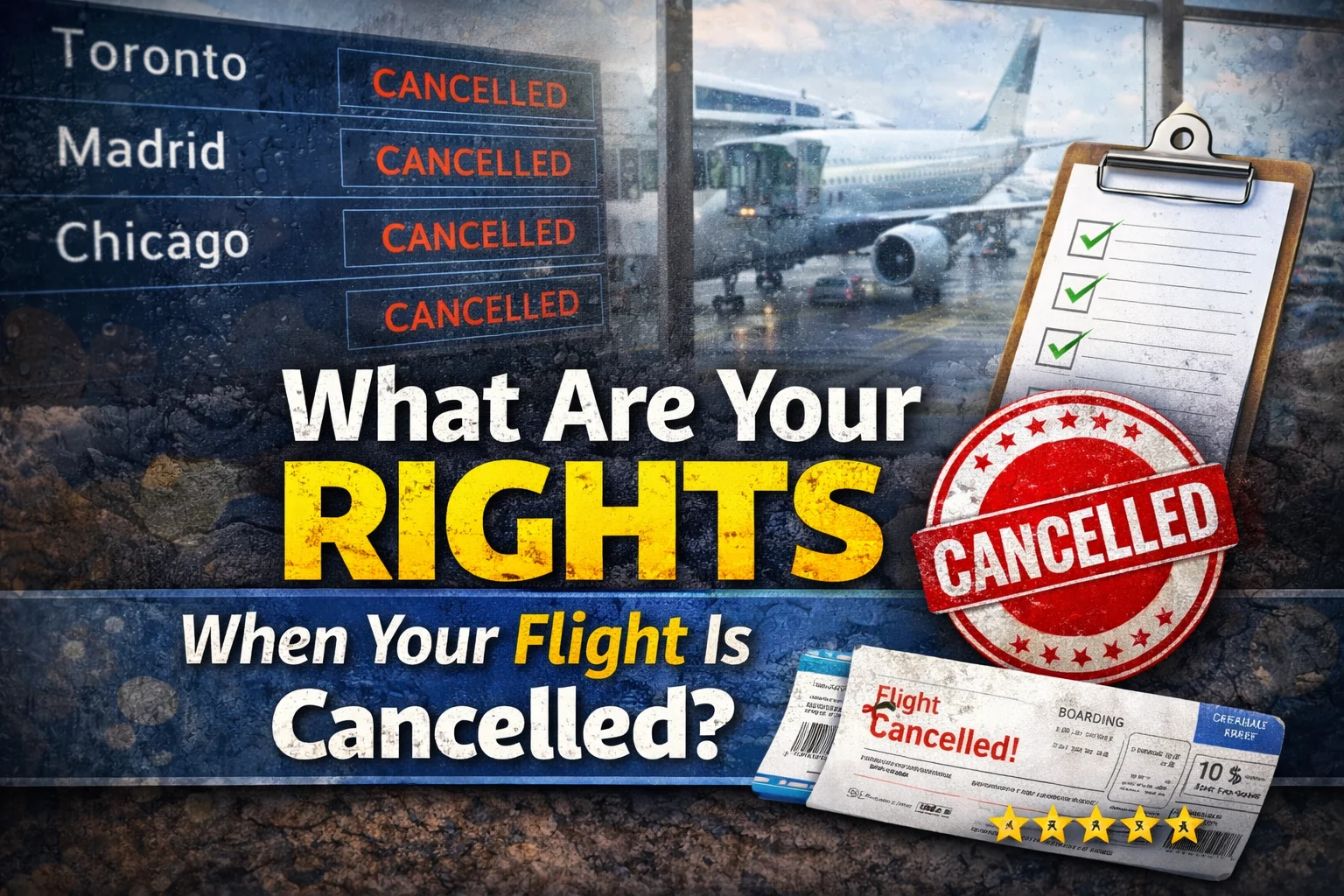
You are standing at the departure gate, coffee in hand, bags checked, and mentally already at your destination. Then the board flips. “CANCELLED.” In an instant, your carefully planned trip becomes a logistical emergency. What do you do? What can you demand? And more importantly, what are you actually entitled to?
Most passengers in this situation do exactly what airlines count on them to do: they join the rebooking queue, accept whatever the agent offers, and walk away having left significant money, meals, hotel nights, and compensation on the table. Not because they are passive people, but because they simply do not know their rights.
Flight cancellation rights are more powerful than most travellers realise — and they vary significantly depending on where your flight departs from, which airline you are flying, why the cancellation occurred, and how much notice you received. This guide walks you through every dimension of the issue in plain language, so the next time your flight is cancelled, you know exactly what to do, what to say, and what to claim.
The Two Worlds of Flight Cancellation Rights: U.S. vs. Europe
Before diving into specifics, it is essential to understand that passenger rights in the context of flight cancellations are governed by two very different legal frameworks, depending on where you are flying.
In the United States, passenger rights for flight cancellations are relatively limited compared to the rest of the developed world. There is no federal law requiring airlines to compensate passengers financially for a cancelled flight beyond a refund of the unused ticket. What protections exist come primarily from Department of Transportation (DOT) rules, individual airline contracts of carriage, and in some cases, your credit card’s travel protection benefits.
In the European Union (and the United Kingdom post-Brexit, which has mirrored EU law), passengers enjoy far stronger legal protections under EC Regulation 261/2004 — commonly called EU261. This regulation mandates financial compensation of up to €600 per passenger for cancellations that are within the airline’s control, in addition to full refunds and care entitlements. It applies to any flight departing from an EU airport, regardless of the airline, and to any EU-based airline operating a flight arriving in the EU.
Understanding which framework applies to your situation is the first and most important step.
Your Rights Under U.S. Law
The Right to a Refund
This is the cornerstone of U.S. passenger rights, and it is non-negotiable. According to the Department of Transportation, if an airline cancels your flight — for any reason whatsoever — you are entitled to a full cash refund to your original form of payment. This applies even to non-refundable tickets.
Many airlines, particularly in the chaos immediately following a mass cancellation event, will proactively offer you a travel voucher or airline credit instead of a cash refund. You are under no obligation to accept this. If you prefer cash back to your credit card or bank account, you are legally entitled to request it, and the airline must comply.
The DOT strengthened this rule significantly in recent years, clarifying that airlines cannot push passengers toward vouchers as a default and must make the cash refund option clear and accessible. If an airline stonewalls you on a cash refund, you can file a complaint with the DOT’s Aviation Consumer Protection Division.
Refund Coverage: What Exactly Is Included?
The refund you are owed is not limited to the base airfare. It includes:
Checked baggage fees. If your bags never flew because your flight was cancelled, the airline must refund any checked baggage fees you paid.
Seat upgrade fees. If you paid extra to select a specific seat or upgrade to a premium cabin and your flight was cancelled, those fees must be refunded.
Ancillary fees. Any other fees paid directly to the airline in connection with the cancelled flight — early boarding, Wi-Fi pre-purchase, and similar charges — are refundable.
Importantly: If you originally booked through a third-party travel agent or booking platform like Expedia or Kayak, your refund may need to go through them rather than directly through the airline. The same entitlement applies, but the process can be slower and more frustrating.
The Right to Rebooking
In addition to a refund, U.S. airlines are expected (though not always legally required) to rebook cancelled passengers on their next available flight to the same destination at no additional charge. In practice, most airlines do this as standard procedure.
However, the details matter. “Next available flight” can mean next available on the same airline, which may be hours or even a full day later if the carrier has limited frequency on the route. You have the right to ask to be rebooked on a partner airline or even a competing carrier if the wait on the original airline is unreasonable — though airlines are not legally required to honour this request. The willingness to accommodate interline rebooking varies by airline and situation.
Tip: Ask explicitly. Many gate agents have more discretion than they initially suggest, especially during major disruption events when the airline’s own network is overwhelmed.
What U.S. Law Does NOT Guarantee
This is the part airlines prefer not to highlight. Under current U.S. law, airlines are not required to:
Provide meal vouchers during a cancellation delay. Provide hotel accommodations if you are stranded overnight. Pay financial compensation beyond the refund for the disruption to your plans. Cover consequential losses such as a missed hotel reservation, a prepaid tour, or a lost business meeting.
Some airlines voluntarily offer meal vouchers and hotel accommodations as a goodwill gesture, particularly when the cancellation is their fault (mechanical issues, crew problems, or operational failures). But if the cancellation is due to weather, air traffic control, or other “extraordinary circumstances,” most U.S. airlines will provide nothing beyond the refund and rebooking.
This is a stark contrast to the European framework and is something U.S. consumer advocates have long argued should change.
The DOT’s Airline Customer Service Dashboard
In 2022 and 2023, the DOT introduced a public-facing Airline Customer Service Dashboard that holds airlines accountable by publicly displaying their voluntary commitments to passengers during cancellations and delays. While these are voluntary commitments rather than legal mandates, public accountability has encouraged major U.S. carriers to formalise their promises.
Most major U.S. airlines — including American, Delta, United, Southwest, Alaska, JetBlue, and others — have publicly committed to providing:
Meal vouchers when a cancellation causes a delay of three or more hours that is within the airline’s control. Hotel accommodations when an overnight stay is required due to a controllable cancellation. Ground transportation to and from the hotel when accommodations are provided.
The key phrase throughout is “within the airline’s control.” A cancellation caused by a snowstorm does not trigger these commitments under most airline policies. A cancellation caused by a mechanical failure or crew scheduling problem does.
Always ask whether the cancellation is considered “controllable” or “within the airline’s control.” The answer determines what you can reasonably demand.
Your Rights Under EU Regulation 261/2004
If your flight falls under EU261 — either because it departs from an EU country or because it arrives in the EU on an EU-based carrier — your rights are dramatically stronger.
Who Is Covered?
EU261 covers you if:
Your flight departs from any airport in the European Union, regardless of the airline. Your flight arrives in the EU and is operated by an EU-based carrier (such as Lufthansa, Air France, KLM, Ryanair, easyJet, or similar). Your flight departs from or arrives in the United Kingdom (UK261, the mirrored post-Brexit regulation, applies the same rules). Your flight departs from Norway, Iceland, or Switzerland, which have adopted equivalent rules.
If you are flying from New York to London on United Airlines, EU261 does not apply on the outbound journey. If you are flying from London to New York on British Airways, UK261 does apply because it is a UK-based carrier departing a UK airport.
Financial Compensation Under EU261
This is where EU law genuinely stands apart. Under EU261, if your flight is cancelled and the airline cannot offer you an alternative flight that departs within a certain window, you are entitled to cash compensation as follows:
€250 for flights of 1,500 kilometres or less (short-haul, such as London to Paris or Madrid to Amsterdam).
€400 for flights between 1,500 and 3,500 kilometres (medium-haul, such as London to Cairo or Paris to Moscow).
€600 for flights over 3,500 kilometres (long-haul, such as Paris to New York or Amsterdam to Bangkok).
These amounts are per passenger, not per booking. A family of four on a cancelled long-haul flight from Amsterdam to New York is entitled to €2,400 in total compensation — on top of their refund.
The “Extraordinary Circumstances” Exception
EU261 compensation does not apply if the cancellation was caused by “extraordinary circumstances” that the airline could not have avoided even with all reasonable measures. This exception covers:
Severe weather conditions make flying unsafe. Political instability, security threats, or acts of terrorism. Air traffic control strikes or restrictions. “Hidden” manufacturing defects discovered during operation.
However, the extraordinary circumstances exception is frequently overclaimed by airlines. Courts across the EU have repeatedly ruled that technical faults arising from normal aircraft operation do not qualify as extraordinary circumstances — they are a foreseeable part of running an airline. Staff shortages and scheduling failures are similarly not extraordinary. If an airline rejects your compensation claim on extraordinary circumstances grounds and you believe the cancellation was operational rather than genuinely extraordinary, you have strong grounds to challenge the decision.
The Right to Care Under EU261
Regardless of the cause of cancellation, EU261 entitles passengers to the “right to care” while they wait for their rebooked flight. This includes:
Two telephone calls, emails, or fax messages (in practice, this means internet access or phone use at the airport). Meals and refreshments in reasonable relation to the waiting time. Hotel accommodation if an overnight stay is required, plus transportation to and from the hotel.
These entitlements kick in from the moment the cancellation is confirmed, and the passenger is waiting for a replacement flight. Keep all receipts for any reasonable expenses incurred — meals, transport, and accommodation — as you are entitled to reimbursement even if the airline does not proactively provide vouchers.
The Right to a Full Refund or Re-routing
Under EU261, you may choose between:
A full refund of your ticket (and a return flight to your point of departure if you are already mid-journey and the cancellation makes your original plan pointless). Re-routing to your final destination at the earliest opportunity. Re-routing at a later date of your convenience, subject to availability.
The choice is yours, not the airline’s. An airline cannot unilaterally rebook you without giving you the option of a full refund.
Notice Periods and Compensation Reductions
The notice the airline gives you before cancelling your flight affects your compensation entitlement:
More than 14 days’ notice: No financial compensation is owed, though you are still entitled to a full refund or rebooking.
7 to 14 days’ notice: Compensation is owed only if the offered alternative flight departs more than two hours earlier than the original or arrives more than four hours later.
Less than 7 days’ notice: Compensation is owed unless the alternative departs no more than one hour earlier and arrives no more than two hours later than the original flight.
At the airport with no notice: Full compensation applies if the airline cannot get you to your destination within a close window of your original arrival time.
Your Rights Under U.K. Law (Post-Brexit)
Following Brexit, the United Kingdom retained the substance of EU261 in its own domestic legislation, commonly referred to as UK261 or the Air Passenger Rights and Air Travel Organisers’ Licensing (Amendment) (EU Exit) Regulations 2019. The compensation amounts remain equivalent (converted to pounds sterling at approximately £220, £350, and £520 respectively), and the rights structure mirrors EU261 almost exactly. The primary enforcement body in the UK is the Civil Aviation Authority (CAA).
Other Key Jurisdictions
Canada
Canada introduced the Air Passenger Protection Regulations (APPR) in 2019, which created a tiered compensation system for disruptions within the airline’s control. For large airlines, compensation for cancellations within their control ranges from CAD $400 to $1,000, depending on the length of the delay to arrival. The Canadian Transportation Agency (CTA) handles complaints and enforcement.
Australia
Australia does not have a comprehensive legislative compensation framework equivalent to EU261. Passengers are primarily protected under the Australian Consumer Law, which requires airlines to provide remedies (refunds or replacements) for significant failures. The framework is complaint-driven and less prescriptive than European rules.
Other Regions
Many other countries have introduced or are developing passenger rights frameworks. When travelling internationally, it is always worth checking whether the destination country or departure country has applicable passenger protection laws.
Practical Steps to Take When Your Flight Is Cancelled
Knowing your rights theoretically is very different from knowing how to exercise them in the heat of the moment. Here is a practical step-by-step guide.
Step 1: Do Not Panic — Gather Information First
Your immediate priority is to understand what has happened. Ask the airline staff clearly: Why was this flight cancelled? Is it within the airline’s control? What options are being offered? How many passengers are affected, and what is the airline’s plan?
The answers to these questions determine your entitlements. Write them down. Take a photo of any departure board showing the cancellation. These details matter if you need to escalate a claim later.
Step 2: Do Not Accept the First Offer Without Thinking
The rebooking queue moves fast, and gate agents are under pressure. You may be offered a voucher, a seat on a flight that arrives 18 hours later, or nothing at all. Pause before accepting anything.
Ask: Is there an earlier flight on this airline? Is there a flight on a partner airline or codeshare? Can I be rebooked on a competitor? What is the earliest I can reach my destination?
Step 3: Claim Your Immediate Entitlements
If you are at the airport and facing a significant wait, ask for meal vouchers immediately. If you are EU-based or flying an EU carrier, you are legally entitled to them. If you are in the U.S., most major airlines have voluntarily committed to providing them for controllable cancellations. Ask specifically and firmly. If refused, buy food anyway and keep your receipt — you may be able to claim reimbursement.
If an overnight stay is required, ask the airline to arrange hotel accommodation and ground transportation. Again, if refused, book a reasonably priced hotel yourself and keep all receipts and documentation.
Step 4: Document Everything
Take photos of the departure board. Screenshot your booking confirmation, boarding pass, and any communications from the airline. Keep receipts for every expense incurred as a result of the cancellation. Note the names of any airline staff you speak to and what they told you. Email yourself a summary of events while the details are fresh.
This documentation is your evidence if you need to file a compensation claim later.
Step 5: File Your Claim
For EU261/UK261 claims, contact the airline directly in writing within a reasonable time (most countries allow claims for up to three years, some up to six). State the flight number, date, reason given for cancellation, and the compensation amount you are claiming. Reference the regulation explicitly. If the airline rejects your claim or fails to respond within a reasonable period, you can escalate to the relevant national enforcement body or use an alternative dispute resolution (ADR) service.
In the U.S., file a complaint with the DOT if an airline refuses your lawful refund. The complaint mechanism puts public pressure on airlines and creates a formal record.
Credit Card Travel Protections: An Underused Safety Net
One of the most overlooked layers of protection for cancelled flights comes not from airlines or regulations but from your credit card. Many premium travel credit cards offer trip cancellation and interruption insurance as a built-in benefit when you purchase the ticket on that card.
These benefits can cover:
Non-refundable hotel nights and tours missed due to the cancellation. Meals and accommodation costs not covered by the airline. Transportation costs to alternative airports or onward travel arrangements.
Coverage limits typically range from $500 to $10,000 per trip, depending on the card. Review your card’s benefits guide or call the benefit administrator directly after a cancellation. This can be a significant financial recovery mechanism, particularly for complex multi-leg trips where a cancellation cascades into multiple prepaid losses.
Premium cards from American Express, Chase Sapphire, Citi, and Capital One are known for strong travel protections. Activating a claim is simpler than most people expect and is often handled online or by phone.
Travel Insurance and Flight Cancellations
If you purchased standalone travel insurance, a cancelled flight may trigger coverage under the trip interruption or trip cancellation benefit. However, the trigger conditions vary widely between policies. Most travel insurance policies cover cancellations that are outside your control — including airline-caused cancellations — but the definition of “covered reason” matters enormously.
When evaluating a travel insurance claim for a cancelled flight, insurers will want:
Written confirmation from the airline that the flight was cancelled. Documentation of the reason for cancellation. Evidence of expenses incurred as a result. Your original booking confirmation and any refund already received from the airline.
Travel insurance rarely duplicates what you have already received from the airline — it is designed to fill gaps. If the airline refunded your ticket but not your prepaid hotel, travel insurance may cover that hotel loss.
Common Airline Tactics to Watch Out For
Airlines are not adversarial, but they are operating in their own commercial interest. Here are the most common tactics that can erode your entitlements if you are not careful.
Pushing vouchers over cash refunds. As discussed, you are legally entitled to a cash refund in the U.S. Do not accept a voucher unless you genuinely prefer it and understand it has an expiry date and usage restrictions.
Blaming the weather when the cause is operational. In the U.S., distinguishing weather from operational cancellations affects your care entitlements. In the EU, it affects your compensation entitlement. If you suspect the cancellation was operational but the airline claims weather, ask for written confirmation of the stated reason and cross-reference it against weather reports for that day.
Offering rebooking on a very delayed flight without mentioning alternatives. Always ask what else is available before accepting any specific rebooking.
Failing to mention your right to a refund when offering rebooking. You are not obligated to take the rebook. If the rebooked flight does not work for you, you can take the refund and book elsewhere.
Claiming extraordinary circumstances too broadly under EU261. Technical faults during normal operation are not extraordinary circumstances under EU law. Challenge rejected claims that cite vague or unconvincing extraordinary circumstances.
What About Codeshare and Partner Flights?
If your flight is operated by a different airline than the one you booked with, the situation becomes more complex. Your contract is with the ticketing carrier, but the operating carrier is the one whose policies govern the on-the-ground experience.
Under EU261, it is the operating carrier that bears the compensation liability. In the U.S., the ticketing carrier generally handles rebooking and refunds for its customers even when the operating flight is on a partner.
Always check your booking confirmation carefully to distinguish the marketing carrier (who sold you the ticket) from the operating carrier (who actually flies the plane). Both may need to be contacted in a disruption scenario.
Frequently Asked Questions
Does it matter if I booked a non-refundable ticket? No. For cancellations initiated by the airline, you are entitled to a full refund regardless of the fare type. Non-refundable means you cannot cancel yourself and get money back — it does not mean the airline can cancel and keep your money.
What if I had already boarded and the flight turned back? If the aircraft returned to the departure airport before reaching its destination, the cancellation rules apply as if you never departed. You are entitled to a refund or re-routing and potentially compensation under EU261.
Does a cancellation of a connecting flight entitle me to compensation for the whole trip? If the cancellation causes you to miss a connection that was part of the same booking, the entitlements apply to the full journey, not just the cancelled segment. If the connection was a separate booking, you may not be covered, which is one reason travel advisors recommend booking entire itineraries on a single ticket when possible.
Can I claim for emotional distress or stress caused by the cancellation? Not under current aviation passenger rights regulations. These frameworks cover financial losses and logistical disruption. Personal injury claims for distress would require separate legal action and are extremely difficult to pursue successfully.
How long do I have to file a compensation claim? This varies by jurisdiction. In the EU, most member states allow two to three years. In the UK, the standard is six years. In the U.S., the timeframe for DOT complaints is less rigid, but the sooner you file, the better.
Conclusion: Know Your Rights Before You Need Them
A cancelled flight is frustrating under any circumstances. But it does not have to be financially or practically devastating if you know what you are entitled to and how to claim it.
The most important takeaways from this guide are clear. In the U.S., your right to a cash refund is absolute and cannot be waived by the airline. Your right to care depends on whether the cancellation was within the airline’s control, but most major carriers have voluntarily committed to meals and hotels in those circumstances. In Europe, your rights are far stronger — up to €600 per passenger in compensation for qualifying cancellations, on top of refund and care entitlements.
Document everything, keep your receipts, ask the right questions, and do not accept the first offer until you understand the full picture. Your credit card may cover losses that the airline won’t. Travel insurance fills additional gaps. And if the airline refuses to honour your rights, the DOT, national enforcement bodies, and alternative dispute resolution services exist precisely for that purpose.
Airlines count on passenger ignorance. The best thing you can do is prove them wrong.
In another related article, What to Do If Your Flight Is Canceled