

You booked your flight months in advance. You paid extra for 14C — an aisle seat with a few inches of extra legroom, close to the front. You checked your boarding pass the morning of your flight and confirmed it was still there. Then you got to the gate, or worse, you sat down on the plane, and 14C didn’t exist. The aircraft had been swapped, the cabin was configured differently, and your seat — the one you paid for — was simply gone.
This happens to thousands of travelers every day, and it catches most of them by surprise, because almost nobody reads the fine print of their ticket contract closely enough to realize a simple truth: when you buy an airline ticket, you’re buying transportation between two cities in a particular class of service. You are not buying a specific seat, and you are not buying a promise about which aircraft will fly the route. When you purchase a ticket, you are paying for transportation between two destinations in a specific travel class — economy, premium economy, business, or first — not for a specific seat or aircraft model.
That distinction is the key to understanding everything else in this article. Let’s break down exactly what an aircraft swap is, why it happens so often, what actually happens to your seat when it does, and — critically — what rights you actually have when it costs you the seat you paid for.
What “Aircraft Swap” Actually Means
An aircraft swap (sometimes called an “equipment change” or “equipment swap” in airline operations language) is exactly what it sounds like: the airline replaces the specific aircraft that was originally scheduled to operate your flight with a different one.
This is different from a flight delay or cancellation, and it’s also different from an overbooking situation, though all three can sometimes happen together. A swap can occur:
- Weeks or months before departure, as part of routine fleet planning and schedule optimization.
- The night before your flight, if the originally scheduled aircraft needs unplanned maintenance.
- Hours before departure, if a mechanical issue is discovered during a routine pre-flight inspection.
- At the gate, in rarer cases, if a last-minute mechanical or operational issue forces a same-day substitution.
Airlines operate dozens of different aircraft types and sub-variants across their fleets, often flying more than one type on the exact same route depending on the day, the season, and demand. A single “flight number” — say, a nonstop from Chicago to Denver — might be flown by a Boeing 737-800 on Tuesday and an Airbus A320 on Wednesday, purely based on which aircraft is available and where it needs to be positioned next in the airline’s network.
Why Airlines Swap Aircraft So Often
Aircraft swaps aren’t rare edge cases — they’re a routine, constant feature of how modern airlines operate. Here are the main drivers.
1. Mechanical and Maintenance Issues
An airline might switch the aircraft scheduled for a flight due to mechanical issues with the original plane or maintenance requirements. This is the scenario most people picture: something goes wrong with the scheduled jet during an inspection, and the airline pulls in a different tail number to keep the flight on schedule rather than delaying or cancelling it. From a passenger standpoint, this is actually the best-case swap scenario — the airline is protecting your departure time by substituting equipment instead of leaving you stranded.
2. Fleet Reassignment to Meet Demand Elsewhere
Airlines sometimes reassign aircraft to other routes to meet fluctuating demand across their networks. If a particular route suddenly needs more capacity — a holiday surge, a major event, a competitor pulling out of a market — an airline may pull a larger aircraft onto that route and backfill your route with something smaller, or vice versa.
3. Right-Sizing for Demand (“Upgauging” and “Downgauging”)
If a different aircraft type is scheduled for a flight — a smaller plane due to lower demand, or a larger one if demand has increased — the seating configuration will likely change, which can affect seat availability, particularly for premium seats. Airlines constantly adjust which aircraft fly which route based on how bookings are trending. A flight that was projected to be lightly booked might get downgauged to a smaller aircraft to save fuel and cost; a flight that’s selling faster than expected might get upgauged to capture more revenue. Either direction changes the cabin layout you originally selected a seat in.
4. Weather, Operational Disruption, and Recovery Rebooking
As explored in disruption scenarios like severe thunderstorm season, when flights get cancelled or significantly delayed due to weather, airlines often rebook affected passengers onto a different flight — sometimes the next available departure to the same destination, sometimes a different routing entirely. That replacement flight is, by definition, a different aircraft, and it may have an entirely different seat map with no guarantee your original seat choice carries over.
5. Crew Rest Requirements and Regulatory Restrictions
Crew rest requirements and international crew restrictions can sometimes eliminate specific rows or force a change in equipment — particularly relevant on long-haul and international routes where crew staffing rules are stricter.
6. Weight and Balance Requirements
Weight and balance calculations occasionally require moving passengers around to maintain the aircraft’s proper center of gravity — this is rare for domestic flights but a real factor on international routes and cargo-heavy flights. This is a genuinely underappreciated reason: on some aircraft, especially smaller regional jets, the distribution of passenger weight throughout the cabin has real flight-safety implications, and gate agents sometimes have to reassign seats purely for balance reasons, independent of any aircraft swap.
What Happens to Your Seat When the Aircraft Changes
The consequences for your specific seat assignment depend heavily on what kind of swap occurs. Not all aircraft swaps are equal.
Scenario 1: Same Aircraft Type, Different Tail Number
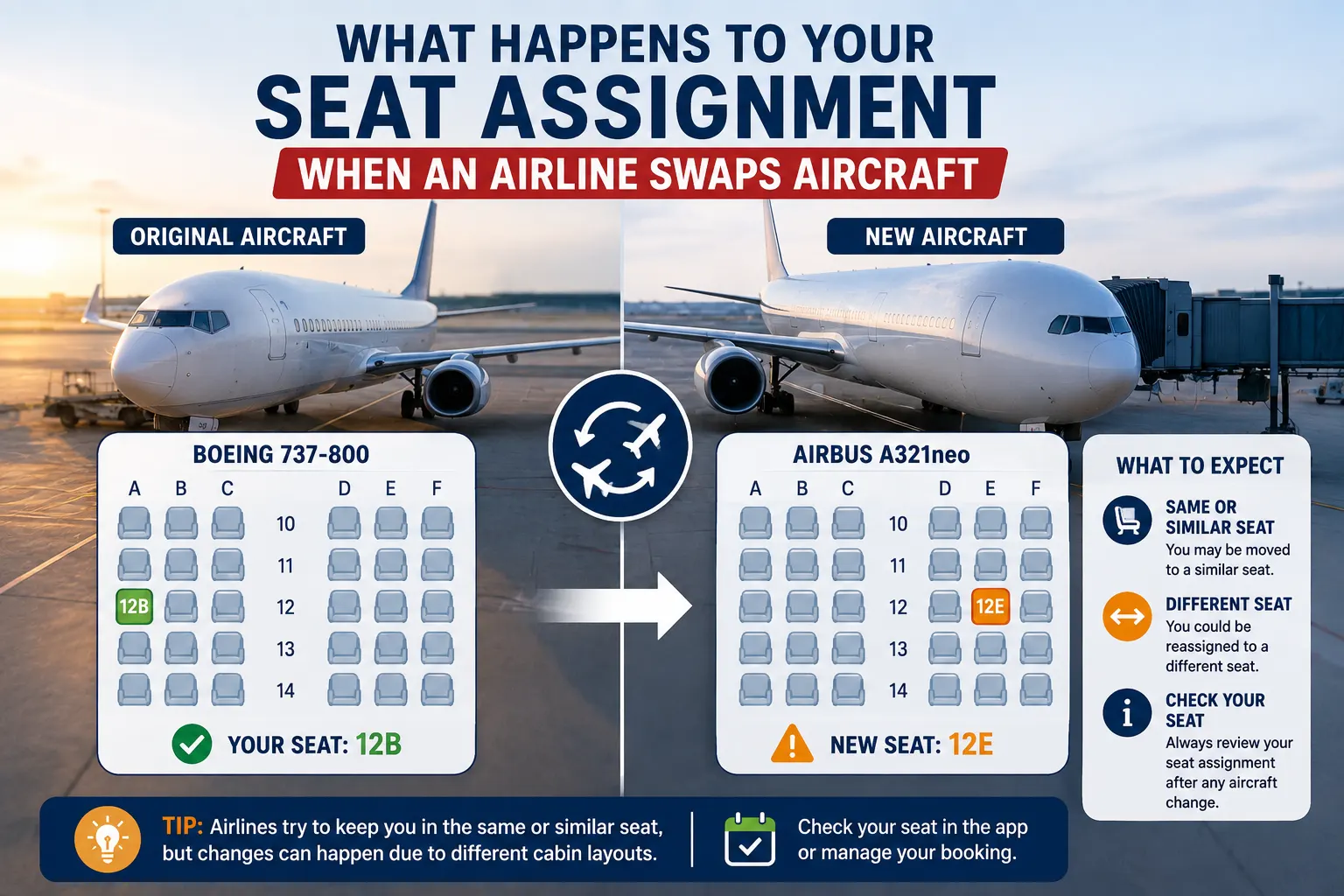
This is the best-case swap. If the airline substitutes a mechanically identical aircraft — same model, same cabin configuration, same number of rows and seat layout — your seat assignment usually survives completely intact. A 737-800 swapped for another 737-800 in the same configuration typically means 14C is still 14C. You may not even notice this type of swap happened unless you’re tracking the specific tail number of your aircraft.
Scenario 2: Different Variant of the Same Family
This is where things start to shift. A Boeing 737-800 has a different cabin layout than a 737-900, which means the exact row and seat on your original confirmation might not exist at all on the replacement aircraft. Airlines frequently operate multiple sub-variants of the same aircraft family with different numbers of rows, different premium cabin sizes, and sometimes different exit row configurations. Your seat number might technically still exist on the new aircraft, but it could be in a completely different part of the cabin than you expected — what was a quiet bulkhead row on one variant might be a middle-of-the-cabin economy row on another.
Scenario 3: Entirely Different Aircraft Type (Downgauge)
If the airline swaps in a genuinely smaller aircraft — say, a widebody replaced with a narrowbody, or a mainline jet replaced with a regional jet — your original cabin might not have enough seats to accommodate everyone who booked it. This is when things get complicated:
- If you had a premium seat (extra legroom, preferred location, upgraded cabin) and the new aircraft has fewer such seats, you may be reassigned to a standard seat, sometimes without advance notice.
- If the new aircraft has a smaller business or first class cabin, some passengers who booked or upgraded into premium may be downgraded to economy entirely — a scenario with much stronger passenger protections, covered below.
- Boarding priority and elite status typically determine who keeps premium seating and who gets bumped down when the numbers don’t add up.
Scenario 4: Entirely Different Aircraft Type (Upgauge)
The reverse can also happen, and it’s the pleasant surprise version. If an airline reseats a passenger in a more premium cabin due to operational needs or an aircraft swap, this is generally considered a positive outcome, and passengers typically aren’t charged extra for the improvement. If a larger aircraft with a bigger premium cabin gets swapped in, airlines sometimes push extra economy passengers up into now-empty premium seats rather than leave them empty, especially for elite frequent flyers.
Scenario 5: Oversold Reassignment Following a Swap
If a downgrade swap means there simply aren’t enough seats in the original cabin class for every ticketed passenger, this can effectively function like an oversold flight, even though it wasn’t oversold in the traditional sense. Oversold flights force reaccommodation — the airline reassigns lower-priority passengers to free up premium seats, typically based on boarding priority or elite status — with the US Department of Transportation’s stronger compensation rules applying specifically to involuntary denial of boarding, not to a same-flight reseating.
Do You Actually “Own” the Seat You Selected?
This is the single most important legal reality for travelers to understand, and it applies almost universally across major carriers: the seat map you see when booking is not a guarantee. It’s a preference, subject to change.
Paid seat assignments are legally provisional — airlines contractually reserve the right to change them without notice during equipment swaps or other operational changes. This applies whether you selected your seat for free as part of your fare or paid an extra fee specifically to lock in a preferred location.
The airline has the exclusive right to change seat assignments as it deems fit, for operational, safety, or security reasons, and aircraft swaps due to maintenance or scheduling are one of the most common triggers.
This right is written into the contract of carriage that every passenger implicitly agrees to when they purchase a ticket — the lengthy legal document almost nobody reads, but which every airline maintains and which governs exactly these scenarios.
Even Paying Extra Doesn’t Change This
A lot of travelers assume that paying a seat selection fee — sometimes $15 to $100+ depending on the route, cabin, and how premium the seat is — creates a binding contractual guarantee that they’ll get that exact seat. It doesn’t. Passengers can pay extra for a window seat, extra legroom, or a specific spot near the front of the plane, only to have the airline swap the seat at the last minute, sometimes with no explanation given.
The one real-world case that illustrates this well: an IT consultant flying Philadelphia to Barcelona had his aircraft — and his seat assignment — changed twice without any notification from the airline. He described carefully choosing an aisle seat near the front of the cabin, only to be re-seated in the last row in a window seat instead. Because the swap happened within the same overall class of service, and the price of his seat assignment was bundled into his premium economy fare, the airline was able to make the change without notifying him and owed him nothing.
That last detail matters enormously: the airline’s obligation to you generally depends on whether the swap changed your class of service, not whether it changed your specific seat. Moving from 3C to 34C is, in most airlines’ eyes, a non-issue as long as you’re still flying in the cabin class you paid for. Moving from business class to economy is a completely different situation with real, enforceable protections.
Your Rights When an Aircraft Swap Causes a Downgrade
This is where the rules diverge sharply depending on where your flight departs from and which regulatory regime applies.
United States (US Department of Transportation Rules)
In North America, if you’re downgraded to a lower class of service, your airline typically must refund the price difference between the ticket you purchased and the lower class you were reassigned to.
This is the core protection US travelers have: a fare-difference refund, not a flat compensation payment. If you paid $1,200 for a business class ticket and end up reseated in economy due to an aircraft swap that reduced the size of the business cabin, you’re generally owed the difference between the business fare and what an equivalent economy fare would have cost — not a punitive payment on top of it.
Critically, this refund right applies to a genuine cabin downgrade (business to economy, economy to basic economy, etc.), not to a same-cabin seat reassignment (aisle to middle, front to back). If a seat is changed involuntarily to a lower class of service, the passenger is typically entitled to a refund for the fare difference — but a same-class reseating, however inconvenient, typically doesn’t trigger this right.
United Kingdom and European Union (UK261 / EU261)
Travelers departing the UK or EU, or flying UK/EU-registered carriers, have meaningfully stronger protections. Passengers downgraded to a lower cabin under UK261 may be entitled to a partial refund of their fare, ranging from 30% to 75% of the affected flight segment, depending on the distance traveled. Importantly, the reason for the downgrade — whether operational or not — does not affect the passenger’s right to reimbursement under these rules.
That last point is a significant difference from the US system. Under UK261/EU261, it doesn’t matter whether the airline swapped the aircraft for a legitimate mechanical reason or simply to optimize revenue — a downgrade is a downgrade, and the compensation percentage kicks in regardless of the cause. The US system, by contrast, generally focuses on refunding the fare difference rather than a flat percentage-based payout.
Comparison Table: Seat Change Scenarios and Your Rights
| Scenario | What Happens | US Rights | UK/EU Rights |
| Same aircraft type swapped (identical layout) | Seat assignment usually unaffected | None needed | None needed |
| Different variant, same cabin class | Seat number/location may change within the same class | Generally none — no cabin downgrade occurred | Generally none — no cabin downgrade occurred |
| Downgrade causes cabin class downgrade (e.g., business to economy) | Fewer premium seats available; some passengers reassigned to lower class | Refund of fare difference between cabins | 30–75% refund of affected segment fare, regardless of cause |
| Upgauge results in upgrade | More premium seats available; some economy passengers moved up | No extra charge; treated as a positive outcome | No extra charge; treated as a positive outcome |
| Seat reassignment functions like an oversold reaccommodation | Passenger reseated within the same cabin, no denial of boarding | Typically no DOT compensation unless boarding is actually denied | Case-by-case; typically no compensation if still on original flight |
| Involuntary denial of boarding due to swap-driven overbooking | Passenger bumped from the flight entirely | $100–$675+ (US) depending on delay length, plus rebooking, under DOT rules | Fixed compensation under UK261/EU261 depending on distance and delay |
(US DOT denied boarding compensation figures are illustrative ranges and vary based on the length of delay caused and the specific circumstances — always confirm current figures with the DOT or your airline at the time of travel.)
The Southwest Case Study: A Whole Airline’s Seating Model Just Changed
No discussion of aircraft swaps and seat assignments in 2026 is complete without addressing Southwest Airlines, because the entire foundation of how the airline handles seating changed this year.
Beginning January 27, 2026, Southwest Airlines moved to an assigned seating model, ending more than five decades of open seating in favor of pre-purchased, assigned seats. Southwest executives framed the change around giving customers more choice and control, including the ability to select Extra Legroom seats and remove the uncertainty of not knowing where they’d sit in the cabin. Passengers can now choose between three seating tiers — “Standard” seats toward the back, “Preferred” seats nearer the front, and “Extra Legroom” seats near the exit rows offering roughly 3 to 5 inches of additional legroom — with the tier purchased also determining boarding order and other perks.
This is a massive shift for a carrier that built its entire brand identity around open seating and boarding groups. And it means Southwest is now subject to the same aircraft-swap seat volatility that every other major carrier has dealt with for years — with one additional wrinkle unique to its rollout: the transition also introduced weight and balance restrictions that limit post-boarding seat swaps, a significant shift for travelers who were used to Southwest’s historically flexible seating culture.
In practical terms, this means Southwest passengers in 2026 need to start thinking about aircraft swaps the same way American, Delta, and United passengers have for years — the seat you select at booking is not guaranteed if your aircraft changes before departure.
Why Airline Algorithms Make This Worse Than You’d Expect
It’s not just that aircraft swaps happen — it’s that the systems airlines use to manage seat inventory are constantly re-optimizing in the background, even without a swap. Airlines run seat assignment algorithms that continuously re-optimize the cabin based on revenue targets, loyalty priorities, and operational constraints.
This means your seat assignment isn’t just vulnerable at the moment of an aircraft swap — it can shift multiple times between booking and departure as the algorithm rebalances the cabin to accommodate elite upgrades, family seating requests, special assistance needs, and last-minute premium seat purchases from other passengers, entirely independent of whether the physical aircraft ever changes.
Special needs accommodations take priority in the reshuffling process — for example, if a passenger connecting from an earlier flight requires a wheelchair-accessible aisle seat, another passenger already assigned to that seat may be moved to accommodate them.
The upshot: even a “normal” flight with no aircraft swap at all can result in your seat changing overnight. An actual equipment change just makes a bad situation for seat stability worse, because it often forces a wholesale re-mapping of the entire cabin at once.
How to Protect Your Seat Assignment Before It’s Swapped Out From Under You
While you can never fully eliminate the risk of an aircraft swap disrupting your seat, there are concrete steps that meaningfully reduce your exposure.
Check your booking status regularly in the days leading up to your flight. Regularly checking your seat assignment status on the airline’s website or app means the sooner you spot a change, the sooner you can try to address it. Don’t wait until you’re at the airport to look — check the night before and again the morning of departure.
Research the specific aircraft types your airline flies on your route before booking. Understanding the different aircraft types an airline uses on a given route, before booking or selecting seats, can help travelers anticipate potential configuration issues in advance. Sites that track scheduled equipment by flight number can show you whether your route is historically prone to swaps between different aircraft variants.
Favor flights that are less likely to see operational adjustments. Flights with less popular departure or arrival times, or on less busy days, tend to be less prone to significant aircraft swaps or operational adjustments — though this isn’t a guarantee, since mechanical issues can strike any flight regardless of how full or popular it is.
Book routes flown with an airline’s larger, newer aircraft when possible. Flying routes operated with an airline’s largest, newest aircraft can reduce exposure to the kind of downgauge swaps that shrink premium cabins and force reseating.
Hold elite status or loyalty tier priority where possible. When a swap forces a reduction in premium seating, airlines almost universally protect their highest-tier frequent flyers first. If you fly a particular airline regularly, building status can meaningfully insulate you from being the passenger who gets bumped out of a paid seat.
Consider a tool or service that reapplies your seat preferences automatically. Some travel management platforms and third-party tools now monitor bookings and automatically attempt to reapply a traveler’s preferred seat type if a swap disrupts the original assignment — useful for frequent travelers who don’t want to manually recheck every booking.
What to Do If Your Seat Gets Changed
If you discover your seat assignment has changed due to an aircraft swap, here’s the practical order of operations:
- Confirm what actually changed. Is it just a different seat number within the same cabin class, or has your cabin class itself changed? This distinction determines what, if any, compensation you’re owed.
- Check your original fare and seat purchase receipt. If you paid specifically for a seat (not just a fare that included seat selection), keep that receipt — you’ll need it if you end up requesting a refund for a seat feature you no longer received.
- Contact the airline before departure if possible, not after. Airlines have more flexibility to fix a seating issue — reassign you to a comparable seat, offer alternatives — before the flight departs than after you’ve already flown. Use the app first, since app-based rebooking and reseating options are often faster to access than a customer service line during high-volume disruption periods.
- If you were downgraded to a lower class of service, request the fare-difference refund explicitly. Don’t assume the airline will proactively issue it — in many cases, passengers have to actively request it through customer relations or a refund claim form.
- If you’re a UK/EU departure and downgraded, cite UK261/EU261 directly. Because compensation is owed regardless of cause under these rules, you don’t need to prove the airline was at fault — only that a downgrade occurred.
- If your seat was changed but you remained in the same cabin class, don’t expect automatic compensation — but it’s still worth asking. Some airlines will offer a partial refund of a seat selection fee as a goodwill gesture even when they’re not obligated to, particularly if you paid a premium fee for a very specific seat feature (extra legroom, bulkhead, exit row) that you no longer received.
- If the swap results in an involuntary denial of boarding (you’re bumped from the flight entirely), that’s a different and stronger protection. If you’re involuntarily denied boarding due to an oversold situation, you’re entitled to compensation ranging from roughly $100 to $400 or more depending on the length of the resulting delay, plus rebooking — but a same-flight seat reassignment where you still fly on the original aircraft does not trigger this rule.
FAQ
Can an airline change my seat without telling me? Yes. Some seat reassignments come with no explanation from the airline at all, and there’s generally no legal requirement in the US for the airline to proactively notify you before departure, though many will show the change reflected in your booking or send an automated notification depending on the carrier.
If I paid extra for a seat and it gets changed, do I get a refund? It depends on what changed. If you remained in the same cabin class but lost your specific seat (aisle became middle, front became back), most airlines are not obligated to refund your seat fee, though some will do so as a courtesy if you ask. If the seat feature you paid for (extra legroom, bulkhead) genuinely disappeared due to the swap, it’s worth formally requesting a refund of that specific fee.
What’s the difference between a seat change and a downgrade? A seat change moves you to a different seat within the same class of service you booked. A downgrade moves you into a lower class of service entirely (business to economy, for example). Downgrades carry much stronger, more clearly defined passenger protections than same-class seat changes.
Does travel insurance cover seat downgrades from aircraft swaps? Standard travel insurance policies typically don’t address seat assignment changes directly, since this isn’t a trip cancellation or interruption in the traditional sense. Your recourse for a downgrade comes primarily from the airline’s own policies and applicable passenger rights regulations (DOT in the US, UK261/EU261 in the UK and EU) rather than from third-party insurance.
Will an aircraft swap ever result in a better seat? Yes, this happens regularly. If an airline swaps in a larger aircraft and reseats a passenger into a more premium cabin as a result, this is typically treated as a positive outcome with no extra charge to the passenger. Elite frequent flyers are often the first to benefit when a swap creates extra premium capacity.
Is Southwest’s new assigned seating model more or less vulnerable to aircraft swap disruption than legacy carriers? It’s early in the new model’s life, but the underlying vulnerability is structurally similar to legacy carriers now that Southwest assigns seats at all. The rollout of assigned seating on Southwest introduced new weight and balance restrictions that specifically limit post-boarding seat swaps, which may make it somewhat harder for Southwest passengers to informally resolve a seating issue once they’re already on the aircraft, compared to the flexibility the airline was known for under open seating.
Can I get compensated if my seat change ruins a trip I was taking with family or a companion? There’s no standard airline compensation specifically for separated seating caused by a swap, though most airlines will make a genuine effort to keep families and companions together during reseating, especially if a minor is involved. If keeping your party together is essential, it’s worth calling the airline directly as soon as you notice a seat change rather than waiting until check-in.
In another related article, Summer Thunderstorm Season: Which Airline Hubs See the Most Weather Delays