


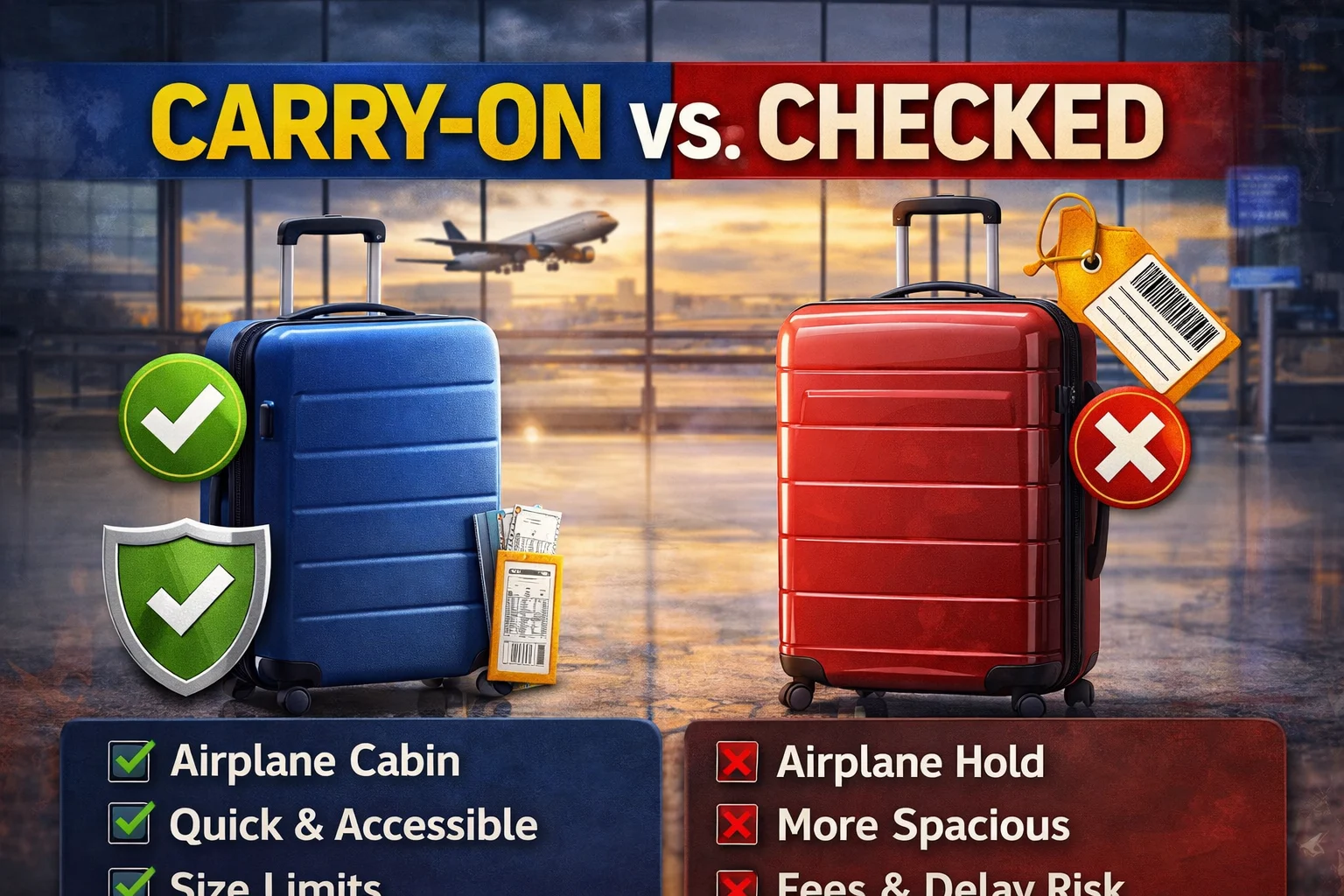
The Ultimate Guide for Modern Air Travellers
Whether you’re a seasoned frequent flyer or planning your first international trip, one question never gets old: should you pack a carry-on or check your baggage? In 2026, this decision carries more weight than ever before. Rising airline fees, tightening security rules, smarter packing technology, and a post-pandemic shift in travel behaviour have all changed the equation significantly.
This comprehensive guide breaks down every angle of the carry-on vs checked baggage debate so you can make the smartest decision for your next trip — and every trip after that.
Why This Decision Matters More Than Ever in 2026
A decade ago, most airlines included at least one free checked bag as standard. Today, that’s increasingly rare outside of long-haul international routes and premium cabin tickets. Budget carriers like Spirit, Frontier, Ryanair, and their global equivalents have turned baggage fees into a major revenue stream — and full-service airlines have followed suit.
In 2026, the average checked bag fee on a domestic U.S. flight has climbed to between $35 and $75 per bag, per direction. On a round trip with two bags, that’s potentially $300 in fees alone — before you even board the plane. Globally, the story is similar. European low-cost carriers, Southeast Asian budget airlines, and African regional carriers have all adopted aggressive ancillary fee structures.
At the same time, airports are smarter and busier. Biometric check-in, automated bag drops, and faster security lanes have changed how travellers move through terminals. Understanding how these systems interact with your baggage choice can save you significant time and money.
Understanding the Basics: What’s the Difference?
Before diving into the pros and cons, let’s clarify the definitions:
Carry-On Baggage refers to luggage small enough to fit in the overhead bin or under the seat in front of you. Typical size limits are around 22 x 14 x 9 inches (56 x 36 x 23 cm), though this varies by airline. Most airlines allow one carry-on and one personal item (like a backpack or handbag) for free — though even this is changing on some ultra-low-cost carriers.
Checked Baggage refers to larger bags that are handed over at the check-in counter, tagged, and loaded into the aircraft’s cargo hold. Standard weight limits are typically 23kg (50 lbs) for economy class, with oversized or overweight fees applying beyond that threshold.
The right choice between the two depends on a combination of factors: your trip length, airline policy, budget, physical ability, travel style, and destination.
The Case for Carry-On Only: Why It’s the Top Choice for Many Travellers
1. You Save Serious Money
This is the number one reason most travellers choose carry-on in 2026. Checked baggage fees have become a hidden cost of air travel. If you’re flying on a budget carrier — especially on multiple legs — those fees stack up fast.
Consider a family of four flying a round trip. If each person checks one bag at $45 each way, that’s $360 in baggage fees for one trip. Over a year of moderate travel, carry-on-only travellers can easily save $500 to $1,000 or more.
2. You Gain Speed and Efficiency
With carry-on only, your airport experience becomes dramatically faster:
- No waiting in check-in lines (use mobile boarding passes and go straight to security)
- No bag drop queues
- No waiting at baggage claim upon arrival, which can take anywhere from 20 minutes to over an hour on busy routes
- No risk of missed connections due to delayed bag transfers
In 2026, with biometric fast lanes and automated security in many major airports, a carry-on traveller can go from airport entrance to gate in under 20 minutes at well-run terminals. That kind of efficiency is invaluable, especially for business travellers or those on tight itineraries.
3. Your Bag Never Gets Lost
Airline baggage mishandling remains a real problem. While technology has improved tracking significantly, bags still get delayed, misdirected, or damaged. The global baggage mishandling rate sits at roughly 6–7 bags per 1,000 passengers, which sounds small until it happens to you. With a carry-on, your bag is always with you. Full stop.
4. You’re Forced to Pack Smarter
The discipline of carry-on travel makes you a better packer. When you know you only have limited space, you naturally cut out the unnecessary items, pack versatile clothing, and rely on doing laundry if needed. Many seasoned travellers swear this makes their trips more enjoyable — less to carry, less to worry about, less decision fatigue each morning.
5. Flexibility at Your Destination
With a carry-on, you can hop in a taxi, take public transport, or walk to your hotel without wrestling with a heavy suitcase. This is especially valuable in cities with cobblestone streets, limited elevator access, or busy public transit systems.
The Challenges of Carry-On Travel
To be fair, carry-on-only travel isn’t perfect. Here are the honest downsides:
Overhead bin wars are real. As more travellers go carry-on only, overhead bin space has become prime real estate. Airlines now sometimes gate-check bags when bins are full — meaning you end up checking your bag anyway, often for free but with the inconvenience of waiting at the jetway upon arrival.
Liquid restrictions are still a pain. The 100ml / 3.4 oz liquid rule remains in force across most global airports in 2026, though some airports in Europe and Asia have piloted CT scanner technology that allows larger liquids. If you rely on specific toiletries, medications, or skincare products, this can be genuinely frustrating.
Size restrictions vary wildly. An overhead bin carry-on that’s perfectly legal on one airline may be rejected or charged a fee on another. This is especially tricky on codeshare flights or when booking multi-airline itineraries. Always check the specific baggage policy for every carrier on your route.
Not practical for long trips. Packing for three weeks in multiple climates, or travelling with formal wear, sports gear, or special equipment, is genuinely difficult in a carry-on. For longer trips, the checked bag often wins.
Physical demands. Lifting a carry-on into an overhead bin can be physically challenging, especially for elderly travellers, those with shoulder or back injuries, or parents juggling children and luggage simultaneously.
The Case for Checked Baggage: When Bigger Really Is Better
1. You Can Pack Everything You Need
This is the irreplaceable advantage of checked baggage. Whether you’re going on a two-week beach holiday, a ski trip, a business conference, or a family vacation with children, a checked bag gives you the freedom to bring exactly what you need without compromise.
No agonizing over whether to bring that second pair of shoes. No decanting shampoo into tiny bottles. No washing clothes in hotel sinks. Just pack and go.
2. Ideal for Families and Group Travel
Travelling with children is dramatically easier with checked baggage. Nappies, strollers, car seats, travel cots, toys, medicines, extra clothing — the logistics of family travel almost demand checked bags. Many airlines also offer free or discounted checked bags for children, making it even more economical for families.
3. Easier for Special Equipment
Golfers, skiers, surfers, cyclists, musicians, and photographers all have specialized gear that simply cannot be condensed into a carry-on. While checked bag fees for oversized or sports equipment can be steep, they are often unavoidable and worthwhile.
4. Less Physical Strain During Travel
A checked bag is handed off at the counter and doesn’t require you to lift, manoeuvre, or manage it until you arrive at your destination. For travellers with mobility issues, chronic pain, or fatigue, this can make a genuine quality-of-life difference during what can already be a physically demanding journey.
5. Better for Longer International Routes
On long-haul international flights — particularly those booked with major carriers like Emirates, Singapore Airlines, Qatar Airways, British Airways, or Air France — checked baggage is often included in the ticket price in economy class. On these routes, the cost-benefit calculation shifts significantly in favour of checking your bag.
6. You Can Bring Prohibited Carry-On Items
Certain items are prohibited in carry-on baggage but perfectly legal in checked bags: full-size toiletries, sharp objects like scissors and razors, certain sporting equipment, and, in some jurisdictions, alcohol purchases. If your trip requires any of these items, checked baggage is the only option.
The Challenges of Checked Baggage
Cost is the elephant in the room. On many routes in 2026, the checked bag fee can equal or exceed a significant portion of the base ticket price, especially on short-haul budget flights.
Time loss is real. Between check-in queues, bag drop, and post-flight baggage claim, checked bag travellers can easily spend an extra hour or more per trip compared to carry-on-only travellers. Over the course of a year of regular travel, that adds up to significant lost time.
Damage and loss risk. Checked bags get thrown around by baggage handlers, sit in cargo holds exposed to temperature extremes, and occasionally go missing. Valuable, fragile, or sentimental items should never go in a checked bag unless necessary.
Less flexibility on arrival. Waiting at baggage claim ties you to the airport longer and removes your ability to move quickly upon arrival. On tight schedules, this can create stress and logistical complications.
Carry-On vs Checked Baggage: A Side-by-Side Comparison
| Factor | Carry-On | Checked Bag |
| Cost | Usually free | $35–$75+ per bag |
| Speed | Fastest airport experience | Adds 30–90 minutes |
| Packing capacity | Limited | Large and flexible |
| Loss/damage risk | None | Low but present |
| Liquid restrictions | Yes (100ml rule) | No restrictions |
| Best for short trips | ✅ Ideal | ❌ Overkill |
| Best for long trips | ❌ Challenging | ✅ Ideal |
| Family travel | ❌ Difficult | ✅ Much easier |
| Business travel | ✅ Efficient | Sometimes needed |
| Sports/special gear | ❌ Not feasible | ✅ Necessary |
The 2026 Airline Policy Landscape: What’s Changed?
Several significant shifts in airline baggage policy have taken place in recent years that every traveller should know about:
Ultra-low-cost carriers are charging for carry-ons. In 2026, a growing number of budget airlines now charge for overhead bin carry-ons in addition to checked bags. Spirit Airlines, Wizz Air, and Ryanair all offer base fares that only include a small personal item under the seat. If you want the overhead bin, you pay extra. This fundamentally changes the cost comparison.
Dynamic pricing on baggage fees. Like airfares themselves, baggage fees are increasingly subject to dynamic pricing — meaning the fee you pay depends on when you add the bag to your booking. Adding a checked bag at the airport is almost always more expensive than adding it during online check-in, which is more expensive than adding it at the time of booking. Always pre-purchase your baggage allowance.
Airline credit cards and status remain powerful. For frequent flyers, airline-branded credit cards and elite status tiers continue to offer free checked baggage as a core benefit. If you fly frequently with one airline, the right credit card can effectively eliminate your baggage costs.
Technology improvements in baggage tracking. Most major airlines now offer real-time baggage tracking through their apps, using RFID tags or barcode scanning throughout the handling process. This has reduced anxiety around checked bags and improved recovery rates when bags are mishandled.
Smart Strategies for Every Type of Traveller
The Business Traveller
Carry-on only is almost always the right call. Speed is paramount, trips are typically short (2–5 days), and packing light in a quality carry-on with wrinkle-resistant clothing is entirely achievable. Invest in a premium carry-on from brands like Away, Rimowa, or Travelpro and learn to pack efficiently.
The Leisure Traveller (1 Week)
For a one-week holiday, carry-on is feasible with careful planning. Pack versatile, mix-and-match clothing in neutral colours, use packing cubes, and plan to do one load of laundry mid-trip if needed. If you’re going somewhere hot, fewer clothes are needed anyway.
The Long-Haul Traveller (2+ Weeks)
For trips of two weeks or more, a checked bag becomes increasingly justified — especially on international routes where it may be included in your fare. Don’t torture yourself trying to pack two weeks of clothing into a carry-on. Your time and energy are better spent elsewhere.
The Family Traveller
Check your bags. Full stop. The logistical and physical demands of travelling with children make carry-on-only travel impractical for most families. Look for airlines with generous family baggage policies and consider hard-shell suitcases that can take a beating.
The Adventure/Sports Traveller
Check your bags and factor the equipment fees into your trip budget from the start. Many airlines have specific policies for sports equipment (golf bags, ski equipment, surfboards, bicycles), and third-party baggage shipping services like DUFL or sports-specific luggage carriers can sometimes offer better value.
Pro Tips for Both Options
For carry-on travellers:
- Always check the specific size and weight limits for every airline on a multi-carrier itinerary
- Board as early as possible to secure overhead bin space
- Use packing cubes to maximize space and organization
- Wear your heaviest or bulkiest items on the plane
- Keep a portable luggage scale to avoid surprises at the gate
For checked bag travellers:
- Always add your baggage at the time of booking — never at the airport
- Use a luggage tracker (like an Apple AirTag or Tile) inside your bag
- Never pack valuables, medications, or essential documents in checked bags
- Photograph your bag’s contents before travel for insurance purposes
- Use a distinctive luggage tag or coloured strap to identify your bag at the carousel quickly
The Verdict: Which Is Better in 2026?
The honest answer is: it depends entirely on your specific trip and travel style. But here’s a practical decision framework:
Choose carry-on if:
- Your trip is 7 days or fewer
- You’re flying on a budget carrier or a route without free checked bags
- Speed and efficiency are priorities
- You’re travelling alone or as a couple
- You’re a frequent business traveller
Choose checked baggage if:
- Your trip is longer than 10 days
- You’re travelling with children or as a large group
- Your ticket includes free checked baggage
- You have special equipment or are going somewhere with extreme weather
- You have physical limitations that make managing overhead luggage difficult
For many travellers, the ideal answer in 2026 isn’t choosing one or the other — it’s mastering both. Know when each approach serves you best, build a versatile travel wardrobe that works across multiple trip types, and always book your baggage in advance to avoid inflated gate fees.
The modern traveller who wins at air travel is not the one who always checks a bag or always travels carry-on only. It’s the one who makes a strategic, informed decision every single time — and that starts with exactly the kind of thinking this article has laid out.
Final Thoughts
In 2026, the carry-on vs checked baggage debate is more nuanced than ever. Airlines have restructured their fee models, airports have evolved, and smart travellers have adapted. The key takeaway is this: your baggage strategy should be as deliberate as your flight booking strategy. Factor in fees from the moment you search for tickets, pack with intention, and let the nature of your trip guide your choice.
Travel lighter when you can. Pack what you truly need when you must. And never, ever add that extra bag at the airport gate.
In another related article, What to Do About Lost Luggage & Broken Suitcases