



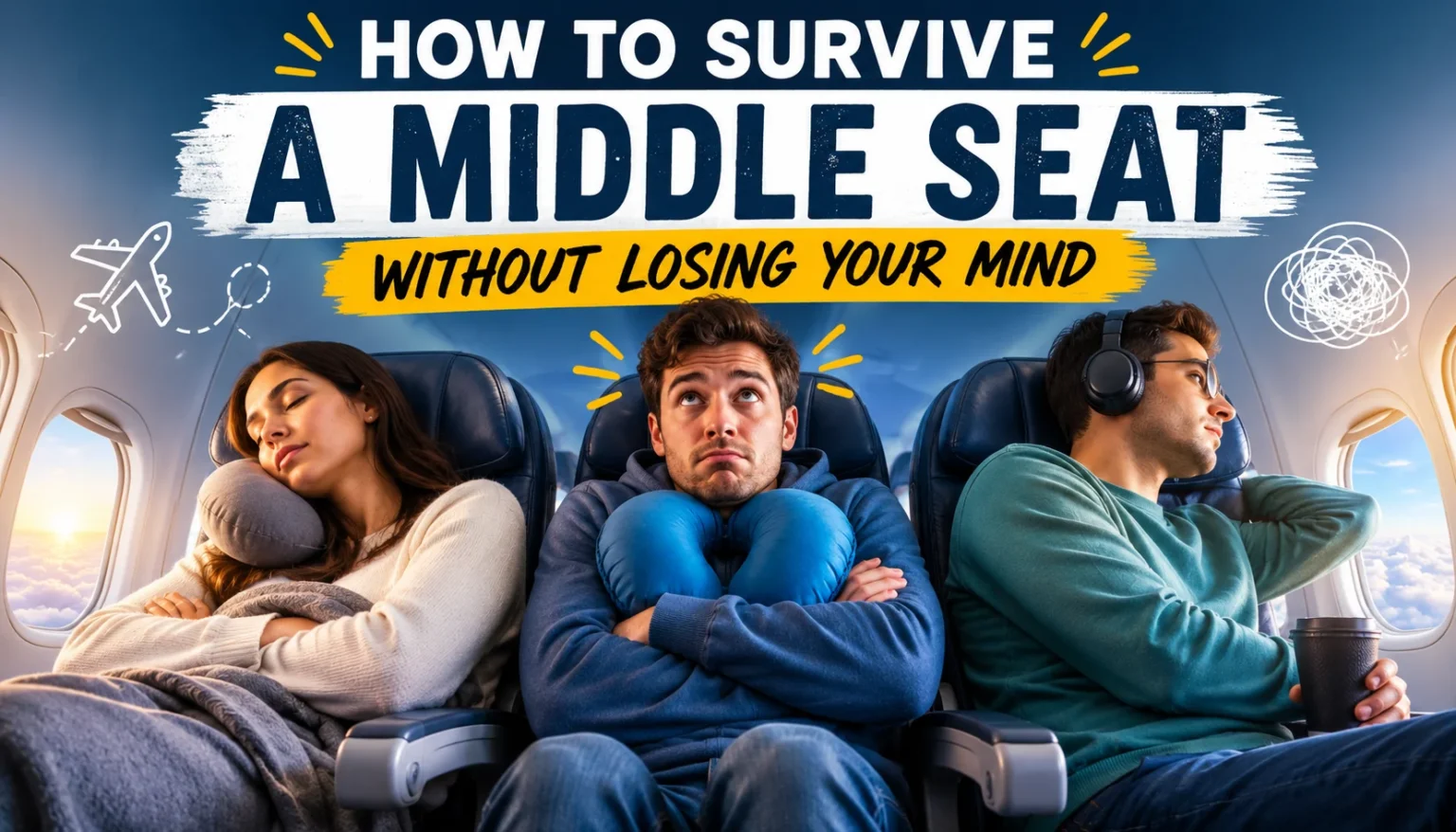
The Middle Seat: Aviation’s Most Universally Despised Spot
There’s a particular kind of dread that washes over a traveler when they open their boarding pass and see it — Row 24, Seat B. The middle seat. Flanked on both sides by strangers, no window to gaze out of, no aisle to stretch into, and an armrest situation that can only be described as a cold war waiting to happen.
You didn’t choose this. Maybe you booked late. Maybe the airline changed your seat during a rebooking. Maybe you were flying on a budget ticket that offered no seat selection. Whatever the reason, you’re here now — sandwiched between two strangers for the next two, five, or heaven forbid, fourteen hours.
But here’s something the travel industry rarely tells you: the middle seat doesn’t have to be a miserable experience. With the right mindset, the right gear, and the right strategies, you can not only survive the middle seat — you can arrive at your destination feeling surprisingly okay about the whole thing.
This guide covers everything you need to know about conquering the middle seat, from pre-flight preparation and gear selection to in-flight psychology, body positioning, and the little-known etiquette rules that can make the whole experience far more civilized for everyone involved.
Why the Middle Seat Feels So Bad (It’s Not Just in Your Head)
Before diving into solutions, it’s worth understanding exactly why the middle seat is so psychologically and physically taxing. This isn’t just a matter of preference — there are real, documented reasons the middle seat is harder on the body and mind.
You Have No Control Over Your Personal Space
Humans are territorial creatures. Research in environmental psychology consistently shows that perceived control over personal space is directly linked to stress levels. In the middle seat, you are surrounded on both sides, with no wall, window, or open aisle to create even a psychological boundary. You are, quite literally, boxed in — and your nervous system knows it.
The Armrest Problem Is Physically Real
Most economy seats are designed with armrests that are shared between two passengers. The middle seat passenger is the only person on the plane sharing armrests on both sides simultaneously. This isn’t just uncomfortable — it forces the middle seat occupant into an unnaturally narrow posture that compresses the shoulders, restricts breathing, and creates tension in the neck and upper back over time.
You’re More Likely to Be Disturbed
Window seat passengers occasionally need to get up, and when they do, they have to pass the middle seat. Aisle passengers stretch, shift, and are bumped by carts — and that movement bleeds into the middle seat. You are essentially at the geographic crossroads of all cabin disturbance.
Psychological Confinement Amplifies Everything
Noise seems louder. Smells seem stronger. Time seems slower. This is partly a function of anxiety and partly a function of your reduced ability to look away — literally. You can’t stare out a window, you can’t easily look down the aisle, and you’re face-to-face with the seat back in front of you. The visual confinement of the middle seat amplifies every other discomfort.
Understanding these dynamics is the first step toward dismantling them. Once you know why the middle seat is hard, you can begin to counter each factor systematically.
Before You Even Get to the Airport: Strategic Pre-Flight Moves
Surviving the middle seat well, actually, begins days before your flight. Your pre-flight decisions can dramatically change the quality of your experience.
1. Keep Checking for Seat Changes
If you’ve been assigned a middle seat and you’d rather not be there, don’t accept it as final. Airlines release held and blocked seats anywhere from 24 to 72 hours before departure. Set a reminder to check the seat map every day leading up to your flight, and again during online check-in (which typically opens 24 hours before departure). Aisle and window seats that were previously unavailable often open up during this window.
Some airlines, including Delta and United, allow free seat changes within the same cabin class. Others charge for preferred seats but release them for free at check-in. It’s always worth checking.
2. Use Seat Tracking Tools
Websites like SeatGuru, ExpertFlyer, and Google Flights allow you to monitor seat availability in real time. Some even send alerts when specific seats become available. If an aisle or window seat opens up, you’ll know immediately.
3. Arrive at the Gate Early — and Ask
Gate agents have more power than most passengers realize. If the flight isn’t full, they can often reassign seats — especially for passengers who ask politely and early. Simply approaching the gate desk and saying, “I’m in the middle seat — if there’s any flexibility, I’d really appreciate a swap,” costs nothing and occasionally works.
4. Pack Smart for Middle Seat Survival
What you bring on board matters enormously. The middle seat calls for a more curated carry-on strategy than other seats. Every item you pull out in-flight means negotiating with limited space, so bring what matters and leave the rest.
Key items to have accessible at boarding:
- Noise-canceling headphones (this is non-negotiable — more on this shortly)
- A neck pillow designed for upright sleeping
- A light, compact blanket or wrap
- Your entertainment device, fully loaded offline
- Snacks that don’t require two hands or create strong smells
- A small personal item bag that fits entirely under the seat in front of you
Keeping your bag under the seat rather than in the overhead bin means you can access items without disturbing seatmates — a small but meaningful quality-of-life upgrade.
The Gear That Actually Makes a Difference
Not all travel gear is created equal, and the middle seat is where the quality of your equipment is most directly tested. Here are the items that genuinely move the needle.
Noise-Canceling Headphones: The Single Most Impactful Investment
If there is one piece of technology that transforms the middle seat experience more than any other, it’s active noise-canceling (ANC) headphones. The constant low-frequency drone of aircraft engines — typically hovering around 85 decibels — is one of the primary sources of fatigue and irritability on long flights. ANC headphones reduce this ambient noise by 20 to 30 decibels, which doesn’t just make your music or movie clearer — it physically reduces the mental load your brain is carrying.
The Sony WH-1000XM5 and Bose QuietComfort Ultra are widely regarded as the top performers for air travel. Over-ear models provide better noise cancellation than in-ear options for the low-frequency engine hum specifically. If budget is a concern, the Anker Soundcore Q45 delivers solid ANC performance at a fraction of the flagship price.
Even if you don’t listen to anything, wearing noise-canceling headphones with no audio playing is a legitimately effective way to reduce cabin stress.
A Proper Neck Pillow — Not the Cheap Inflatable Kind
The $8 inflatable horseshoe pillow you bought at the airport newsstand is doing more harm than good. It positions your head too far forward, strains your cervical spine, and provides negligible support during real sleep. In the middle seat — where you can’t lean against a wall — proper neck support becomes even more critical.
Look for memory foam neck pillows that support the head from both sides and slightly tilt the chin downward. Brands like Trtl, Cabeau, and bcozzy design pillows specifically for upright sleeping with no side support. These allow you to genuinely rest in the middle seat without waking up with neck pain.
Compression Socks
Deep vein thrombosis (DVT) risk increases significantly on flights over four hours, and the middle seat compounds this because you’re least likely to get up and walk the cabin. Compression socks — specifically graduated compression at 15–20 mmHg — improve circulation in the lower legs and significantly reduce swelling and discomfort. They are also genuinely protective against clot risk. Brands like Sockwell, Comrad, and CEP make options that look like regular socks and feel comfortable for the duration of even a long-haul flight.
A Lumbar Support Cushion
Economy seats are designed around an average body that doesn’t match most actual bodies. The lower back support in most economy seats is either absent or positioned incorrectly. A small inflatable lumbar cushion placed in the curve of your lower back maintains the natural S-curve of your spine, reducing back pain significantly over a long flight. This is especially important in the middle seat, where you’re less likely to shift freely.
An Eye Mask That Actually Blocks Light
The middle seat offers no dark corner to retreat to — cabin lights, screen glow from seatmates, and aisle activity all reach you. A contoured sleep mask (one that doesn’t press directly on your eyelids) blocks light while allowing your eyes to move naturally, which improves sleep quality considerably. The Alaska Bear and Manta Sleep Mask are popular options among frequent flyers.
The Armrest Situation: What the Rules Actually Say
Let’s address the most contentious social dynamic in economy class directly: who gets the armrests?
The informal but widely accepted rule among flight attendants, aviation etiquette experts, and frequent flyer communities is this: the middle seat passenger gets both armrests. The reasoning is simple and fair — the window seat passenger has a wall to lean against, and the aisle seat passenger has open space on one side. The middle seat passenger has neither advantage, so the armrests are their compensation.
This is acknowledged by multiple airline etiquette guides and has been the subject of surveys showing that the majority of travelers — including window and aisle seat passengers — agree with this convention.
How to Claim the Armrests Without Conflict
Knowing the rule is one thing. Exercising it gracefully is another. Here’s how to approach it:
Board early or on time. The first person to settle into a seat tends to establish armrest position before others sit down. If you’re in the middle seat and you settle in first, placing your arms comfortably on both rests before your neighbors arrive establishes your position naturally and without awkwardness.
Be the first to make contact. Once seated, gently position both forearms on the armrests. Don’t make it a dramatic claim — just settle naturally. Most seatmates will adjust without comment.
If the armrest is already taken, you can still negotiate. A simple, friendly “Would you mind if we shared the armrest?” goes a long way. Most people respond positively to direct, polite communication and aren’t even aware they’ve encroached.
Use the lower half of the armrest. If sharing becomes necessary, there’s an unspoken but effective division: the person who arrived first uses the forward portion near the tray table, and the second person uses the rear portion. It’s not perfect, but it creates a workable arrangement.
Body Positioning: How to Sit in the Middle Seat
How you hold your body during a flight has a significant impact on how you feel when you land. The middle seat creates specific postural challenges that intentional positioning can address.
The Slight Forward Lean
Rather than pressing back completely against the seat (which compresses lumbar discs over time) or hunching forward (which strains the thoracic spine), try a slight forward lean with your lumbar cushion engaged. This distributes weight more evenly across your sit bones and reduces spinal compression.
Feet Flat or Slightly Elevated
Keep your feet flat on the floor rather than crossed at the ankle or tucked under the seat. Crossing legs reduces circulation and increases DVT risk. If you’re petite and your feet don’t reach comfortably, a small inflatable footrest can be placed under the seat in front of you.
Shoulder Position
One of the middle seat’s biggest physical complaints is the forced inward-shoulder posture caused by tight quarters. Periodically roll your shoulders back and down — away from your ears — and take a deep breath to open the chest. Set a reminder on your phone or watch to do this every 45 minutes.
Strategic Leaning
When sleeping, lean slightly toward your dominant side — typically toward whichever neighbor you feel most comfortable with (or toward whichever side has more space). A slight lean is far better than a stiff upright position. If you’re traveling with someone seated next to you, this becomes even easier.
Managing the Psychology of the Middle Seat
Much of the misery of the middle seat is psychological — and that means it’s genuinely addressable with the right mental strategies.
Reframe the Time
One of the most effective cognitive techniques for uncomfortable situations is reframing the time as protected and productive, rather than suffering to be endured. A four-hour middle seat flight is four hours where no one can call you, email you, or knock on your door. It’s four hours with no obligations other than sitting there.
Some of the most prolific readers, writers, and thinkers use flights — even uncomfortable ones — as their most focused creative time precisely because of the forced disconnection. Bring a book you’ve been meaning to read. Start the writing project you’ve been putting off. Use the discomfort as a signal to go inward rather than outward.
The “Stranger Bubble” Technique
In the middle seat, you are in unusually close physical proximity to two strangers. This creates low-level social anxiety for many people — the hyperawareness of every elbow, every movement, every sound. The stranger bubble technique involves a conscious mental act: you acknowledge the strangers’ presence, wish them well internally (“I hope they have a good flight”), and then mentally release them from your awareness. They become a neutral background rather than a source of friction.
This sounds almost too simple, but it is rooted in solid mindfulness practice. The anxiety generated by strangers in proximity is almost entirely anticipatory — it’s the possibility of conflict or discomfort, not actual conflict. Naming and releasing that anticipation removes most of its power.
The 20-Minute Reset
Long flights in the middle seat feel longest when you’re tracking every minute. Instead of thinking about how much time remains, divide the flight into 20-minute blocks. Commit to one thing for the next 20 minutes — a chapter, an episode, a playlist, a nap attempt. When the 20 minutes end, reassess. This micro-chunking of time makes even the longest flight feel manageable.
Controlled Breathing for Anxiety
If you feel the walls closing in — particularly on crowded or turbulent flights — controlled breathing is a clinically effective intervention for acute anxiety. The 4-7-8 method (inhale for 4 counts, hold for 7, exhale for 8) activates the parasympathetic nervous system and produces measurable calm within a few minutes. Box breathing (4 counts in, 4 hold, 4 out, 4 hold) is equally effective and slightly easier to remember.
These techniques work. They are used by fighter pilots, surgeons, and elite athletes to manage acute stress. They will work in Row 24B.
Middle Seat Etiquette: Being a Good Neighbor
Surviving the middle seat isn’t just about your own comfort — it’s also about the dynamic you create with the people around you. A middle seat passenger who is considerate and communicative has a dramatically different experience than one who is tense and territorial.
Introduce Yourself Briefly
You don’t need to make a new best friend. But a simple “Hey, long flight — hope you’re comfortable” as everyone settles in does something remarkable: it humanizes the interaction. Strangers who have exchanged even a brief greeting are measurably less likely to have armrest conflicts, and more likely to be accommodating if you need to get up or need something.
Communicate About Movement
If you know you’ll need to get up frequently — for bathroom visits, circulation, or anxiety management — let your aisle neighbor know early. “Just a heads-up, I might need to get past you a couple of times — I’ll try not to disturb you too much” is all it takes. This removes the tension of unannounced interruptions.
Keep Your Space Contained
In the middle seat, spatial discipline is a form of courtesy. Keep your elbows from spilling beyond the armrest onto your neighbor’s lap. Keep your personal items under the seat rather than on the shared floor space. If you’re using a device, angle the screen so it’s not glaring into your neighbor’s peripheral vision.
Don’t Recline — or Recline Considerately
The recline debate is heated in aviation circles, but it’s worth noting that in the middle seat, reclining directly impacts the person seated behind you without giving you any additional space relative to your neighbors. If you do recline, do it slowly (not with a sudden jerk) and only when the cabin lights are dimmed for a long-haul flight.
Surviving Long-Haul Flights in the Middle Seat
Everything above applies even more urgently when the flight stretches beyond six or eight hours. Long-haul middle seat survival deserves its own playbook.
Hydration Is Non-Negotiable
Cabin air at altitude is exceptionally dry — typically between 10% and 20% humidity, compared to 30–60% at sea level. Dehydration accelerates fatigue, headaches, and irritability, all of which are more acute in the confined middle seat. Drink at least 8 ounces of water for every hour of flight time. Bring an empty reusable water bottle through security and fill it before boarding. Avoid alcohol and excess caffeine, both of which are dehydrating.
Move Every 60–90 Minutes
On long-haul flights, the risk of DVT is real, and the discomfort of prolonged sitting is severe. Set an alarm on your watch or phone to get up and walk to the rear galley every 60 to 90 minutes. While you’re there, do a few calf raises, hip circles, and shoulder rolls. Two minutes of movement dramatically improves circulation and reduces muscle stiffness for the next segment of sitting.
If you genuinely cannot leave your seat (during turbulence, for example), ankle circles, seated leg lifts, and shoulder shrugs provide meaningful circulation benefit without leaving your row.
Build a Sleep Strategy
Long-haul middle seat sleep requires intention. The core elements:
- Take a sleep aid only if you’ve used it before and know how you respond (experimenting on a plane is never a good idea)
- Dim your screen to the lowest setting at least 30 minutes before your sleep window
- Put on your eye mask and noise-canceling headphones even before you feel tired
- Use your neck pillow and recline only if the cabin lights are down
- Accept imperfect sleep — even 2–3 hours of light sleep significantly reduces arrival fatigue
Eat Lightly on Long Flights
Heavy in-flight meals increase bloating and digestive discomfort — both of which are amplified in the upright, compressed posture of the middle seat. Eat lightly, choose options that aren’t high in sodium (which increases water retention and bloating), and consider skipping the complimentary wine or cocktail even if it’s included.
When to Just Ask for a Different Seat
All of the above strategies are designed for the scenario where the middle seat is unavoidable. But it’s worth naming clearly: sometimes, the best middle seat strategy is getting out of the middle seat.
Ask a Fellow Passenger to Swap
If you’re traveling with a companion who has an aisle or window seat, you obviously have options. But even alone, asking a stranger to swap can work — particularly if you’re offering an upgrade. Offering to trade your middle seat for someone’s aisle seat sounds counterintuitive, but if a passenger is in an aisle seat they didn’t want (or if you’re offering a specifically better aisle position), some people do accept.
Speak to a Flight Attendant After Boarding
Once the boarding door closes, flight attendants have visibility into available seats that gate agents didn’t have. If the aircraft isn’t full, they can often move middle seat passengers to open rows. Wait until the boarding process is complete, then quietly ask: “Is there any availability in an open row?” The answer is sometimes yes.
Use Points for Upgrades Strategically
If you have airline miles or credit card travel points, the middle seat scenario is exactly when redeeming them for an upgrade makes the most sense. A business class seat — or even a domestic first class upgrade — transforms the entire experience. Many airlines allow last-minute point upgrades at check-in or at the gate for a fraction of the miles required for a full redemption.
The Silver Lining Nobody Talks About
Here’s the truth that travel veterans discover eventually: the middle seat, survived well, builds a specific kind of traveler resilience that no premium seat can offer.
When you’ve made peace with the middle seat — when you’ve figured out your gear, your breathing, your armrest strategy, your sleep routine, and your mental game — you become someone who can travel anywhere, on any airline, in any seat, and still have a productive and tolerable journey. That’s a genuinely valuable capability.
The middle seat strips away the illusions that travel comfort depends on external conditions. It forces you to develop internal resources — focus, patience, adaptability, self-regulation — that serve you well beyond the cabin.
Some of the most experienced travelers in the world have been in the middle seat so many times that they’ve stopped dreading it. Not because they love it, but because they’ve mastered it.
Quick Reference: Middle Seat Survival Checklist
Before You Fly:
- [ ] Check seat map daily for openings
- [ ] Set alerts on SeatGuru or ExpertFlyer
- [ ] Ask the gate agent about seat changes
- [ ] Pack carry-on with survival gear accessible
Gear to Bring:
- [ ] Noise-canceling headphones
- [ ] Memory foam neck pillow
- [ ] Lumbar support cushion
- [ ] Compression socks
- [ ] Contoured eye mask
- [ ] Reusable water bottle
- [ ] Offline entertainment downloaded
In-Flight Strategy:
- [ ] Board on time to establish armrest position
- [ ] Brief, friendly greeting to neighbors
- [ ] Hydrate consistently (8 oz per hour)
- [ ] Move every 60–90 minutes
- [ ] Breathing exercises if anxious
- [ ] 20-minute time blocks for mental management
At Landing:
- [ ] Ask the flight attendant about open rows after boarding
- [ ] Use points for upgrade if available
Final Thoughts
The middle seat will never win any awards. It is objectively the worst seat on the plane, and anyone who tells you otherwise is either lying or has never sat in one for ten hours. But “worst” doesn’t mean unbearable, and unbearable doesn’t have to be your experience.
With the right preparation, the right equipment, and the right mindset, the middle seat becomes just another travel variable to manage — not a source of dread or misery. You will have your armrests. You will have your noise-canceling bubble. You will have your plan. And when you land — whether it’s two hours or fourteen — you will step off that plane not as someone who endured something terrible, but as someone who handled something hard with grace and competence.
That’s what experienced travelers do. That’s what you’ll do.
Now go book your flight. Window seat or not.