


Introduction: The Rise of the Middle Ground
For decades, the world of commercial aviation operated on a rigid two-tier system: you either flew economy and endured the cramped indignity of coach, or you splurged on business or first class and experienced a near-hotel-like level of luxury. There was no comfortable middle ground — just a wide, uncomfortable chasm between affordability and elegance.
That chasm is now being filled — rapidly, decisively, and profitably — by premium economy.
Once dismissed as an awkward marketing gimmick, a “lipstick on a pig” upgrade that offered marginally more legroom at a disproportionately higher price, premium economy has evolved into something far more substantive. Today, it represents one of the most dynamic and fastest-growing segments in commercial aviation. Passengers are choosing it in record numbers. Airlines are investing billions to expand and enhance it. And travel industry analysts are calling it the most important cabin innovation in aviation since the lie-flat bed transformed long-haul business class.
So what exactly is premium economy? Why are so many travelers — from budget-conscious millennials to road-weary frequent flyers to luxury-leaning leisure travelers — choosing it over the alternatives? And what does its meteoric rise tell us about the evolving expectations and psychology of the modern airline passenger?
This article explores all of that and more in comprehensive detail.
What Is Premium Economy? Defining the Cabin Class
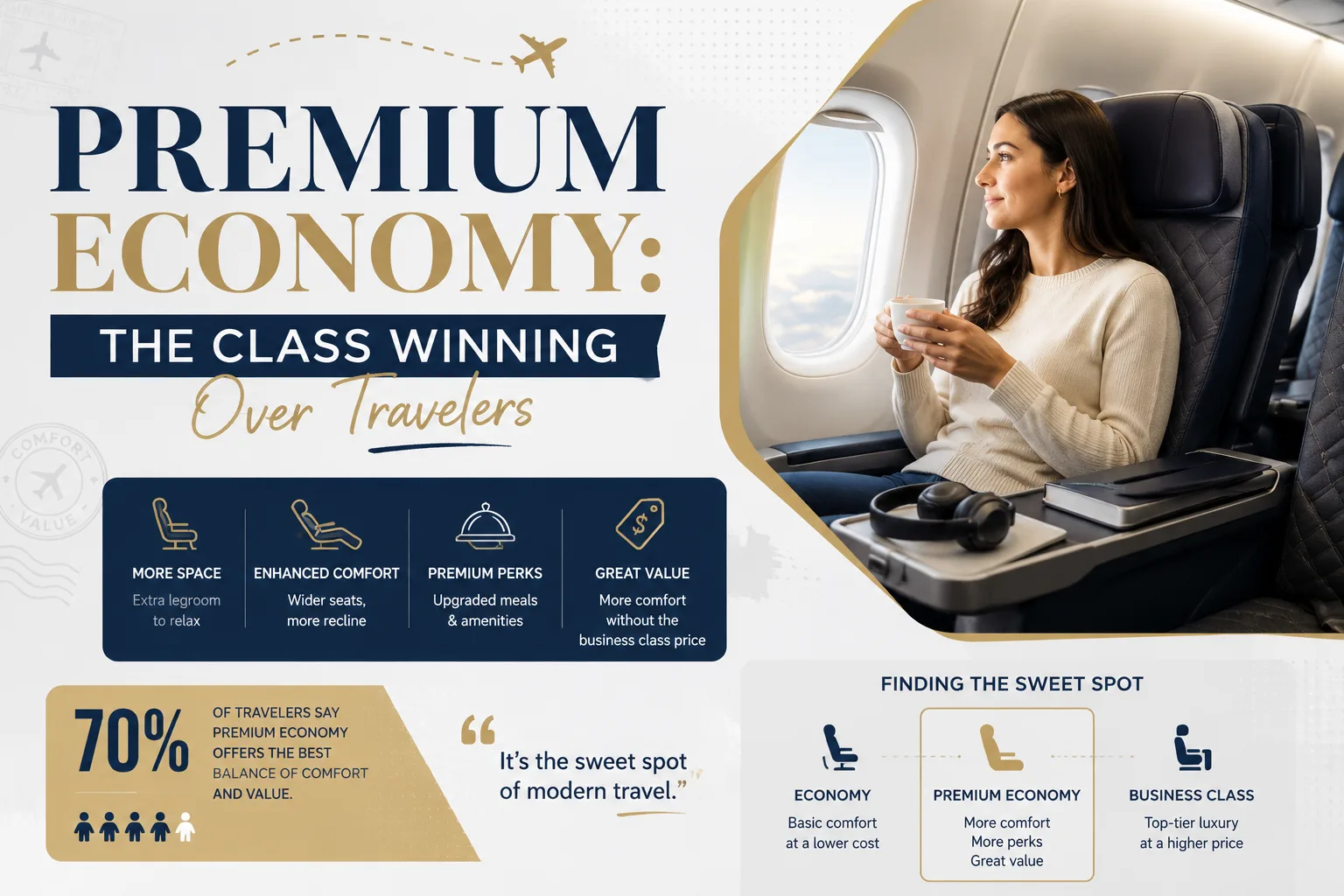
Premium economy occupies the physical and experiential space between the standard economy cabin and the full business class cabin. Depending on the airline, it may be called Premium Economy, Economy Plus, World Traveller Plus, Economy Comfort, or Comfort+, among other brand names — but the core proposition is consistent: meaningfully better comfort and service than economy, at a price point significantly below business class.
The typical premium economy seat offers:
- Seat width of 17 to 21 inches, compared to 16 to 18 inches in economy
- Seat pitch (the distance between your seat and the one in front) is 35 to 40 inches, versus 28 to 32 inches in economy
- Recline of up to 8 inches, often with leg rests and footrests
- Wider personal entertainment screens, typically 13 inches or larger
- Enhanced meal service, often with proper ceramic dishware and a wider menu selection
- Upgraded amenity kits including eye masks, earplugs, socks, and skincare products
- Priority boarding and check-in access
- Increased baggage allowance
- Dedicated cabin crew with a lower passenger-to-crew ratio
The pricing structure is equally important to understanding the premium economy’s appeal. On a transatlantic route, an economy ticket might cost $500 to $900. A business class ticket on the same route might run $3,000 to $8,000 or more. A premium economy ticket typically lands between $1,200 and $2,500 — a meaningful premium over economy, but a fraction of what business class demands.
This price-to-comfort ratio is, in large part, the engine driving premium economy’s explosive growth.
The Numbers Don’t Lie: Premium Economy’s Market Surge
The data on the ascent of premium economy is striking. According to reports from the International Air Transport Association (IATA) and several leading aviation research firms, premium economy has posted some of the strongest load factors — the percentage of available seats filled — of any cabin class over the past five years.
A 2023 report by travel analytics firm OAG found that global premium economy capacity had grown by over 30% since 2019, even accounting for the COVID-19 disruption. Airlines, including British Airways, Air France, Qantas, Singapore Airlines, Cathay Pacific, and Air New Zealand, have all made significant investments in expanding and redesigning their premium economy offerings during this period.
Crucially, premium economy is not merely maintaining its position — it is actively stealing passengers from both adjacent cabin classes. Research by consulting firm McKinsey & Company found that roughly 40% of new premium economy passengers are former economy travelers who have upgraded, while approximately 35% are former business class travelers who have traded down without sacrificing too much comfort. The remaining 25% are new travelers who specifically planned their trip around flying premium economy.
This dual-direction migration is unprecedented in aviation history and speaks to the premium economy’s unique positioning as a class that makes sense from multiple directions.
The Psychology Behind the Premium Economy Choice
Understanding why travelers choose premium economy requires examining the psychology of value perception, comfort thresholds, and identity — a more complex calculus than simply comparing seat dimensions.
The Value Paradox
Human beings are not rational economic actors. We do not simply calculate cost per inch of legroom and make the optimal choice. Instead, our decisions are shaped by reference points, loss aversion, and perceived value relative to alternatives.
Premium economy exploits this psychology masterfully. When a traveler compares a premium economy ticket to a business class ticket, they experience something psychologists call reference-point anchoring. The business class price becomes the reference, and premium economy — at 40% to 60% of that price — feels like a bargain, even though it is objectively expensive compared to the economy baseline.
Conversely, when the traveler compares premium economy to economy, the additional cost feels justified because the improvements are tangible, visible, and immediately experienced. You sit down, and your body tells you that this is different. The seat is wider. There is room to breathe. Your knees do not touch the seat in front. This physical confirmation of value is enormously powerful.
This is the value paradox of premium economy: it feels affordable compared to what’s above it, and luxurious compared to what’s below it. It occupies what behavioral economists call the “Goldilocks zone” — not too expensive, not too basic, just right.
The Dignity Threshold
There is a concept in travel psychology that researchers call the dignity threshold — the minimum level of comfort and space required for a traveler to feel that their basic physical and psychological dignity is being respected during a journey.
Economy class, particularly on long-haul flights with aggressive cost-cutting configurations, frequently fails the dignity threshold test. Seats that are so narrow that passengers’ shoulders overlap, legroom so tight that circulation is compromised, and meal service so abbreviated as to be almost perfunctory — these conditions create a quiet but real sense of indignation in travelers.
Premium economy reliably clears the dignity threshold. The extra inches of width and pitch, the improved recline, the enhanced meal — these are not merely physical improvements. They are psychological signals that the airline acknowledges your humanity and values your comfort. Travelers who choose premium economy consistently report not just greater physical comfort but a greater sense of being respected and valued — an emotional payoff that contributes significantly to overall satisfaction.
The Social Identity Dimension
Seat class on an airplane is, whether we acknowledge it or not, a social identity marker. Where you sit says something about your status, your spending power, your priorities, and even your self-image.
For a growing segment of travelers, economy class carries a social stigma they prefer to avoid — particularly on long-haul leisure trips where they will be photographed, where they want to arrive feeling and looking their best, and where the journey is part of the overall luxury travel narrative they are constructing.
But full business class comes with its own identity complications. For many travelers — particularly younger affluent millennials and Gen Z high-earners — the conspicuous luxury of business class feels excessive, wasteful, or even slightly embarrassing in an era of growing environmental consciousness and economic inequality awareness.
Premium economy threads this identity needle. It is comfortable and discernibly better than economy, signaling that you value yourself enough to invest in the experience. But it does not tip over into the realm of excess. It is the smart, considered choice — and for a generation that prides itself on smart, considered choices, that identity fit is meaningful.
Airline by Airline: Who Is Leading the Premium Economy Revolution?
Not all premium economy products are created equal. Some airlines have made it a genuine priority and delivered world-class products; others offer modest improvements over economy. Understanding who is doing it best reveals what the category is truly capable of.
Singapore Airlines: The Gold Standard
Singapore Airlines is widely credited by aviation reviewers and passenger surveys with operating the world’s finest premium economy product. Their cabin features seats with 38 inches of pitch and up to 8 inches of recline, a dedicated footrest, and a 13.3-inch touchscreen. The meal service is notably elevated, with a curated menu, proper glassware, and a wider selection of beverages, including a respectable wine list.
What truly sets Singapore Airlines’ premium economy apart is the service philosophy. Crew assigned to the premium economy cabin operate with the same attentiveness and warmth that have made Singapore Airlines’ business and first class legendary. Passengers are addressed by name, preferences are noted and accommodated, and the experience feels genuinely premium rather than merely slightly better than standard.
Air New Zealand: Innovation and Comfort
Air New Zealand’s premium economy — particularly on its long-haul routes between Auckland and North America — has consistently been rated among the best in class. The airline’s Spaceseat configuration features a wider-than-average seat with a distinctive angled design that maximizes personal space without encroaching on neighbors.
Air New Zealand has also been a pioneer in onboard wellness for premium economy passengers, offering dedicated stretching zones, enhanced hydration service, and sleep-focused amenity kits with high-quality eye masks and melatonin supplements — a recognition that arriving refreshed is itself a form of luxury.
British Airways: World Traveller Plus
British Airways’ premium economy — branded as World Traveller Plus — is one of the most recognized premium economy products globally, partly due to British Airways’ high profile on transatlantic routes and partly due to the consistent quality of the offering.
The World Traveller Plus cabin features 38-inch pitch, a 6.5-inch recline, and a distinctly quieter cabin environment (positioned away from the galleys and lavatories that make economy noisy). The meal service is notably better than economy, with more courses and genuine glassware.
British Airways has recently invested significantly in updating World Traveller Plus for its new aircraft fleet, adding wider screens, USB-C charging ports, and improved seat cushioning — signaling the airline’s belief that premium economy is a long-term strategic investment, not an afterthought.
Qantas: The Long-Haul Pioneer
Given that Australia’s geographic isolation makes ultra-long-haul flights a practical necessity for Australian travelers, it is perhaps unsurprising that Qantas has been one of the most committed investors in premium economy quality. The airline’s premium economy product on its A380 and 787-9 Dreamliner fleet features generous pitch, wide seats with articulating leg rests, and a notably well-curated Australian wine selection.
Qantas has also been innovative in its premium economy-specific wellness programming, collaborating with sleep scientists and nutritionists to develop meal timing, cabin lighting, and hydration protocols specifically designed to minimize jet lag on its exhausting 14-to-20-hour routes.
Delta Air Lines: Domestic Comfort Premium
In the North American context, Delta Air Lines has been among the most aggressive domestically in establishing premium economy as a meaningful product tier. Delta’s Premium Select cabin on international routes and its Comfort+ cabin on domestic routes have both seen significant investment and strong passenger uptake.
Delta’s approach has been particularly savvy in the loyalty dimension: Medallion status members often receive complimentary or discounted access to Comfort+, creating a pathway for travelers to experience premium economy and become habituated to its comforts before they are asked to pay full price — a classic “try before you buy” psychological strategy.
The Business Traveler Conversion: Why Road Warriors Are Choosing Premium Economy
One of the most commercially significant trends in premium economy is its growing adoption by business travelers — specifically, mid-level corporate travelers whose companies have tightened travel policies and no longer automatically authorize business class for all long-haul journeys.
The corporate travel market was reshaped dramatically by two forces: the post-2008 financial crisis scrutiny of travel expenses, and the COVID-19 pandemic’s forced reset of corporate travel norms. Many companies that previously had a blanket “business class for all long-haul” policy now require travelers to fly premium economy unless the flight exceeds a certain duration threshold (typically 8 to 10 hours), or unless the traveler is of a specified seniority level.
For these travelers, premium economy is not a voluntary upgrade from economy — it is a voluntary downgrade from business. And the critical finding from corporate travel research is that the satisfaction gap between business class and premium economy is significantly smaller than the cost gap. A 2022 survey by the Global Business Travel Association found that over 70% of corporate travelers who had flown premium economy in the past 12 months rated their experience as “satisfactory” or “highly satisfactory” for business travel purposes.
The ability to work comfortably — with a wider tray table, better screen, reliable power supply, and a quieter cabin — meets most business travelers’ core functional needs on a flight. The additional perks of business class (lie-flat beds, fine dining, exclusive lounges) are delightful, but they are not essential for a 7-hour transatlantic flight where the primary goal is to arrive rested and ready for a morning meeting.
This corporate adoption of premium economy is important for airlines strategically: corporate travelers are typically frequent flyers with loyalty status, travel on flexible fares with higher base prices, and provide valuable repeat business and data.
The Leisure Traveler Perspective: A Once-in-a-Lifetime Upgrade Becoming a Habit
Beyond corporate travelers, the leisure travel market has been a crucial driver of premium economy’s growth — and its psychology is somewhat different.
For leisure travelers, particularly those on significant trips — honeymoons, milestone birthday journeys, once-in-a-lifetime adventures to far-flung destinations — premium economy often represents the answer to a question that economy makes impossible and business class makes financially painful: How do I make this journey feel special without bankrupting myself before I even arrive?
Premium economy answers this question compellingly. On a 14-hour flight to New Zealand, the difference between arriving exhausted, crumpled, and sleep-deprived after 14 hours in economy, versus arriving relatively rested and comfortable after the same journey in premium economy, is not a trivial lifestyle distinction. It is the difference between the first day of your dream vacation being written off to recovery and it being the first full day of genuine adventure.
Travel researchers have documented what they call the arrival effect — the measurable impact of travel comfort on the overall quality of the vacation or trip experience. Studies consistently show that travelers who arrive at their destinations in better physical condition — less fatigued, less physically stiff, less dehydrated, and headache-prone — rate their overall trip experience significantly higher, even when controlling for all other variables. Premium economy, with its better hydration service, improved sleep posture, and reduced physical stress, materially improves arrival conditions.
The insidious genius of premium economy for the leisure market is that once travelers experience this arrival effect, they find it very difficult to go back. The comfort becomes a baseline rather than a luxury. This is precisely the customer conversion dynamic that airlines are counting on when they offer promotional premium economy pricing or upgrade opportunities — they know that experiential goods create strong habituation, and that the traveler who flies premium economy to Japan for their 40th birthday is likely to budget for it on the next long-haul trip, and the one after that.
Environmental Consciousness and Premium Economy
An increasingly important and underreported dimension of premium economy’s appeal is its environmental positioning relative to business class.
The carbon footprint of air travel is not uniformly distributed across the cabin. Business class and first class passengers occupy significantly more physical space on the aircraft — space that, in a premium economy or economy configuration, could hold additional passengers. The result is that business class passengers bear a disproportionately large share of the aircraft’s per-flight carbon emissions when calculated on a per-passenger basis.
Various studies have attempted to quantify this differential, with figures typically suggesting that a business class passenger generates two to four times the carbon emissions per flight of an economy passenger on the same route, due to the space differential and weight of the seats and associated equipment.
Premium economy, with its more modest space footprint compared to business class, represents a meaningful reduction in per-passenger environmental impact relative to flying up front. For the growing cohort of eco-conscious affluent travelers — who want comfort but are genuinely uncomfortable with the environmental implications of full business class — premium economy provides a defensible compromise.
This is not the primary reason most travelers choose premium economy, but it is increasingly a secondary justification that makes the choice feel ethically coherent. As carbon footprint awareness grows among frequent travelers, this dimension of the premium economy’s appeal is likely to strengthen.
The Technology and Innovation Arms Race in Premium Economy
Airlines are not simply expanding premium economy — they are actively competing to out-innovate one another in the cabin, driving rapid improvements in seat technology, connectivity, and amenities.
Seat engineering has advanced significantly. Modern premium economy seats are the product of sophisticated aerospace ergonomics, with articulating lumbar support, independently adjustable leg rests, and head rests, and seat foam engineered to maintain comfort over 14-plus hour journeys in ways that cheaper economy foams cannot. Manufacturers like Recaro, Stelia, and Collins Aerospace have invested heavily in premium economy seat development, recognizing it as the fastest-growing market segment.
In-flight entertainment in premium economy has largely caught up with business class. Screens of 13 to 15 inches, high-resolution displays, noise-canceling headphone provision (rather than the flimsy earbuds of economy), and access to premium content libraries are now standard in leading premium economy products.
Connectivity is a growing differentiator. Premium economy passengers increasingly expect high-speed Wi-Fi as a standard feature rather than a paid add-on, and airlines are responding. Several airlines now include complimentary messaging service or reduced-cost data packages as part of the premium economy fare.
Power supply has been standardized at a serious level in premium economy — proper AC power outlets at every seat, USB-A and USB-C charging ports, and in some cases, wireless charging pads. This is not trivial for business travelers who need to arrive with charged devices.
Premium Economy and the Future of Aviation
Several converging trends suggest that premium economy will only grow in importance in the coming decade.
Ultra-long-haul route expansion: As airlines extend routes to 18, 19, and even 20 hours of flying time, the physical demands on passengers intensify dramatically. On these routes, the difference between economy and premium economy moves from a comfort preference to a genuine well-being consideration. Singapore Airlines’ Project Sunrise routes between Singapore and New York or Los Angeles — nearly 20 hours — are expected to drive premium economy demand significantly.
Middle-class wealth expansion in emerging markets: The growing middle and upper-middle class in markets like India, Indonesia, Vietnam, and Brazil includes a large cohort of aspirational travelers who are flying long-haul for the first time. Many of these travelers, accustomed to consuming quality products in other categories of their lives, will not accept basic economy as their introduction to long-haul travel. Premium economy is positioned to capture this emerging demographic.
Remote work and the digital nomad economy: The normalization of remote work has created a class of travelers who are flying not to attend a brief meeting but to spend weeks or months in a new location. For these travelers, the flight is not a means to an end but a significant event in itself — one worth investing in. Premium economy aligns naturally with this mindset.
Airline economics: Airlines make significantly more profit per square foot of cabin space from premium economy than from economy. As aircraft orders are placed for the next generation of wide-body jets — including the Airbus A350 and Boeing 777X — airlines are configuring more of their floor space to premium economy, reflecting both passenger demand and the superior unit economics of the class.
How to Get the Best Premium Economy Experience
For travelers considering their first premium economy flight, or veterans looking to optimize their experience, several strategies consistently deliver better outcomes.
Book early for better positioning: Premium economy cabins are small — typically 20 to 40 seats on wide-body aircraft. The best seats — those with extra legroom, better window alignment, or distance from lavatories — go quickly. Booking early and selecting seats thoughtfully pays dividends.
Use points and miles strategically: Frequent flyer programs offer significantly better value for premium economy than for business class redemptions. On some programs, a premium economy redemption requires 50 to 60% fewer miles than business class while delivering 70 to 80% of the experience — an excellent points value proposition.
Choose airlines with a genuine commitment to the cabin: Not all premium economy products are equivalent. Airlines like Singapore Airlines, Air New Zealand, Japan Airlines, and Cathay Pacific have invested most heavily in the experience. On airlines that offer premium economy as an afterthought, the product may be only marginally better than a well-configured economy seat.
Leverage credit card upgrade offers: A growing number of premium travel credit cards offer complimentary or discounted premium economy upgrades as a cardholder benefit, particularly on partner airlines. These offers are frequently underutilized by travelers who do not read the full benefits guide for their cards.
Fly the right routes: Premium economy shines on long-haul routes of 8 hours or more. On short-haul flights under 4 hours, the price premium is rarely justified by the experience differential. The category is optimized for transcontinental and transoceanic routes where the cumulative value of better sleep, better meals, and better comfort compounds over many hours.
Conclusion: The Class That Changed the Game
Premium economy is no longer the aviation world’s awkward middle child. It has grown into something genuinely significant: a well-defined, well-delivered, psychologically resonant product category that speaks to the evolving needs, values, and economic realities of modern air travelers.
It represents a sophisticated understanding of what passengers actually want — not the performative excess of first class, not the bleak functionality of basic economy, but a dignified, comfortable, meaningfully upgraded experience at a price that feels justifiable rather than indulgent.
The airlines that have invested most seriously in premium economy are reaping the rewards in passenger loyalty, revenue per available seat mile, and satisfaction scores. The travelers who have discovered it are, in remarkable numbers, choosing it again. And the broader aviation industry is watching these outcomes and investing accordingly.
The seat between economy and business class is no longer a compromise. It has become a destination in itself.
Key Takeaways
- Premium economy bridges the gap between economy and business class with meaningful comfort improvements at a fraction of the business class price.
- The class is growing rapidly, with global capacity up over 30% since 2019, driven by both leisure and business traveler adoption.
- The psychology of premium economy’s appeal is rooted in the value paradox, the dignity threshold, and social identity — it feels like a bargain from above and a luxury from below.
- Leading airlines, including Singapore Airlines, Air New Zealand, British Airways, and Qantas, are investing heavily to differentiate their premium economy products.
- Corporate travel policy changes, eco-consciousness, ultra-long-haul route expansion, and emerging market affluence are all structural tailwinds for continued premium economy growth.
- Travelers can maximize premium economy value by booking early, using miles strategically, and prioritizing airlines with genuine product commitments.