


Introduction: The Red-Eye Is Neither a Trick Nor a Trap
Red-eye flights occupy a strange place in travel culture. To some travelers, they’re a clever hack — a way to “sleep through” a long flight, arrive with a full day ahead of you, and avoid burning a vacation day on travel. To others, they’re a miserable ordeal to be avoided at nearly any cost — a night of fragmented, seated non-sleep followed by a day of exhaustion that ruins the first 24 hours of a trip.
Both of these framings are true for different people, which is exactly the problem with how red-eyes get discussed. Most advice either recommends them broadly (“great way to save a day!”) or warns against them broadly (“you’ll be miserable, don’t do it”) without engaging with the actual variable that determines the outcome: how well does your specific body, sleep pattern, and itinerary tolerate a compressed, disrupted overnight sleep window, and does your trip structure give you room to recover if it doesn’t go well?
This article breaks the red-eye decision down properly — the physiological reality of what actually happens to your sleep and alertness on an overnight flight, who genuinely benefits from this flight type, who should actively avoid it, and the specific tactics that meaningfully improve the experience if you do end up booking one.
Part 1: What Actually Happens to Your Sleep on a Red-Eye
The Core Problem: You’re Not Actually Getting a Normal Night’s Sleep
A red-eye flight typically departs late evening (commonly 9 PM to midnight) and arrives early morning at the destination. On paper, this looks like it lines up with a normal sleep window — six to eight hours overnight. In practice, actual sleep obtained on a red-eye is significantly less than that, and of meaningfully lower quality, for several compounding reasons.
Boarding and taxi time eat into the window. By the time you’ve boarded, the plane has pushed back, taxied, and reached cruising altitude where the seatbelt sign turns off, you’ve often lost 30–60 minutes of your available sleep window before you can even begin trying to sleep.
Seated sleep is fundamentally different from lying-down sleep. Sleep research consistently shows that seated sleep — even in a reclined economy seat — produces less time in deep, restorative sleep stages compared to lying flat. Upright or semi-reclined posture makes it harder to reach and stay in slow-wave sleep, the stage most associated with feeling physically rested.
Cabin environment actively works against sleep. Cabin noise (engine sound, cart service, announcements), lower cabin humidity, and often cooler-than-ideal or inconsistent temperature all interfere with sleep onset and maintenance. Even with earplugs and an eye mask, these factors reduce sleep quality compared to a bedroom environment.
Interruptions are common and unavoidable. Beverage service, turbulence, seatmates moving past you to use the lavatory, and the descent/landing sequence (which typically begins 30–45 minutes before arrival, with lights coming up and announcements starting) all fragment whatever sleep you do get.
The realistic outcome for most passengers on a red-eye: somewhere between two and five hours of actual, fragmented sleep, rather than the six-to-eight-hour block the flight’s scheduled duration might suggest. This is the single most important fact to internalize before deciding whether a red-eye works for you — you are not trading a bed for a seat and getting equivalent rest; you’re accepting a meaningfully smaller and lower-quality sleep total.
Sleep Debt and Next-Day Cognitive Performance
Sleep research on partial sleep deprivation (getting some sleep, but less than needed) shows measurable effects on reaction time, decision-making, mood regulation, and short-term memory the following day — even after just one night of reduced sleep. This matters directly for red-eye travelers: if your itinerary requires you to be sharp shortly after landing — a business meeting, driving a rental car, navigating an unfamiliar city, caring for children — a red-eye’s typical sleep debt can meaningfully affect your performance and safety, not just your mood.
Individual Variation Is Enormous
This is the crux of why “who should take a red-eye” doesn’t have one universal answer: individual capacity to sleep in non-ideal conditions (seated, upright, noisy, interrupted) varies dramatically. Some people are genuinely capable “anywhere sleepers” who can fall asleep within minutes of sitting down and stay reasonably asleep through disruptions. Others are highly sensitive sleepers who need a quiet, dark, flat, and familiar environment to get meaningful rest, and for whom a red-eye essentially guarantees a night of little to no real sleep. Neither type is unusual — this is a well-documented spectrum of individual sleep trait variation, sometimes discussed in sleep research in terms of arousal threshold and sleep onset latency differences between individuals.
Part 2: Who Red-Eyes Genuinely Work Well For
1. Self-Identified “Anywhere Sleepers”
If you already know from experience that you can fall asleep on planes, trains, in cars, or in unfamiliar environments relatively easily — the kind of person who’s dozed off during a movie in a theater or fallen asleep on a short flight without trying — a red-eye is likely to work reasonably well for you. Your baseline sleep flexibility means the compressed, lower-quality sleep window is less costly for you specifically than it would be for a more sensitive sleeper.
2. Travelers With a Recovery Buffer Built Into Their Itinerary
The single biggest factor that determines whether a red-eye is a good decision isn’t your sleep type — it’s whether your itinerary gives you room to recover if the flight goes poorly. If you land and have a full free day before anything important happens (no meetings, no scheduled activities, just time to check into a hotel and rest or take it easy), a red-eye’s downside is low even if you sleep badly, because you have a built-in buffer. If you land and walk directly into a full day of activities, a client meeting, or a demanding schedule, the downside of a bad night is much higher.
3. Travelers Optimizing for Vacation Days or Trip Length
For travelers with limited paid time off, a red-eye’s core value proposition is real: departing after work on a weekday and arriving the next morning effectively adds a full day to the usable portion of a trip, compared to a daytime flight that consumes most or all of a travel day. For someone taking a short trip (a long weekend, a 4-5 day vacation), this can be the difference between a trip that feels rushed and one that doesn’t — and that time value can be worth a rough night of sleep for many travelers, particularly younger or more resilient travelers without significant next-day obligations.
4. Budget-Conscious Travelers
Red-eye flights are frequently priced lower than equivalent daytime departures on the same route, since demand for the overnight slot is generally lower. For price-sensitive travelers who can tolerate the sleep tradeoff, this is a legitimate practical reason to choose a red-eye beyond just the schedule benefit.
5. Travelers Who Can Sleep In Post-Arrival
If your destination and itinerary allow for a late check-in, a hotel room available early, or simply the flexibility to nap on arrival before starting your day, the red-eye’s sleep debt can be substantially offset. This is different from the “recovery buffer” point above — it’s specifically about whether you have a place and permission to actually sleep more within the first few hours after landing, which meaningfully changes the net effect of the red-eye’s shortened overnight sleep.
6. Certain Route and Time Zone Combinations
For routes crossing a moderate number of time zones (particularly westbound-then-eastbound or certain transcontinental routes), a red-eye’s arrival timing can sometimes align better with local circadian adjustment than a daytime flight would — landing in the morning local time and pushing through a day before sleeping that night can, for some travelers, help reset their internal clock faster than a daytime arrival that leads to an evening arrival and an awkward, too-early bedtime. This benefit is route- and individual-specific, and shouldn’t be assumed universally, but it’s a real factor worth considering for specific itineraries.
Part 3: Who Should Actively Avoid Red-Eyes
1. Sensitive or Anxious Sleepers
If you know from experience that you struggle to sleep away from your own bed, need a fully dark and quiet environment, or have any history of sleep anxiety, a red-eye is likely to produce a genuinely bad night with very little actual sleep — not just “not ideal,” but functionally close to an all-nighter in terms of how you’ll feel the next day. For this group, the theoretical time savings of a red-eye are usually not worth the near-certainty of arriving exhausted.
2. Travelers With Demanding Plans Immediately Upon Arrival
If you’re landing and heading directly into a job interview, an important business meeting, a wedding you’re part of, a long drive, or any activity requiring sharp cognitive function or physical alertness, the sleep debt risk from a red-eye is a genuine liability, not just an inconvenience. Cognitive performance research on partial sleep deprivation consistently shows measurable impairment in exactly the domains — attention, working memory, decision-making — that matter most for these kinds of high-stakes activities.
3. Parents Traveling With Young Children
Red-eyes with young children introduce a compounding problem: children often don’t sleep well on overnight flights either (disrupted routine, unfamiliar environment, excitement or overstimulation), which means parents are frequently managing an awake or distressed child during the flight while also failing to get their own rest — arriving with a sleep debt for the whole family rather than just the adults. Unless a specific child is a documented strong traveler-sleeper, most parenting and travel guidance leans toward daytime flights for trips with young children specifically to avoid this compounding effect.
4. Anyone With a Known Medical Condition Sensitive to Sleep Disruption
Certain medical conditions — including some seizure disorders, some mental health conditions where sleep disruption is a known symptom trigger, and some cardiovascular conditions where sleep quality affects blood pressure regulation — can be meaningfully affected by a single night of significantly disrupted sleep. This is worth discussing with a treating physician specifically, rather than assuming a single rough night is inconsequential, if you have a relevant diagnosed condition.
5. Drivers Immediately After Landing
If your itinerary involves picking up a rental car and driving any meaningful distance shortly after a red-eye lands, this deserves specific caution: drowsy driving research finds that the effects of significant sleep restriction on reaction time and attention can be comparable to alcohol-impaired driving in some studies, and this risk is often underappreciated by travelers who wouldn’t consider driving after drinking but don’t apply the same caution to driving after a red-eye. If you must drive after a red-eye, build in a rest stop plan, share driving duties if possible, or consider a few hours of hotel rest before getting on the road.
6. Travelers Prone to Getting Sick While Traveling
Sleep deprivation is well established in research as a factor that measurably weakens immune response in the short term. Frequent travelers who already notice they tend to get sick after trips may find that red-eyes, by compounding travel-related sleep loss, increase this risk further — worth factoring in particularly during cold and flu season or before an important event you can’t afford to be unwell for.
Part 4: The Middle Ground — Travelers Who Should Weigh It Carefully
Not everyone falls cleanly into “great fit” or “avoid entirely.” Several traveler types genuinely depend on trip-specific factors:
Solo Business Travelers
A red-eye can be an efficient way to arrive for an early morning meeting without burning a full travel day — but only if you have a documented ability to function reasonably well on partial sleep, and ideally a buffer of at least an hour or two after landing before the meeting starts to freshen up and mentally reset. For business travelers who need to be sharp for negotiations, presentations, or detailed decision-making, weigh the schedule efficiency against the real performance risk honestly, rather than defaulting to the red-eye because it looks efficient on paper.
Couples or Groups With Mixed Sleep Tolerance
If you’re traveling with a partner or group and only some of you are strong “anywhere sleepers,” consider that the group’s overall trip experience may be dragged down by the members who don’t sleep well, even if others in the group are fine. This is worth an honest conversation before booking, rather than assuming everyone will handle it the same way.
Long-Haul International Red-Eyes vs. Domestic Red-Eyes
A domestic red-eye (typically 4-6 hours) and a long-haul international overnight flight (potentially 8-12+ hours) are different propositions. Longer flights give more total time in the seat, which can mean more opportunity for cumulative sleep even if individual sleep segments are fragmented — but they also mean a longer period of cabin noise and interruption exposure, and jet lag becomes a much larger factor on longer routes crossing many time zones. The calculus shifts based on flight length, and this is worth considering separately from the general red-eye tolerance question.
Part 5: Practical Tactics That Meaningfully Improve the Red-Eye Experience
If you’ve decided a red-eye makes sense for your trip, several concrete steps measurably improve your odds of a decent night, beyond the generic “bring an eye mask” advice.
Before the Flight
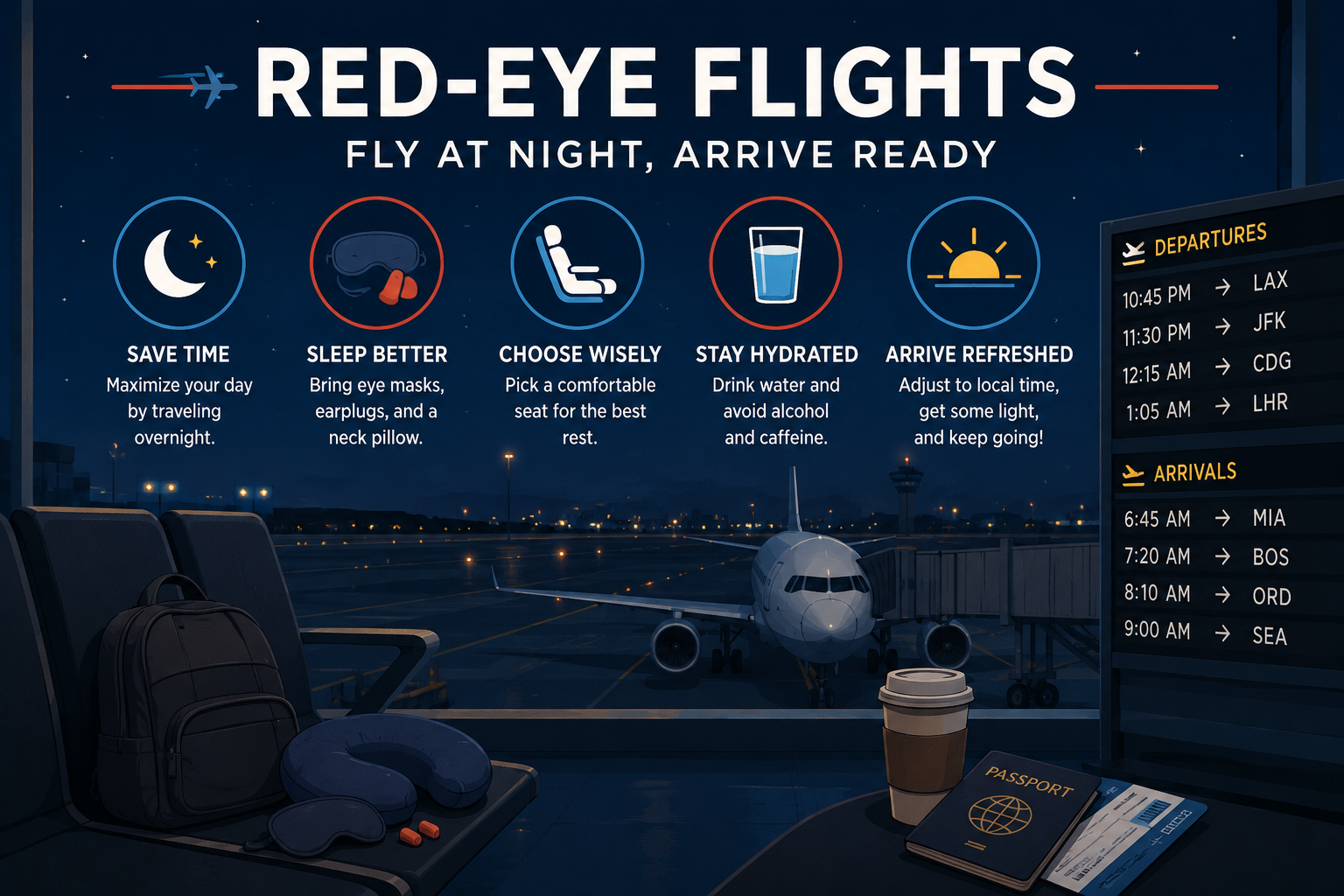
Avoid caffeine for several hours before boarding. This sounds obvious but is frequently ignored, particularly by travelers grabbing coffee to power through a long day before an evening flight. Caffeine’s half-life means an afternoon coffee can still meaningfully affect your ability to fall asleep during a late-evening flight.
Consider a light pre-flight routine that mimics your normal bedtime routine. Brushing teeth, changing into comfortable clothes, and other small rituals can help signal to your body that it’s time to sleep, even in an atypical environment — this leverages the psychological association your brain has built with these cues over years of nightly repetition.
Choose your seat deliberately. A window seat gives you something to lean against and control over the shade, reducing light disruption and eliminating the risk of being disturbed by a seatmate needing to get past you to the aisle. For red-eyes specifically, frequent travelers who prioritize sleep over aisle convenience choose window seats for exactly this reason, even though aisle seats otherwise offer their own advantages for other flight types.
During the Flight
Use blackout-quality eye coverage, not just a thin airline-provided mask. Cabin lighting, screens from nearby passengers, and reading lights all interfere with sleep onset — a well-fitted, opaque eye mask makes a measurable difference.
Prioritize noise reduction over noise elimination. Active noise-canceling headphones or high-quality earplugs reduce the steady engine drone that, while not loud enough to consciously notice, does interfere with reaching deeper sleep stages. Some travelers find white noise or specific ambient sound tracks played through noise-canceling headphones more effective than silence alone, since it masks sudden, sleep-disrupting sounds (a cart wheel, a cough, an announcement) more consistently than earplugs alone.
Decline the meal or beverage service if sleep is the priority. Many airlines will skip you if you’re asleep or indicate in advance you don’t want to be woken, but this isn’t universal — some flight attendants default to waking passengers for service unless told otherwise. If sleep is genuinely your priority, politely and proactively tell the flight attendant during boarding that you plan to sleep through service.
Recline immediately if your seat allows it, rather than waiting. Every minute spent upright before attempting sleep is a minute lost from an already-compressed window. Get settled and reclined as soon as the seatbelt sign allows it.
Use a proper travel pillow suited to your sleep position, not just the generic neck pillow — some travelers sleep better with a pillow that supports leaning fully to one side against the window, while others need chin/neck support for an upright position. This is worth testing before a long trip rather than discovering mid-flight that your travel pillow doesn’t suit how you actually sleep.
After Landing
Get natural light exposure as soon as possible after arrival, particularly if you’re also adjusting across time zones. Morning light exposure is one of the most effective tools for resetting circadian rhythm and can help offset some of the grogginess from a poor night’s sleep, signaling to your body that it’s time to be alert.
Avoid the temptation to power through with excess caffeine. A little caffeine can help with acute alertness, but overdoing it — especially combined with existing sleep debt — often leads to a harder crash later in the day and can interfere with sleeping well that following night, compounding the problem into a second night of poor sleep.
Build in a short nap window if your schedule allows, ideally in the early-to-mid afternoon rather than late in the day, to avoid interfering with nighttime sleep at your destination. A 20–30 minute nap can measurably improve alertness without the grogginess that longer naps sometimes produce.
If at all possible, don’t schedule anything demanding in the first few hours after landing. Even travelers who generally tolerate red-eyes well benefit from treating the first part of arrival day as a buffer rather than assuming full performance capacity immediately.
Part 6: A Simple Decision Framework
To pull this together into something actionable, ask yourself these questions honestly before booking a red-eye:
- Do I already know, from real experience, whether I can sleep reasonably well in a seated, upright, noisy environment? If you’ve never really tested this, a red-eye for a high-stakes trip isn’t the time to find out.
- Does my itinerary give me a genuine recovery buffer after landing — free time, a place to rest, no demanding obligations in the first several hours? If yes, the downside risk of a red-eye is low even if the flight itself goes poorly.
- Is anything about my arrival day genuinely high-stakes — driving, an important meeting, an activity requiring sharp physical or mental performance? If yes, weigh this seriously against the schedule benefit.
- Am I traveling with anyone (children, a sleep-sensitive partner) whose experience I need to factor in, not just my own?
- Is the time or cost savings genuinely meaningful for this specific trip — does it add a real day to a short vacation, or save a significant amount on the fare — or is it a marginal convenience that isn’t worth the sleep tradeoff?
If your answers point toward “I sleep fine anywhere, I have buffer time, nothing demanding is scheduled right after landing, and the time/cost savings matter for this trip,” a red-eye is a reasonable, even smart, choice. If your answers point toward “I don’t sleep well away from home, I have something important scheduled soon after landing, and I’m just choosing it out of habit,” a daytime flight — even at a higher cost or with a less convenient schedule — is very likely the better decision for that specific trip.
Frequently Asked Questions
How much actual sleep do most people get on a red-eye flight? Realistically, somewhere between two and five hours of fragmented, lower-quality sleep, even on flights scheduled for six to eight hours, due to boarding time, seated sleep posture, cabin noise, and service interruptions.
Are red-eyes worse for jet lag than daytime flights? It depends on the specific route and time zones crossed — for some itineraries, a red-eye’s morning arrival can actually help reset your circadian rhythm faster than a daytime flight, while for others it can compound sleep debt with jet lag adjustment. This is route- and individual-specific rather than a universal rule.
Is it safe to drive right after landing from a red-eye? This deserves real caution — sleep restriction can impair reaction time and attention in ways comparable to alcohol impairment in some research, and this risk is frequently underestimated by travelers. If you must drive after a red-eye, build in rest breaks, share driving duties, or consider resting for a few hours before getting behind the wheel.
Do red-eye flights actually cost less than daytime flights on the same route? Often, yes — overnight departure slots frequently see lower demand, which can translate to lower fares, though this varies by route, airline, and how far in advance you’re booking, so it’s worth comparing directly rather than assuming.
Should I avoid red-eyes entirely if I’m traveling with young children? Most parenting and travel guidance leans toward avoiding red-eyes with young children unless you have specific, confirmed experience that your child sleeps well on overnight flights, since disrupted sleep often affects the whole family’s rest, not just the adults’.