


Introduction: A New Era of Airborne Accountability
Imagine settling into your airplane seat after a long day, only to notice the passenger next to you has removed their shoes, propped their bare feet on the tray table, and is loudly chewing with their mouth open. A decade ago, your options were limited — endure it in silence, ask them to stop, or politely flag a flight attendant. Today, however, millions of travelers have found a fourth option: take out their smartphone, snap a photo or video, and share it with the world.
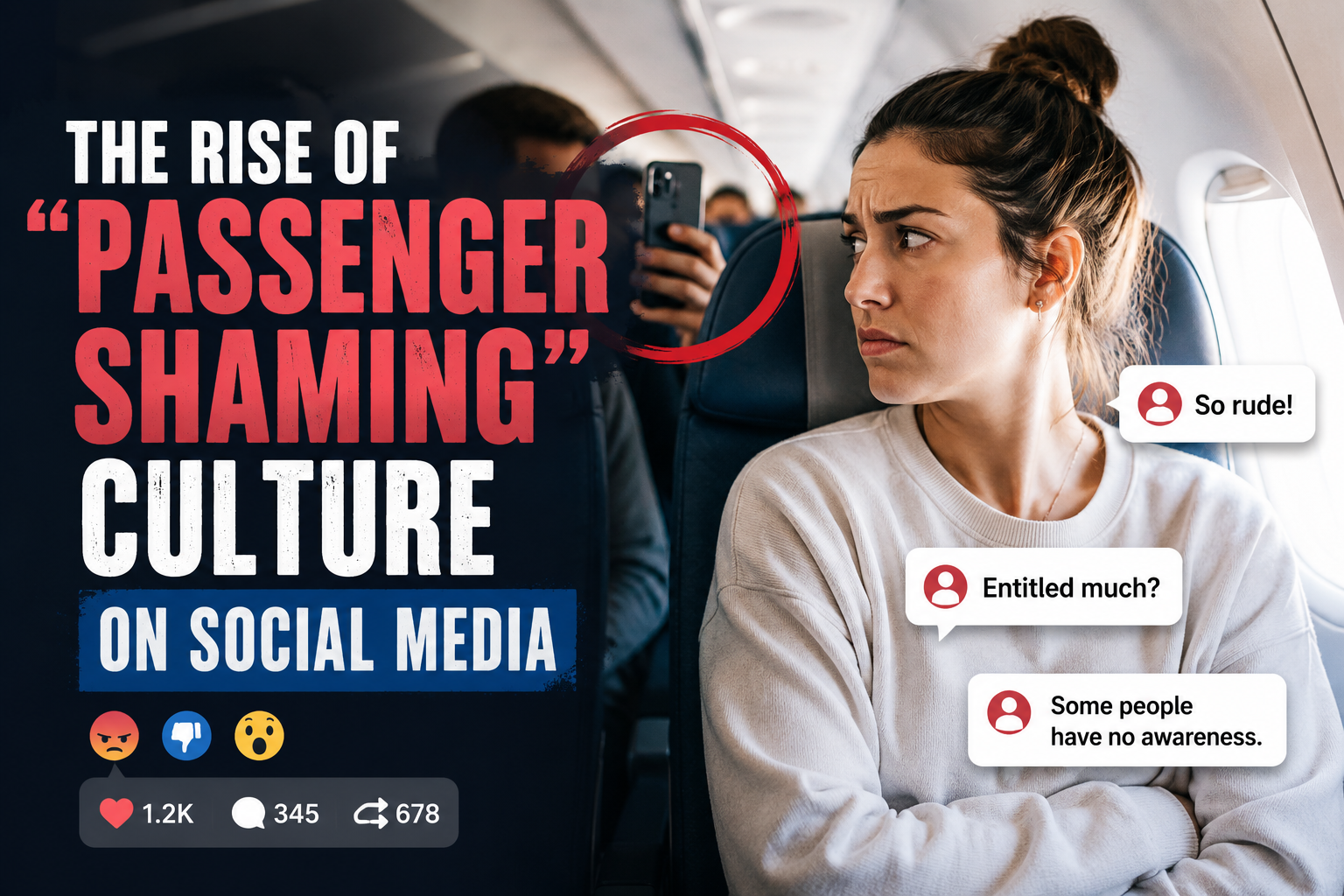
Welcome to the era of passenger shaming — the growing social media trend in which fellow travelers, airline crew members, and bystanders publicly document and broadcast the rude, bizarre, unhygienic, or downright outrageous behavior of airline passengers.
From dedicated Instagram pages and Facebook groups to viral TikTok videos and Reddit threads, passenger shaming has exploded into a full-blown online culture with tens of millions of followers globally. It raises fascinating, complex, and often uncomfortable questions about privacy, public accountability, digital ethics, human behavior under pressure, and the evolving social contract of shared travel spaces.
This article takes an in-depth look at how passenger shaming culture emerged, why it resonates so deeply with audiences who participate in it, what its consequences are, and what it signals about our broader digital society.
What Exactly Is “Passenger Shaming”?
Passenger shaming refers to the practice of photographing, filming, or otherwise documenting the inappropriate or inconsiderate behavior of airline passengers and then sharing that content publicly — most often on social media platforms — for purposes that range from humor and venting to genuine public callout and accountability.
The behavior documented under the passenger shaming umbrella is wide-ranging and includes:
- Poor hygiene habits — barefoot passengers, nail-clipping mid-flight, unwashed hair spread across seat backs, and strong body odors
- Rude or inconsiderate conduct — reclining seats aggressively, hogging armrests, blocking overhead bins, or spreading personal items into neighboring seats
- Boundary violations — passengers who reach through or over seats, touch strangers, or behave in sexually inappropriate ways
- Disruptive behavior — screaming without reason, playing music loudly, getting intoxicated, and becoming belligerent
- Outright unruly conduct — physical fights, verbal altercations with flight attendants, and in extreme cases, attempts to open aircraft doors in flight
The content is often captioned with sarcastic humor, exasperated commentary, or genuine outrage, and it spreads quickly because it taps into a universally relatable frustration: the shared misery of flying in proximity to strangers for hours on end.
The Origins: How Did Passenger Shaming Begin?
While people have complained about rude travel companions since the dawn of commercial aviation, the digital age gave those complaints an audience. The roots of modern passenger shaming can be traced back to the mid-2000s, when smartphones began putting high-quality cameras in the hands of every traveler.
Early examples of viral travel content focused mostly on oddities — strange sights at airports, unusual in-flight meals, spectacular views from windows — but as social media matured, so did the appetite for conflict and confrontation. Platforms like Twitter and Facebook made it easy to share grievances in real time, and the response from followers was immediate and enthusiastic.
The watershed moment for organized passenger shaming came in 2013, when Passenger Shaming — the Instagram account that would become the movement’s most prominent brand — was launched by Shawn Kathleen Powder, a former flight attendant. Drawing on her years of first-hand experience witnessing appalling passenger behavior, Powder began curating and reposting photos and videos submitted by flight crew and passengers alike. The account grew rapidly, amassing hundreds of thousands of followers and inspiring countless imitators across every major platform.
Powder’s origin story is instructive: she was not simply a frustrated traveler venting online. She was a professional who had spent years absorbing passenger misconduct as part of her job, and she recognized that the internet provided an unprecedented outlet for documenting what had long been an invisible — and largely unpunished — side of air travel. Her account gave voice to the voiceless: the exhausted cabin crew member who could not tell a passenger to put their shoes back on without risking a formal complaint.
By the 2015s, dozens of copycat accounts, websites, and Facebook groups had emerged, turning passenger shaming into a self-sustaining ecosystem of content creators, commenters, and consumers. The term itself entered common usage, appearing in mainstream media outlets from the BBC to CNN, the New York Times to BuzzFeed.
Why Does Passenger Shaming Resonate So Deeply?
The extraordinary popularity of passenger shaming content is not accidental. It taps into several powerful psychological and social forces that make it almost irresistibly compelling to audiences.
1. The Universal Frustration of Flying
Air travel is, for most people, a deeply uncomfortable experience. Seats have grown smaller, legroom has decreased, flights are more crowded, and delays are frequent. Passengers are crammed together in a metal tube for hours, unable to escape each other, sharing recycled air and narrow armrests. In this high-stress, low-comfort environment, the actions of inconsiderate fellow travelers feel especially galling.
When someone shares a photo of a passenger who has put their feet on someone else’s headrest, millions of people who have endured similar affronts feel an immediate, visceral sense of validation. The message is: you are not alone, this really is that bad, and your frustration is legitimate. That sense of shared experience is enormously powerful and deeply social.
2. The Appeal of Schadenfreude and Comic Relief
A significant portion of passenger shaming content is genuinely funny. The absurdity of some captured behaviors — a grown adult building a makeshift privacy tent out of a blanket, someone attempting to dry their socks on an air vent, a passenger who has inexplicably brought an entire rotisserie chicken on board — generates genuine amusement. Laughing at others’ bad behavior is an ancient human instinct, and social media simply supercharges the reach of that laughter.
This comedic element helps passenger shaming transcend the niche audience of frequent flyers. Even people who rarely travel find the content entertaining because it presents an extreme, almost absurdist version of everyday social transgression.
3. The Desire for Justice and Accountability
At its core, passenger shaming is driven by a desire for accountability in a space that historically offered very little. Airlines have been notoriously reluctant to discipline misbehaving passengers publicly, fearing bad publicity or legal liability. Flight attendants are often powerless to do more than politely ask offenders to stop. Other passengers have even less recourse.
Public shaming on social media offers a form of justice that the formal system cannot. When a passenger who behaved abominably goes viral, they face social consequences — embarrassment, ridicule, sometimes even the loss of employment — that the airline system would never impose. For many observers, this feels deeply satisfying, a kind of crowdsourced accountability that corrects a systemic imbalance.
4. Community and Identity Building
Frequent flyers — particularly business travelers — have developed a strong sense of in-group identity. They have their airport routines, their loyalty programs, and their preferred seats. Passenger shaming content reinforces the boundaries of that community by clearly defining what unacceptable behavior looks like. Sharing and commenting on these posts is a way of affirming shared values and belonging to a group that “knows how to travel properly.”
The Major Platforms and Key Players
Passenger shaming culture lives across multiple platforms, each offering a different flavor of the experience.
Instagram remains the spiritual home of the movement, with Shawn Kathleen’s original account — now also extending to a website, podcast, and book — continuing to be the definitive aggregator of submitted content. The visual nature of Instagram makes it ideal for the static photo format that dominates passenger shaming content.
TikTok has brought passenger shaming to a younger, more dynamic audience. Video content on TikTok allows creators to narrate their experiences in real time, building dramatic tension and inviting viewer reactions. Some TikTok passenger shaming videos have accumulated tens of millions of views, with comment sections functioning as lively communal courts rendering instant judgment.
Reddit offers the most nuanced and debate-rich environment for passenger shaming content. Subreddits like r/mildlyinfuriating, r/trashy, and r/publicfreakout regularly feature travel-related content, and the Reddit format encourages longer discussions about context, ethics, and appropriate responses.
Twitter/X is the preferred platform for real-time flight incident reporting. Passengers live-tweet unfolding situations — gate confrontations, in-flight disturbances, delayed baggage — creating a running commentary that can go viral within minutes and sometimes attract responses from airline accounts themselves.
Facebook Groups serve a slightly older demographic and often function more as support communities for flight crew, where cabin staff share experiences and offer each other solidarity away from the public eye.
The Ethics of Passenger Shaming: A Complicated Conversation
For all its entertainment value and emotional appeal, passenger shaming raises serious and unresolved ethical questions that deserve careful consideration.
Privacy in Public Spaces
The most fundamental question is one of consent. When someone is photographed in a public space — including an airplane cabin — they generally have a reduced expectation of privacy compared to their home. In most jurisdictions, photographing people in public without their consent is legal. However, legal and ethical are not the same thing.
Being photographed without knowledge or consent and then having that image shared with potentially millions of strangers is a form of exposure that many people would find deeply disturbing, regardless of how their behavior is characterized. Critics of passenger shaming argue that even genuinely rude passengers retain their fundamental dignity and right not to be held up to mass public ridicule without due process.
There is also the question of context. A photo captures a single moment. The passenger sleeping with their mouth open and head on a stranger’s shoulder may be a first-time flyer with crippling anxiety who took too much medication. The person eating a pungent meal may have a medical condition that limits their dietary options. The shoeless passenger may have a foot condition. Social media, with its rush to judgment and appetite for outrage, rarely pauses to consider these possibilities.
The Risk of Escalation and Real-World Harm
Viral shaming can have consequences that extend far beyond a few moments of online embarrassment. People have lost jobs, received death threats, been harassed by strangers in their homes, and suffered lasting psychological damage as a result of viral shaming. The scale and speed of social media mean that content can reach millions before anyone has time to verify its accuracy or consider its proportionality.
There have been documented cases of misidentification — where the wrong person is identified as the subject of a shaming post — with devastating consequences for innocent individuals. The internet’s capacity for rapid, often anonymous pile-ons means that the punishment delivered by viral shaming frequently far exceeds any reasonable proportion to the original offense.
Power Dynamics and Selective Targeting
Critics have also noted that passenger shaming content is not applied neutrally. Research and observation suggest that the people most frequently targeted tend to be those with less social power: economy class passengers rather than business class travelers, people traveling with children, elderly passengers, those who appear to be lower-income, and people of color. Meanwhile, the truly egregious behavior of entitled first-class passengers or powerful executives often goes undocumented.
This selective targeting means that passenger shaming, far from being a neutral accountability mechanism, can reinforce existing social hierarchies and biases, punishing those who have fewer resources or social capital more harshly than those with more.
The Flight Crew Dimension
One particularly charged aspect of the ethics debate concerns content shared by flight crew members. Cabin staff who photograph and share images of sleeping, disheveled, or misbehaving passengers are violating a professional duty of care and the reasonable expectation of privacy that passengers — however imperfectly — extend to airline staff.
While flight attendants have legitimate grievances about passenger behavior and deserve platforms to address them, the power asymmetry of the relationship — a professional capturing and publicly mocking a client who is unaware they are being photographed — raises distinct ethical concerns that go beyond the passenger-to-passenger dynamic.
The Industry Response: Airlines, Policies, and Legal Implications
Airlines have generally been slow and inconsistent in their responses to passenger shaming. Most major carriers have vague policies that prohibit photographing other passengers without consent, but enforcement is rare and inconsistent.
A handful of high-profile incidents have prompted policy reviews. In 2017, when a United Airlines passenger was violently dragged off an overbooked flight, and the video went globally viral, it demonstrated with devastating clarity both the power of in-flight recording and the reputational risk it posed to carriers. Airlines learned that the smartphone camera was not just a passenger-shaming tool — it could also turn on the airline itself.
In response, some carriers have tightened their policies around onboard photography, particularly prohibiting the filming of crew members without consent. Others have invested in training flight attendants on how to respond to situations likely to be recorded and shared.
The legal landscape remains murky. While photographing in public spaces is generally legal, sharing images on social media in ways that could be construed as defamatory, harassing, or in violation of data protection laws (particularly in Europe, where GDPR applies) introduces legal risk. Several individuals who have been the subjects of viral shaming posts have successfully pursued legal action against those who shared their images.
The Psychology of the Shamer: Who Posts and Why?
Understanding passenger shaming culture requires asking not just why people find it entertaining, but why people participate in creating it. Research into online shaming behavior offers some illuminating insights.
Studies on moral psychology suggest that public shaming activates the same reward centers in the brain as other forms of social bonding. When we identify a norm violator and join with others in condemning them, we experience a sense of righteousness and community that is neurologically pleasurable. This is, evolutionarily speaking, a feature rather than a bug — group norm enforcement was essential to the survival of early human communities.
However, the same research suggests that this instinct, when amplified by the scale and anonymity of social media, becomes dysregulated. The checks that would moderate in-person shaming — empathy, proportionality, the ability to see the shamed person as a full human being — are stripped away, leaving the reward without the restraint.
People who share passenger shaming content also often report doing so as a form of social capital accumulation. A well-timed, relatable post about a terrible fellow passenger can generate thousands of likes, comments, and shares, delivering a significant boost to one’s online profile and sense of social status. In this sense, the motivation is not purely moral but also performative and self-serving.
Passenger Shaming and the Broader Culture of Online Public Shaming
Passenger shaming does not exist in isolation. It is part of a broader cultural phenomenon of online public shaming that has reshaped social interaction over the past decade. From “Karen” videos to restaurant reviewer pile-ons, from college admissions scandals to workplace misconduct exposés, social media has become a primary arena for public accountability — with all the power and danger that implies.
Journalist Jon Ronson’s influential 2015 book So You’ve Been Publicly Shamed documented the devastating real-world consequences for individuals caught in viral shaming storms and raised urgent questions about the proportionality and humanity of digital mob justice. The book struck a nerve precisely because its concerns applied to everything from minor celebrity missteps to the modest misdeeds of ordinary people — including, inevitably, rude airline passengers.
The question passenger shaming raises, in common with all online shaming, is not simply “was this behavior wrong?” but “is this response proportionate, fair, and likely to produce good outcomes?” The answer, in most documented cases of viral shaming, is far more complicated than the crowd-pleasing certainty of social media judgment would suggest.
The Positive Outcomes: When Passenger Shaming Works
It would be unfair to present only the critiques of passenger shaming without acknowledging cases where it has produced genuinely positive outcomes.
Airline accountability has been meaningfully advanced by viral recording. The aforementioned United Airlines incident led to significant policy changes around overbooked flights across the industry. Multiple incidents of racial discrimination by airline staff, captured on video and shared widely, have led to investigations, apologies, and in some cases firings and policy reforms that would not have occurred without the public record.
Serious misconduct has been documented and acted upon. Cases of sexual harassment, assault, and grossly dangerous behavior by passengers — reaching across seats to grope neighbors, attempting to open aircraft doors, physically attacking crew members — have been captured on video and shared, leading to arrests, prosecutions, and no-fly bans that might otherwise have gone unenforced.
Industry-wide conversations about passenger behavior standards have been elevated by the visibility that viral content creates. Topics like reclining seat etiquette, the use of technology during flights, and the treatment of families with young children have all entered mainstream discourse in ways that have influenced airline policy and social norms.
When the subjects of shaming are perpetrators of genuine harm rather than merely inconsiderate, and when the exposure leads to institutional accountability rather than individual pile-ons, passenger shaming demonstrates its most legitimate and valuable form.
What the Future Holds for Passenger Shaming Culture
As technology evolves, so too will the landscape of passenger shaming. Several trends are likely to shape its future:
Improved recording technology — including high-resolution front-facing cameras, discreet wearable cameras, and AI-enhanced video editing — will make it easier to capture and share content with greater clarity and production value, raising both the entertainment potential and the ethical stakes.
Deepfakes and misinformation — the same technology that makes genuine documentation easier also makes fabrication simpler. As AI-generated video becomes more convincing, the already complicated question of content authenticity will become more fraught, potentially enabling malicious actors to manufacture false passenger shaming content.
Regulatory intervention — particularly in Europe, where data protection law is strong- regulation of the use of images captured in public spaces is likely to tighten. Airlines may be required to adopt clearer, more enforceable photography policies, and platforms may face greater liability for hosting shaming content.
Shifting social norms — as awareness of the harms of online shaming grows, cultural attitudes toward passenger shaming may evolve. Already, a significant counter-discourse questions the ethics of the practice, and younger generations who have grown up entirely online may develop more nuanced views of digital accountability.
Conclusion: Living With Each Other — Online and at 35,000 Feet
Passenger shaming culture is, at its heart, a symptom of two overlapping phenomena: the genuine social friction created by modern air travel, and the extraordinary power that digital technology has placed in the hands of ordinary people.
The frustration that drives passengers and crew to document and share bad behavior is real and understandable. Commercial flying is stressful, uncomfortable, and increasingly demanding. The social contract of shared public space is strained to its limits in an airplane cabin, and when it breaks down, the effects are felt acutely by everyone in proximity.
But the response to that frustration — public exposure, viral ridicule, crowdsourced judgment — carries its own serious costs. It can cause disproportionate harm to individuals, reinforce existing social biases, and substitute the emotional satisfaction of mob justice for the harder, slower work of genuine accountability and systemic change.
Perhaps the most honest conclusion is this: passenger shaming, like so many features of our digital culture, contains genuine value and genuine danger in roughly equal measure. It works best when it shines light on systemic failures and serious misconduct, and worst when it becomes an outlet for cruelty dressed up as accountability.
The challenge for travelers, airlines, platforms, and regulators alike is to find ways to preserve the legitimate accountability function while building better guardrails against its worst impulses. That is, in the end, not so different from the challenge we face in navigating every other shared public space in an increasingly connected and observable world.