


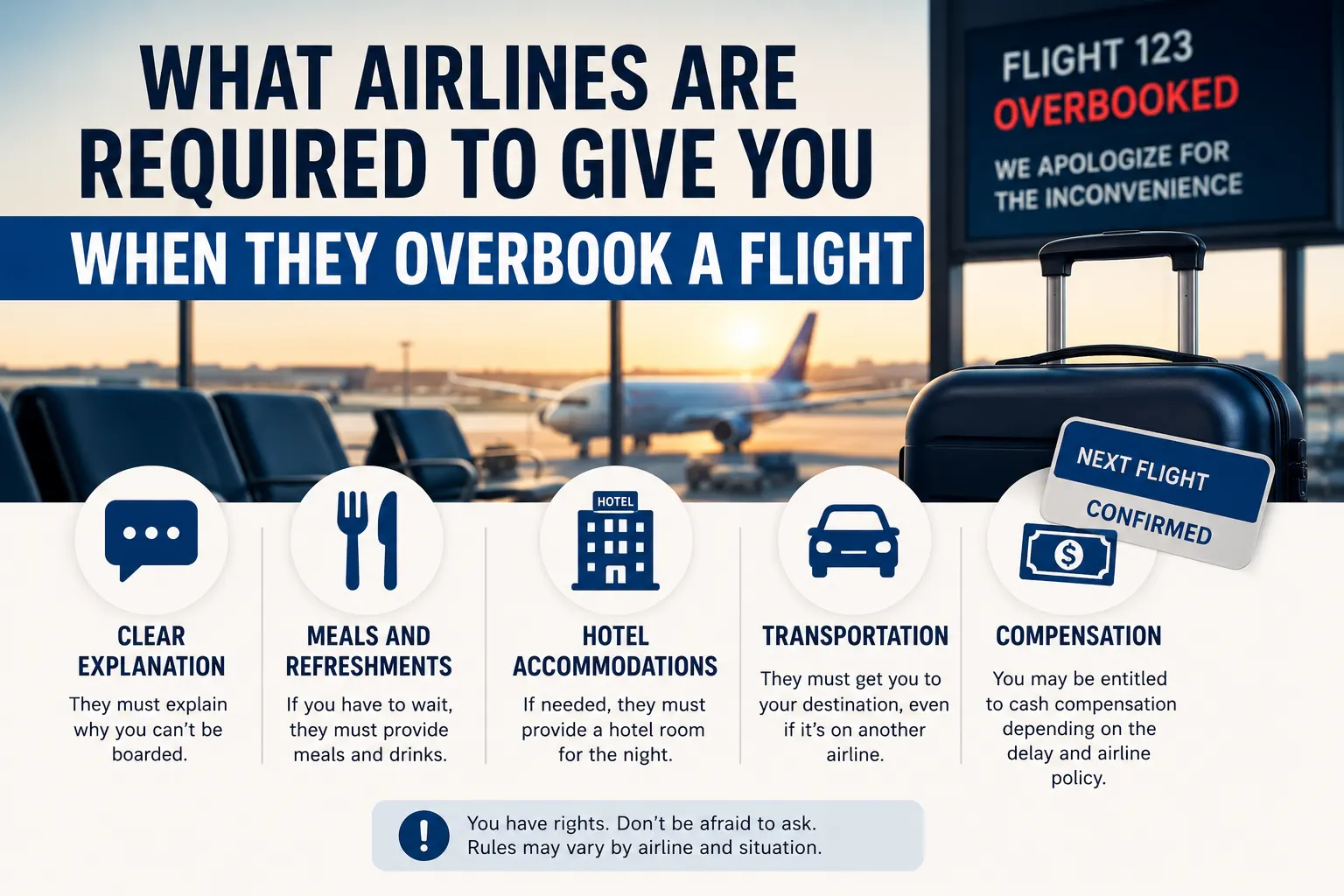
Introduction: The Moment You Realize You’re Not Getting on That Plane
You have checked in, cleared security, grabbed a coffee, and settled into your gate seat. Your bag is packed perfectly, your connection is tight, and your hotel is waiting on the other side. Then the gate agent’s voice cuts through the terminal noise with a request that makes every experienced traveler’s stomach drop:
“We are looking for volunteers to give up their seats on today’s flight.”
That announcement is your first warning sign. The flight is overbooked — and if not enough volunteers step forward, someone is getting bumped, whether they want to be or not.
Overbooking is one of the most misunderstood and financially consequential practices in commercial aviation. Airlines do it deliberately, every single day, on nearly every route they operate. And the passengers who understand exactly what they are owed in that moment — in cash, in meals, in hotel rooms, and in rebooking rights — walk away with hundreds or even thousands of dollars more than those who simply accept whatever the gate agent slides across the counter.
This guide covers everything you need to know about airline overbooking in 2025: why airlines do it, what US federal law requires them to give you, how the voluntary and involuntary bumping processes work, what to do in the critical moments at the gate, and how to negotiate for the maximum compensation you are legally entitled to receive.
Why Airlines Overbook Flights in the First Place
To understand your rights, you first need to understand the practice itself — because overbooking is not a mistake or an administrative failure. It is a deliberate, mathematically calculated revenue strategy that airlines have refined over decades.
The Economics of an Empty Seat
When a passenger books a ticket and then does not show up for the flight, the airline loses the revenue from that seat permanently. The plane departs with a space that cannot be sold, returned, or recovered. Across thousands of daily flights, the financial drain from no-shows is enormous.
Airlines address this by selling more tickets than the plane has seats, relying on statistical models to predict how many passengers on any given flight will not show up. Those models factor in the route, the day of the week, the time of year, the fare class mix, whether the flight is a connection, and dozens of other variables. On most flights, the prediction holds: the right number of passengers fail to appear, the plane departs full, and everyone profits.
The problem arises when the models are wrong — when fewer passengers than expected cancel or miss the flight, and more ticketed travelers show up at the gate than there are seats available. At that point, the airline must remove someone from the flight who has a confirmed, paid reservation. That is the moment federal passenger protection regulations take over.
How Common Is Overbooking?
Overbooking is extremely common across the US airline industry, though the frequency and handling of denied boardings vary significantly by carrier. The US Department of Transportation requires airlines to report both voluntary and involuntary denied boarding statistics quarterly. In a typical year, major US carriers collectively handle several hundred thousand denied boarding situations — the vast majority resolved through volunteers before anyone is removed involuntarily.
The involuntary bump — where a passenger with a confirmed reservation is denied boarding against their will — is rarer but not unusual. When it happens, federal law steps in with specific, non-negotiable protections.
The Two Types of Denied Boarding: Voluntary and Involuntary
The most important distinction in the entire overbooking process is the difference between voluntary denied boarding and involuntary denied boarding. Your rights, your compensation, and your negotiating position are completely different depending on which category applies to you.
Voluntary Denied Boarding: You Choose to Give Up Your Seat
When a flight is overbooked, airlines are required by DOT regulations to first seek volunteers willing to give up their seats in exchange for compensation before removing any passenger involuntarily.
If you volunteer your seat, you and the airline negotiate the terms. The airline proposes compensation — typically starting with a voucher for future travel — and you either accept or counter. You are under no obligation to accept the first offer, and in many cases, the initial offer is far below what the airline is ultimately willing to provide.
Volunteers typically receive:
- A travel voucher or cash payment (the amount is negotiable and not capped by law)
- A confirmed seat on the next available flight to your destination
- Meal vouchers if the wait exceeds a certain threshold
- Hotel accommodation if an overnight stay is required
The keyword in voluntary denied boarding is negotiable. You have leverage. The airline needs your seat, and if not enough passengers volunteer at the initial offer, the compensation tends to rise — sometimes dramatically — as departure time approaches.
Involuntary Denied Boarding: The Airline Removes You Against Your Will
If the airline cannot secure enough volunteers, it proceeds to involuntary denied boarding — removing passengers with confirmed reservations by force of its own selection process. This is where federal regulations impose hard, non-negotiable requirements on what the airline must provide.
Involuntary denied boarding triggers DOT compensation rules that are among the strongest passenger protection regulations in the United States. Understanding exactly what those rules require — and what they do not — is the foundation of protecting yourself in this situation.
What US Federal Law Requires Airlines to Give You
The Department of Transportation’s passenger protection regulations, codified under 14 CFR Part 250, establish the legal minimum for what airlines must provide when they involuntarily deny boarding to a ticketed passenger. These are not courtesy policies or airline goodwill gestures. They are federal mandates with specific dollar amounts, time thresholds, and delivery requirements.
Cash Compensation: The Core Requirement
The most important thing to understand about involuntary denied boarding compensation is this: the airline must pay you in cash (or a cash equivalent such as a check), not just travel vouchers. If you are involuntarily bumped, you have the legal right to demand actual money, not airline currency.
The amount of that cash compensation depends on two factors: how long the airline delays your arrival at your final destination compared to your original scheduled arrival time, and the price of your original ticket.
Current DOT Compensation Thresholds (as of 2025):
For domestic flights within the United States:
- If the airline gets you to your destination within one hour of your original scheduled arrival, no compensation is required
- If the airline gets you to your destination between one and two hours after your original scheduled arrival, compensation equal to 200% of your one-way fare, with a maximum of $775
- If the airline gets you to your destination more than two hours after your original scheduled arrival (or if the airline does not make alternative arrangements): compensation equal to 400% of your one-way fare, with a maximum of $1,550
For international flights departing the United States:
- If the airline gets you to your destination within one hour of your original scheduled arrival, no compensation is required
- If the airline gets you to your destination between one and four hours after your original scheduled arrival, compensation equal to 200% of your one-way fare, with a maximum of $775
- If the airline gets you to your destination more than four hours after your original scheduled arrival, compensation equal to 400% of your one-way fare, with a maximum of $1,550
These figures represent the minimum legal requirement. Airlines are free to offer more, and passengers are free to negotiate for more — but the airline cannot legally offer less to an involuntarily bumped passenger who holds a confirmed reservation.
The Right to Immediate Payment
Federal regulations require airlines to provide the compensation check or cash equivalent on the spot — at the airport, before you board the alternative flight. The airline cannot require you to wait for a check to arrive by mail or process a reimbursement later. Payment is immediate.
If the airline attempts to delay payment or insists that compensation will be mailed to you, you have the right to insist on immediate payment at the airport. Document the interaction and, if necessary, ask to speak with a supervisor.
The Written Statement of Rights
Airlines are legally required to provide every involuntarily bumped passenger with a written statement explaining their rights under DOT regulations. This document must describe the compensation formula, the passenger’s right to the alternative routing, and the process for filing a complaint if the passenger believes the airline has not complied with its obligations.
If a gate agent attempts to process an involuntary bump without providing this written notice, that is a regulatory violation. Ask for it explicitly if it is not offered immediately.
The Right to Keep Your Original Ticket
This is one of the most overlooked protections in the DOT’s denied boarding regulations. If you are involuntarily bumped and accept the compensation, you retain the right to use your original ticket on a later flight. The airline cannot void or confiscate your ticket as a condition of paying you the mandated compensation.
In practice, most passengers take the alternative routing the airline arranges rather than rebooking on their own, but the legal right to both the compensation and the original ticket’s value is significant, particularly for passengers on expensive, non-refundable fares.
What Airlines Are NOT Required to Give You
Understanding the boundaries of the law is just as important as knowing its protections. Several situations that feel like overbooking do not actually trigger the DOT’s denied boarding compensation requirements.
Flight Cancellations
If an airline cancels a flight entirely — for weather, mechanical issues, crew availability, or any other reason — the DOT’s denied boarding compensation regulations do not apply. Cancellations are governed by a separate, and significantly weaker, set of airline obligations. In the United States, as of 2024, airlines are required to provide refunds for cancelled flights but are not legally mandated to pay the same cash compensation required for denied boardings.
This distinction matters because some airlines have attempted to reclassify oversold flight situations as cancellations to avoid the higher compensation obligation. If you are removed from a flight that subsequently departs with other passengers on board, you have been bumped — not cancelled on — and the full denied boarding regulations apply.
Passengers Who Fail to Meet Check-In Requirements
Federal denied boarding protections only apply to passengers who have met all of the airline’s check-in requirements. Each airline sets its own deadline for checking in and appearing at the gate, and passengers who miss those deadlines — even by a few minutes — forfeit their denied boarding rights, even on overbooked flights.
The practical implication: always check in as early as the airline allows (typically 24 hours before departure for online check-in), and be at the gate well before the published boarding time. A confirmed seat and boarding pass in hand is your protection against being classified as a no-show rather than a bumped passenger.
Passengers on Smaller Aircraft
DOT denied boarding compensation rules apply to scheduled airline flights on aircraft with 30 or more passenger seats. Passengers on charter flights or small regional aircraft with fewer than 30 seats may have weaker or different protections depending on their carrier’s tariff policies.
International Flights Arriving in the United States
The DOT’s denied boarding regulations apply to flights departing from US airports. If you are bumped from an overbooked flight in another country — even if that flight is operated by a US carrier — you may be subject to the passenger protection rules of that country rather than US regulations. European travelers benefit from EU Regulation 261/2004, which in many respects offers stronger protections than US rules, including fixed compensation of €250 to €600 per passenger regardless of ticket price.
How Airlines Choose Who Gets Bumped
When an overbooked flight cannot be resolved through volunteers, the airline must select which passengers to remove involuntarily. Federal regulations require airlines to have a written boarding priority policy that determines the order in which passengers are bumped. The DOT does not mandate a specific priority order, but it prohibits selection based on race, color, national origin, religion, sex, or ancestry.
In practice, most major US carriers apply a combination of the following factors, roughly in this priority order:
Passengers are least likely to be bumped:
- Elite frequent flyer status holders (top tiers first)
- Passengers who checked in the earliest
- Passengers who are connecting to international flights
- Passengers traveling with minor children
- Passengers with disabilities or medical conditions requiring accommodation
- Full-fare, non-discounted ticket holders
- Unaccompanied minors
Passengers most likely to be bumped:
- Passengers who checked in last
- Passengers traveling on the cheapest available fare class
- Passengers without elite status
- Passengers on discounted or promotional fares
- Solo travelers with flexible itineraries
Understanding where you fall in this priority hierarchy helps you assess your risk on an overbooked flight — and informs whether volunteering on your own terms is preferable to risking an involuntary bump at the airline’s chosen compensation level.
What to Do in the Critical Moments at the Gate
The minutes between the overbooking announcement and the gate closing are the most financially consequential moments of your travel day. Here is exactly how to handle them.
Step 1: Listen Before You Act
When the gate agent announces they are seeking volunteers, resist the immediate impulse to rush to the desk. Take 60 seconds to assess your situation. How tight is your connection? How important is your arrival time? Do you have the flexibility to arrive several hours or even a day later? The answers determine your negotiating position.
If your schedule is genuinely flexible, an overbooked flight is a financial opportunity. If you have a wedding, a cruise departure, a medical appointment, or a tight connection to an international flight, your time has real value — and you should factor that into any decision about volunteering.
Step 2: Negotiate Aggressively If You Volunteer
If you decide to volunteer, do not accept the first offer. Airlines almost always open with the minimum they believe will secure enough volunteers. A $300 voucher is the opening bid, not the final price. Ask for more. Ask for cash instead of a voucher. Ask for a confirmed seat on a specific flight — not standby placement, but a guaranteed confirmed reservation. Ask for meal vouchers and lounge access during the wait. Ask for hotel accommodation if there is any possibility of an overnight delay.
Airlines frequently have authority to offer significantly more than the initial announcement — $800, $1,000, $1,500, or more in cash or voucher value — particularly in the final minutes before departure when they are still short of volunteers. Gate agents at larger hubs often have more flexibility than they initially reveal.
Crucially, always ask for cash or a check rather than a voucher. Travel vouchers expire, carry restrictions, often cannot be used on sale fares, and are worth less than their face value in most practical applications. Cash is universal. A $600 check and a $600 airline voucher are not the same thing — the check is worth $600, while the voucher may be worth significantly less depending on how and when you can use it.
Step 3: Confirm Everything in Writing Before You Leave the Gate
Before you step away from the counter, having accepted voluntary denied boarding, confirm every element of the agreement in writing. Get the specific dollar amount. Get the flight number and departure time of your alternative flight. Confirm that your seat is confirmed — not waitlisted. Get the meal and hotel voucher amounts if applicable. If anything changes once you are at the next gate or the hotel desk, you want documentation of what was promised.
Step 4: If You Are Bumped Involuntarily, Know the Numbers
If the airline proceeds to bump you without your consent, immediately calculate your compensation entitlement. Know your ticket price. Know your original scheduled arrival time. Know what alternative routing the airline is offering and when it arrives. Run the DOT formula and confirm that the check you are being offered matches or exceeds the legal minimum.
If the number does not add up, say so — calmly and specifically. Reference 14 CFR Part 250. Ask for a supervisor. Write down the names of the gate agents you speak with.
Step 5: File a DOT Complaint If the Airline Violates Your Rights
If an airline refuses to pay required denied boarding compensation, pays less than the legal minimum, fails to provide the required written statement of rights, or otherwise violates the DOT’s passenger protection regulations, file a formal complaint with the Department of Transportation’s Aviation Consumer Protection Division at airconsumer.dot.gov.
DOT complaints create an official record, trigger a formal airline response, and, in aggregate, influence regulatory enforcement priorities. They are also, in some cases, the catalyst for airlines to resolve individual compensation disputes that were initially denied at the airport.
Airline-Specific Policies That Go Beyond the Legal Minimum
Federal law sets the floor for denied boarding compensation. Several major US carriers have adopted policies that exceed those minimums — and knowing which airline you are flying with can inform your expectations and negotiation strategy.
Delta Air Lines has invested significantly in its volunteer solicitation process, offering compensation escalation through its app and automated gate systems before departure. Delta has offered voluntary compensation packages reaching $9,950 in some situations — the legal maximum the DOT allows airlines to offer volunteers without additional regulatory requirements. Delta’s involuntary bump rate has historically been among the lowest of the major US carriers.
United Airlines made significant policy changes following a high-profile involuntary bumping incident in 2017 that generated widespread public attention. United increased its maximum voluntary compensation, implemented automated volunteer solicitation through its app, and committed to reducing its reliance on involuntary bumping. United also eliminated change fees on most fares, making it easier for passengers to modify travel plans proactively when overbooked flights are anticipated.
American Airlines has similarly invested in volunteer solicitation technology and increased its maximum voluntary compensation ceilings. American’s gate agents typically have the authority to offer cash equivalents rather than vouchers when the volunteer pool is thin.
Southwest Airlines operates differently from other major carriers in several relevant respects. Southwest does not overbook in the traditional sense — it sells the exact number of seats available. However, Southwest’s open seating model means that passengers who board later may not find their preferred seat available, which is a separate issue from denied boarding.
Special Situations: When Overbooking Gets More Complicated
Connecting Flights and Overbooking
If you are bumped from the first leg of a connecting itinerary and miss your connection as a result, the DOT’s compensation calculation is based on your final destination, not the intermediate stop. An involuntary bump from Chicago to Denver that causes you to miss your Denver-to-Tokyo connection means the airline must compensate you based on your delay arriving in Tokyo — not Denver — which can dramatically increase the compensation amount under the 400% formula.
Passengers With Disabilities
DOT regulations explicitly prohibit airlines from using disability as a factor in selecting passengers for involuntary denied boarding. Passengers with disabilities who are involuntarily bumped retain the same compensation rights as other passengers, and may have additional remedies available under the Air Carrier Access Act if their disability was used as a factor in the bumping decision.
Families With Young Children
Most major airline policies prioritize keeping families with young children together and give them protection against involuntary bumping. If you are traveling with children under the age of two and are selected for involuntary bumping, challenge that selection immediately and ask for a supervisor.
Paid Upgrades and Class of Service
If you have paid for a seat in a premium cabin and are involuntarily bumped to a lower class of service — either on a replacement flight or on the same flight — you are entitled to a refund of the fare difference. The airline cannot keep the upgrade fee or premium fare differential when it fails to deliver the class of service you paid for.
Frequently Asked Questions
Can an airline legally overbook a flight? Yes. Overbooking is entirely legal in the United States and most other countries. Airlines are not required to disclose that a specific flight is overbooked. What is regulated is how airlines must handle the situation when more passengers show up than there are seats available.
What if I already boarded the plane and then got removed? Being removed from an aircraft after boarding is a significantly more serious situation than being denied boarding at the gate, and different regulations and standards govern it. Airlines face far greater operational, reputational, and legal scrutiny for removing seated passengers. If this happens to you, document everything immediately and consult an aviation attorney, as your remedies may extend beyond the standard denied boarding compensation framework.
Can I sue the airline for more than the DOT compensation? The DOT’s denied boarding compensation is the regulatory minimum, not a cap on civil liability. Passengers who suffer additional documented damages — missed business meetings, non-refundable hotel reservations, prepaid event tickets, or other consequential losses resulting from an involuntary bump — may have grounds to pursue additional compensation through the airline’s customer relations process or through civil litigation. Results vary by jurisdiction and circumstance.
Does travel insurance cover involuntary denied boarding? Many comprehensive travel insurance policies include a trip delay or trip interruption benefit that covers additional expenses — meals, hotels, transportation — caused by a significant delay, including one resulting from a denied boarding situation. Review your policy’s covered reasons and daily benefit limits carefully before assuming coverage exists.
What happens to my checked luggage if I get bumped? If you are involuntarily bumped, the airline is responsible for ensuring your checked luggage travels on your alternative flight or is available for retrieval if you choose to make your own arrangements. If your bag travels on the original flight and arrives before you do, the airline must hold it securely until your arrival.
Can an airline bump me if I have a first-class ticket? Technically, yes — federal regulations do not exempt any class of service from denied boarding. In practice, full-fare first- and business-class passengers are almost always the last to be considered for involuntary bumping, and airlines typically resolve overbooking situations through volunteers well before reaching premium-cabin passengers.
Conclusion: The Bumped Passenger Who Knows Their Rights Always Wins
Being bumped from an overbooked flight is an inconvenience. For the unprepared traveler, it is a frustrating, disorienting experience that ends with a $300 voucher they will forget to use before it expires.
For the informed traveler, it is a different story entirely.
Knowing that federal law guarantees you cash — not vouchers, not apologies, not miles — when an airline removes you from a confirmed flight changes everything about how you approach that gate counter conversation. Knowing that the 400% formula can translate a $400 fare into a $1,550 check changes your posture. Knowing that you can negotiate aggressively as a volunteer before involuntary bumping even becomes a question gives you options that most passengers do not realize exist.
The airline has done the math on overbooking. Every seat they oversell, every volunteer they secure for $300 less than the legal maximum, every passenger who accepts a voucher instead of demanding a check — it all feeds a system carefully optimized for the airline’s revenue.
Your job, as a passenger who now understands the rules, is to optimize for yourself.
Know your rights. Know the numbers. Ask for cash. Get everything in writing. And if the airline does not comply — file the complaint, keep the documentation, and let the DOT do its job.
The gate agent has a script. Now you have one too.