



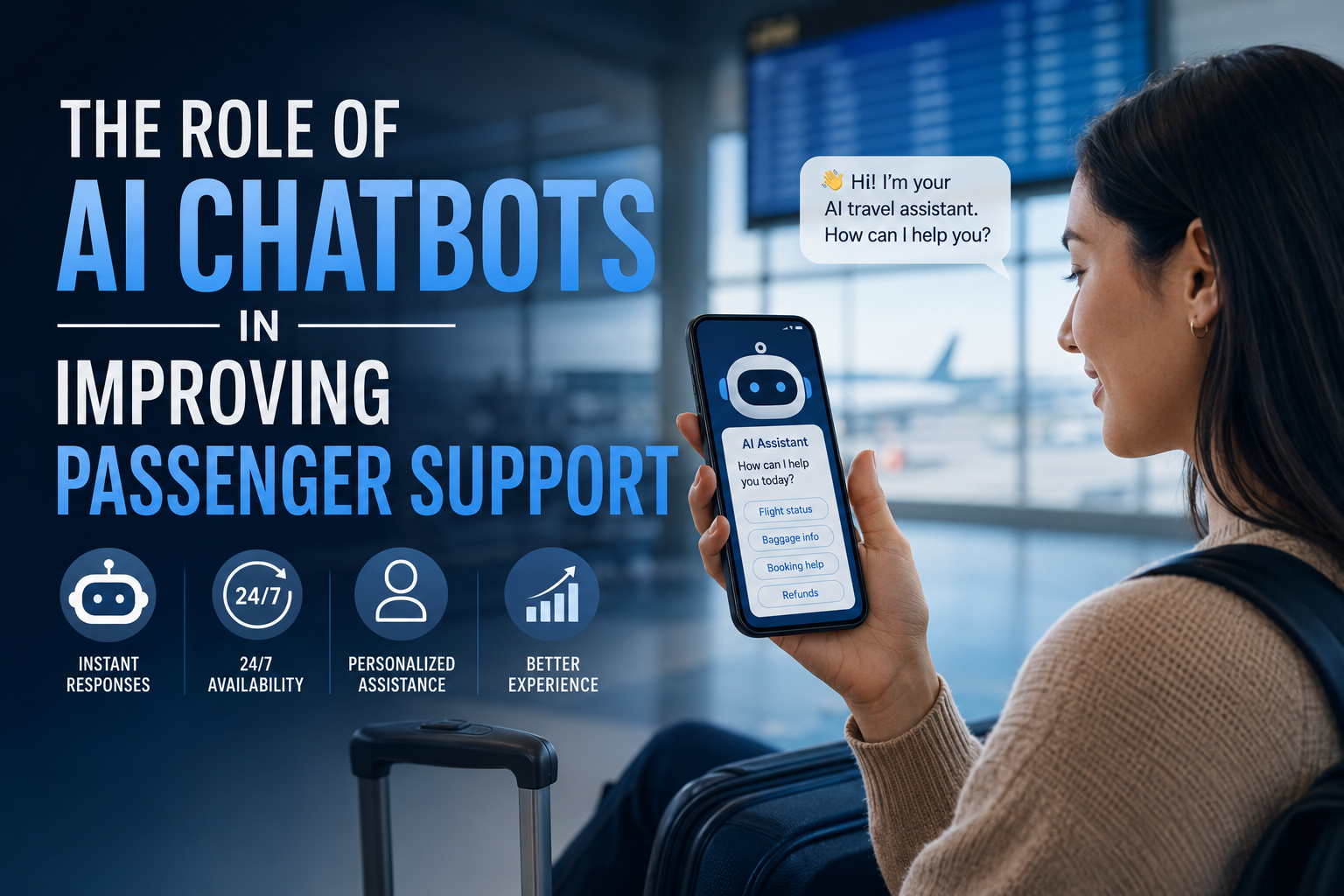
Introduction: The Quiet Revolution at 30,000 Feet
Every year, billions of passengers move through the world’s airports and airline systems, each carrying their own set of expectations, anxieties, questions, and needs. A missed connection, a misplaced bag, a sudden flight cancellation, a medical requirement mid-flight — the complexities of air travel generate an enormous, relentless volume of passenger inquiries that even the largest, best-staffed airline in the world struggles to meet with speed, consistency, and quality.
For decades, the airline industry’s answer to passenger support was a familiar trio: call centers, airport desks, and gate agents — human-powered systems that, while often excellent, are inherently limited by the number of staff available, the hours they work, the languages they speak, and the volume of simultaneous interactions they can handle. During disruptions — storms, strikes, mechanical failures — these systems are overwhelmed almost instantly, leaving thousands of passengers stranded, frustrated, and unassisted.
That is changing. With breathtaking speed, artificial intelligence-powered chatbots have moved from experimental novelty to operational backbone across the global aviation industry. Airlines, airports, online travel agencies, and booking platforms are deploying AI chatbot technology at scale, fundamentally reshaping the relationship between carriers and their passengers.
This article offers a comprehensive, in-depth examination of the role AI chatbots play in improving passenger support — exploring the technology itself, the specific ways it serves travelers, the benefits it delivers to airlines, the challenges it introduces, the ethical questions it raises, and the extraordinary future that lies just ahead.
Understanding AI Chatbots: What They Are and How They Work
Before exploring their role in aviation, it is worth establishing precisely what modern AI chatbots are and how they differ from the simplistic automated phone menus and FAQ bots that gave earlier generations of chatbot technology a frustrating reputation.
A modern AI chatbot in the airline context is typically built on one or more of the following technologies:
Natural Language Processing (NLP) allows the chatbot to understand and interpret human language as it is actually written or spoken — including abbreviations, colloquialisms, typos, regional dialects, and indirect phrasing. Instead of requiring a passenger to type an exact command, NLP-powered chatbots can parse a message like “my bags didn’t come out with everyone else’s, what do I do?” and correctly identify it as a lost baggage inquiry.
Machine Learning (ML) enables chatbots to improve over time. By analyzing millions of past interactions, identifying which responses led to successful resolutions, and continuously updating their models, ML-powered chatbots become more accurate, more contextually intelligent, and better at anticipating passenger needs with each passing month.
Large Language Models (LLMs) — the technology underlying systems like ChatGPT and Google’s Gemini — represent the most advanced frontier of chatbot capability. LLM-powered assistants can engage in extended, nuanced, multi-turn conversations that feel remarkably similar to speaking with a knowledgeable human agent. They can synthesize information from multiple sources, handle ambiguity, and generate responses that are contextually appropriate, grammatically natural, and genuinely helpful.
Integration with airline systems is what transforms a capable language model into a genuinely useful passenger support tool. When a chatbot is connected to an airline’s reservation system, real-time flight data feeds, baggage tracking infrastructure, frequent flyer databases, and payment processing systems, it can not only converse intelligently about a passenger’s situation but actually take action — rebooking flights, issuing refunds, filing baggage claims, and updating seat assignments — without any human intervention.
Together, these technologies create AI chatbot systems that are qualitatively different from anything that came before: responsive, intelligent, continuously improving, and capable of genuine end-to-end problem resolution.
The Scale of the Problem: Why Airlines Needed AI Chatbots
To fully appreciate what AI chatbots offer the airline industry, it is essential to understand the scale of the passenger support challenge they address.
The International Air Transport Association (IATA) estimates that commercial airlines carry more than four billion passengers per year across hundreds of thousands of flights operated by thousands of carriers. Each of those journeys generates potential touchpoints for passenger support: booking inquiries, check-in questions, baggage rules, seat selection, meal preferences, visa requirements, loyalty program queries, delay notifications, cancellation management, compensation claims, and post-flight complaints.
Even in normal operating conditions, the volume of these interactions is staggering. A major international carrier like Delta, Emirates, or Singapore Airlines may receive hundreds of thousands of passenger inquiries per day through phone, email, chat, and social media combined. During a significant disruption — a hub airport closure, a severe weather event, a technology outage — that volume can spike to millions within hours.
Traditional contact center models simply cannot scale to meet these demands. Staff must be trained, managed, and paid. They can only handle one conversation at a time. They work shifts, take breaks, and need days off. They make errors when tired, become frustrated when abused, and sometimes deliver inconsistent information. And while airlines have worked hard to improve their human customer service — investing in training, expanding call center capacity, and deploying offshore support teams — the fundamental arithmetic of human labor makes truly scalable passenger support all but impossible.
AI chatbots change the arithmetic entirely. A single well-designed chatbot deployment can handle millions of simultaneous conversations, at any hour of the day, in dozens of languages, with perfect consistency, zero fatigue, and continuously improving accuracy. For an industry operating at the scale of global aviation, this is not merely convenient — it is transformative.
Core Functions: How AI Chatbots Support Passengers
Modern airline AI chatbots serve passengers across a remarkably broad range of functions. The most significant and impactful are examined below.
1. Booking Assistance and Flight Search
The booking process has historically required passengers to navigate complex fare rules, filter through hundreds of options, and manage the anxiety of making time-sensitive financial decisions. AI chatbots have made this process dramatically more accessible and intuitive.
A passenger can now describe their travel needs in plain, conversational language — “I need a flight from Lagos to London in late November, I prefer a window seat, and I’d like to avoid connections if possible” — and receive a curated set of options tailored to their preferences, complete with fare explanations, baggage allowance details, and instant booking capability.
For passengers who find traditional airline booking interfaces overwhelming — particularly older travelers, those with limited digital literacy, or those booking in a second language — the conversational interface of an AI chatbot dramatically lowers the barrier to completing a reservation accurately and confidently.
Chatbots also excel at upselling and cross-selling in a way that feels helpful rather than pushy. By understanding the context of a passenger’s journey, an AI assistant can proactively suggest relevant upgrades, add-ons like priority boarding or extra baggage, or complementary services like airport transfers and hotel bookings — contributing meaningfully to airline ancillary revenue while genuinely enhancing the passenger experience.
2. Real-Time Flight Status and Disruption Management
One of the most high-value applications of AI chatbots in passenger support is real-time flight information delivery and disruption management — areas where the limitations of traditional support channels are most acutely felt.
When a flight is delayed or cancelled, the resulting surge in passenger inquiries overwhelms human agents almost immediately. Passengers waiting on hold for thirty minutes or more while their rebooking window closes is a common and deeply damaging experience for airline passenger relationships.
AI chatbots integrated with live operational data systems can instantly deliver accurate flight status updates, explain the reason for delays, and proactively notify passengers of changes before they even think to check. More importantly, they can manage the rebooking process autonomously — offering available alternative flights, applying compensation entitlements automatically, issuing meal and accommodation vouchers, and confirming new itineraries — all within minutes and without human agent involvement.
Airlines, including KLM, Lufthansa, Air Asia, and Delta, have deployed chatbot systems capable of managing disruption at scale, with measurable improvements in passenger satisfaction scores and significant reductions in the volume of escalated complaints and refund demands.
3. Check-In and Pre-Flight Support
The pre-flight period — from 24 to 2 hours before departure — is a high-anxiety, high-question-volume window for many passengers. Questions about check-in procedures, document requirements, baggage drop times, security wait times, lounge access, and last-minute seat changes flood airline support channels in this window.
AI chatbots are ideally suited to this moment. Available around the clock, they can guide passengers through the online check-in process step by step, verify document requirements for specific routes and nationalities, confirm boarding pass delivery, explain special assistance procedures, and answer the hundreds of specific, situational questions that arise in the hours before a flight.
By handling this pre-flight support volume autonomously, chatbots free human agents to focus on the complex, high-stakes situations that genuinely require human judgment — a passenger with a medical emergency, a family separated by an overbooking, a visa complication that requires carrier liaison with immigration authorities.
4. Baggage Services and Tracking
Baggage-related inquiries are among the most common and emotionally charged interactions in airline customer service. A passenger arriving at their destination to find their luggage has not followed them is stressed, often stranded without essentials, and urgently in need of clear, accurate information and practical help.
AI chatbots connected to baggage tracking systems can provide real-time status updates on delayed or lost luggage, guide passengers through the property irregularity report (PIR) filing process, explain compensation entitlements, arrange for essential purchase reimbursements, and provide estimated delivery timelines — all without requiring the passenger to queue at a baggage desk or wait on hold.
More sophisticated implementations use AI to proactively contact passengers when their baggage is identified as delayed before they even reach the carousel, getting ahead of the anxiety and beginning the resolution process before the passenger is aware of the problem. This proactive approach — impossible at scale with human agents — has been shown to significantly reduce the emotional intensity of baggage delay experiences and improve overall satisfaction outcomes.
5. Loyalty Program Management
Frequent flyer programs are extraordinarily complex systems with intricate rules about earning, tier qualification, redemption, expiry, partner earning, class of service bonuses, and more. Loyalty program queries have historically been one of the highest-volume categories in airline call centers, consuming significant agent time on matters that are, by and large, information delivery rather than complex judgment calls.
AI chatbots excel at loyalty program support. They can instantly retrieve a passenger’s account status, explain exactly how many miles are needed for a specific redemption, detail the earning rates for an upcoming itinerary, explain tier qualification progress, process straightforward miles redemptions for upgrades or ancillary services, and flag account anomalies for human follow-up.
By deflecting the high volume of routine loyalty inquiries to AI, airlines free their human agents to handle the genuinely complex situations — disputed miles, account security concerns, elite status exceptions — where human judgment and relationship management genuinely add value.
6. Special Assistance and Accessibility Support
One of the most profoundly positive applications of AI chatbots in aviation is the improvement of support for passengers with disabilities, medical conditions, and special needs — a group that has historically been among the most underserved by airline customer service systems.
Arranging wheelchair assistance, confirming the availability of medical oxygen on a specific aircraft, communicating dietary requirements for religious or medical reasons, requesting extra time during boarding, or flagging cognitive or sensory impairments that affect how a passenger should be supported — these are interactions that require accuracy, sensitivity, and follow-through that many traditional customer service interactions fail to deliver consistently.
Well-designed AI chatbots, built with accessibility in mind, can provide a consistent, reliable, and dignified interaction experience for passengers with special needs. They can be designed to interface with screen readers for visually impaired passengers, to communicate in simple language for passengers with cognitive disabilities, and to work seamlessly with TTY/text relay systems for deaf and hard-of-hearing passengers.
By standardizing the special assistance request process through AI, airlines can also improve the reliability of downstream service delivery — ensuring that a request made at booking is accurately communicated to ground handling teams at every point in the journey, rather than being lost in the handoffs between booking systems, check-in counters, and gate agents.
7. Complaint Handling and Compensation Claims
The handling of passenger complaints and compensation claims — particularly those arising from EU261 flight delay and cancellation compensation regulations — is a laborious, legally complex process that has historically been slow, inconsistent, and deeply frustrating for passengers.
AI chatbots are increasingly taking on the initial stages of complaint and claim management, guiding passengers through the information-gathering process, automatically assessing eligibility for statutory compensation, calculating entitlements, and either processing straightforward claims autonomously or routing complex cases to specialist human agents with all relevant information pre-populated.
This AI-assisted process dramatically reduces the time from complaint submission to resolution, improves consistency of outcome, and reduces the administrative burden on human agents — who can focus on the cases that genuinely require discretion, empathy, and negotiation rather than routine eligibility assessment.
Business Benefits: What Airlines Gain From AI Chatbot Deployment
The benefits of AI chatbot deployment extend well beyond improved passenger experience. Airlines that have successfully implemented AI-powered support systems have documented significant business advantages.
Cost reduction is the most immediately quantifiable benefit. Industry estimates suggest that AI chatbot deflection of routine inquiries reduces contact center handling costs by 20 to 40 percent, with leading implementations achieving even greater efficiencies as the technology matures. Given that large carriers operate contact centers employing thousands of agents at significant per-interaction cost, even modest deflection rates translate into hundreds of millions of dollars in annual savings.
Revenue generation through conversational commerce is an increasingly important AI chatbot benefit. As chatbots handle more pre-trip interactions, they become natural vehicles for offering relevant ancillary services — seat upgrades, priority boarding, lounge access, travel insurance — in a contextually appropriate, non-intrusive way. Studies suggest that AI-guided ancillary upselling converts at meaningfully higher rates than traditional banner advertising or checkout-page prompts.
Data capture and insight represent a less visible but strategically important advantage. Every passenger interaction with an AI chatbot generates structured data about what passengers want, what they struggle with, what causes them anxiety, and where operational failures generate the most friction. Analysed intelligently, this data provides airlines with an extraordinarily detailed picture of the passenger experience that was previously impossible to obtain at scale.
Brand differentiation in a fiercely competitive industry is increasingly driven by service quality and passenger experience. Airlines that offer genuinely effective, intelligent, fast, and empathetic AI-powered support create a meaningful competitive advantage, particularly among the frequent-flyer business traveler segment that drives disproportionate revenue.
The Human Factor: AI and the Future of Airline Customer Service Jobs
Any honest examination of AI chatbot technology must engage with the question of its impact on the human workers it displaces or supplements. This is a conversation the airline industry is having — sometimes openly, sometimes with considerable discomfort.
The near-term reality is that AI chatbots are already reducing the volume of work flowing to human contact center agents. Airlines that deploy effective AI deflection systems handle a smaller proportion of their total inquiry volume through human agents. For call center employees — particularly those in lower-cost offshore locations whose primary function has been to handle high-volume, routine inquiries — this represents a genuine threat to employment.
The more optimistic and longer-term view — supported by some, though not all, evidence from the industry — is that AI enables a redeployment rather than elimination of human talent. As routine transactions move to AI, human agents can focus on the interactions that genuinely require their skills: complex multi-leg itinerary rebuilds, emotionally sensitive situations involving bereavement or serious medical emergencies, high-value customer retention conversations, and the nuanced relationship management that distinguishes great carriers from merely adequate ones.
The reality, as with most technology-driven labor market shifts, is likely to be somewhere between these poles — with net job displacement in certain categories and job creation in others, and a transition period that is disruptive for individuals even if broadly positive for the industry.
Challenges and Limitations: Where AI Chatbots Fall Short
For all their promise, AI chatbots in aviation are not without significant limitations and challenges that airlines must honestly acknowledge and actively manage.
Emotional intelligence remains the most persistent gap between AI and human support. When a passenger has missed a connecting flight to a family funeral, when a child is travelling alone and is frightened and confused, when a passenger has had a deeply distressing experience of discrimination or harassment — these situations demand empathy, genuine human warmth, and the kind of attentive presence that current AI systems cannot reliably deliver. Deploying a chatbot as the primary or sole response to emotionally charged situations risks compounding distress rather than alleviating it.
Complexity and ambiguity challenge even the most advanced AI systems. Highly unusual itineraries, tickets issued through complex interline agreements, bookings involving multiple airlines, and situations involving overlapping regulatory frameworks can stretch AI capabilities to their limits, generating responses that are technically accurate in narrow senses but miss the passenger’s actual need.
Language and cultural nuance present ongoing challenges. While NLP has advanced dramatically, regional dialects, culturally specific expressions, and the full range of human communicative creativity continue to generate misunderstandings in AI interactions, particularly for passengers communicating in languages that are less well-represented in training data.
Trust and passenger acceptance vary significantly across demographic groups. Older travelers, in particular, often express strong preferences for human interaction and frustration with being “fobbed off” by automated systems. Forcing AI interactions on passengers who do not want them risks destroying the goodwill that effective AI deployment is supposed to build.
System integration complexity means that even technically capable chatbots are frequently limited by the quality and accessibility of the data they can access. An AI chatbot that cannot reliably pull real-time information from a legacy reservation system, or that cannot actually execute a rebooking in a carrier’s infrastructure, cannot deliver on the promise of end-to-end resolution — and a chatbot that confidently delivers incorrect information is actively harmful.
Case Studies: Airlines Leading the Way in AI Passenger Support
Several airlines and aviation organizations have become recognized leaders in the deployment of AI chatbot technology for passenger support.
KLM Royal Dutch Airlines has been among the most ambitious adopters of AI-powered passenger support, deploying chatbot technology across Facebook Messenger, WhatsApp, and its own website. KLM’s AI assistant handles booking queries, sends boarding passes, delivers flight status updates, and manages post-flight surveys — processing hundreds of thousands of conversations per week with high satisfaction rates and measurable cost efficiencies.
Air India launched its AI chatbot “Maharaja” (later rebranded) to handle the massive volume of passenger inquiries generated by one of the world’s most complex aviation markets. The system handles multiple Indian languages, manages the particular complexities of domestic and international Indian travel documentation, and has significantly reduced pressure on the carrier’s human contact centers.
Lufthansa Group has integrated AI chatbot capability across its group carriers, with a particular focus on disruption management. The system’s ability to process mass rebookings during major hub disruptions — offering personalized alternatives to thousands of affected passengers simultaneously — has been highlighted as a model for industry-wide adoption.
Singapore Changi Airport — consistently rated the world’s best airport — has extended AI-powered passenger support beyond the airline itself to the airport experience, deploying conversational AI to assist with terminal navigation, shopping recommendations, immigration queue information, and ground transportation options.
The Future of AI Chatbots in Passenger Support
The AI chatbot technology deployed across aviation today is, from the perspective of the technology’s trajectory, still relatively early-stage. The developments anticipated over the next five to ten years suggest a future of passenger support that is dramatically more capable, more personalized, and more deeply integrated into the entire travel experience.
Voice-first interfaces will increasingly replace text-based chat, allowing passengers to interact with AI support systems through natural speech — on their phone, through in-cabin intercom systems, via smart earbuds, or through voice-activated devices at airport kiosks and lounges.
Hyper-personalization enabled by AI’s ability to synthesize a passenger’s complete travel history, stated preferences, loyalty status, and real-time context will allow chatbot interactions to feel genuinely individualized. An AI that knows a passenger always prefers aisle seats, regularly travels with a musical instrument, has a severe nut allergy, and values lounge access above price can anticipate and address their specific needs without being asked.
Proactive rather than reactive support will become the norm. Rather than waiting for passengers to experience a problem and initiate contact, AI systems will monitor each passenger’s journey in real time, identifying potential issues before they materialize and proactively offering solutions — rerouting a connecting passenger who is at risk of missing their connection, arranging alternative transport when a flight lands late and ground transport is missed, or flagging a passport expiry risk before a passenger arrives at the airport.
Multimodal AI — systems that can process and respond to text, voice, images, and documents simultaneously — will enable passengers to photograph their boarding pass, their luggage tag, or an airport sign and receive instant, contextually relevant assistance without needing to type or even speak.
Emotional AI capable of detecting distress, frustration, or confusion in a passenger’s tone or word choice and responding with appropriately calibrated empathy — escalating to human agents when emotional intensity crosses defined thresholds — will address one of the most persistent current limitations of chatbot support.
Ethical Considerations: Privacy, Data, and Passenger Trust
The deployment of AI-powered passenger support raises important questions about data privacy, informed consent, and the appropriate boundaries of AI capability that the airline industry cannot afford to treat as secondary concerns.
AI chatbot systems learn from passenger interactions. Every conversation that improves the system’s accuracy also represents a record of a passenger’s queries, concerns, travel plans, medical requirements, and personal circumstances. How that data is stored, how long it is retained, who has access to it, whether it is shared with third parties, and how it is protected against breach are questions that passengers have every right to ask, and airlines have every obligation to answer honestly.
Regulatory frameworks, including the European Union’s General Data Protection Regulation (GDPR) and emerging AI regulations, impose significant obligations on airlines deploying AI systems that process personal data — including transparency requirements about how AI is used in passenger interactions and data subject rights to access, correct, and delete personal information.
Beyond data privacy, the question of transparency about AI in passenger interactions is increasingly important. When passengers believe they are communicating with a human agent and discover they have been talking to a chatbot, the experience of deception — even if technically legal — significantly damages trust. Best-practice guidelines increasingly suggest that airlines should be upfront about the use of AI in their support systems, presenting it as a feature rather than concealing it as a convenience.
Conclusion: A New Chapter in the Passenger Experience
The rise of AI chatbots in airline passenger support is not a passing trend or a cost-cutting gimmick. It represents a fundamental shift in the architecture of how airlines communicate with, serve, and build relationships with the billions of travelers who depend on them.
At its best, AI chatbot technology delivers something genuinely valuable to passengers: support that is always available, instantly responsive, consistent in quality, available in any language, and capable of resolving problems end-to-end without the delays, holds, transfers, and inconsistencies that have long characterized airline customer service. For travelers with disabilities, language barriers, limited technological confidence, or simply very high standards for speed and quality, well-designed AI support can represent a meaningful improvement in the experience of flying.
At its best for airlines, it delivers operational efficiencies, competitive differentiation, revenue growth, and data-driven insight that transform the economics and strategy of passenger relations.
The challenges — emotional intelligence gaps, system integration complexity, data privacy obligations, passenger acceptance — are real and must be taken seriously. The most successful implementations in the industry share a common characteristic: they view AI not as a replacement for human connection but as a complement to it, handling what machines do best so that humans can do what they do best.
The future passenger support landscape will be one in which AI and human agents work together seamlessly, each playing to their strengths, with technology serving not to remove the human from the equation but to make human attention available where it matters most. That is a future worth building — and the most forward-thinking airlines are already building it.