


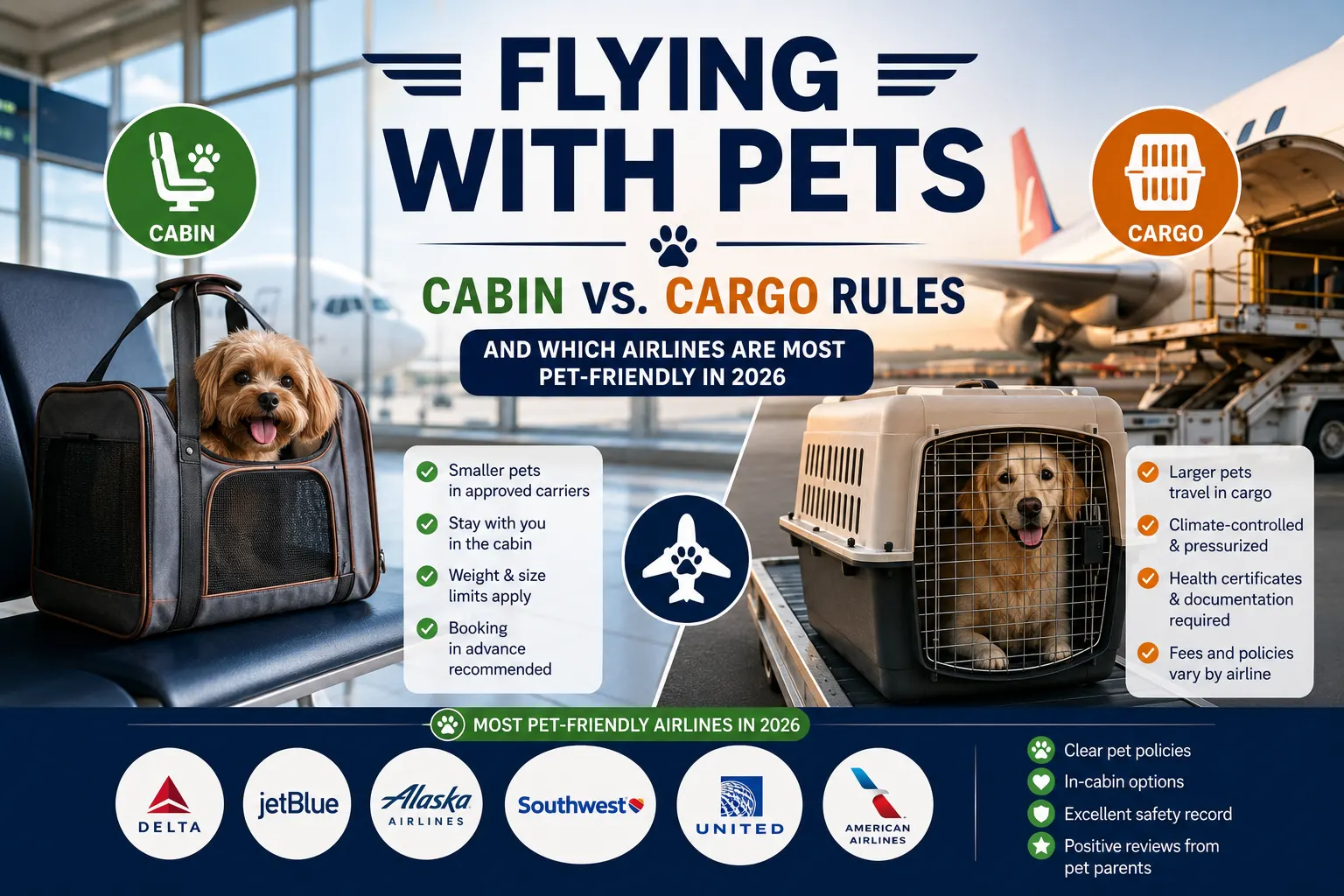
For millions of pet owners, “can I bring my dog” isn’t a small detail in trip planning — it’s the deciding factor in whether a trip happens at all. Yet airline pet policies remain some of the most fragmented, inconsistently enforced rules in air travel. One carrier treats a 20-pound dog as a routine under-seat passenger; another won’t touch any animal heavier than a house cat without routing it through a cargo hold. One charges $35; another charges $150 for the same itinerary.
This guide breaks down the real mechanics of cabin versus cargo pet travel, what each airline actually allows in 2026, and how to avoid the costly mistakes — wrong carrier dimensions, missed temperature embargoes, banned breeds — that get pets bumped at the gate.
Cabin vs. Cargo: The Fundamental Difference
The distinction between cabin and cargo pet travel isn’t just about comfort. It’s a different regulatory category, a different price structure, and a different risk profile entirely.
In-cabin travel means your pet rides in the passenger compartment, inside an airline-approved carrier that fits under the seat in front of you, for the entire flight. The pet stays with you. It’s treated functionally like an extra piece of carry-on luggage, and most airlines that allow it cap eligibility by carrier size rather than a strict pet weight limit — if the animal and carrier fit under the seat, it generally qualifies. Practically, that means roughly 15 to 20 pounds for the pet and carrier combined on most major U.S. carriers.
Cargo travel means the pet flies in the climate-controlled hold of the aircraft, in a hard-sided kennel, separate from its owner. This is a completely different operation — one that involves loading procedures, temperature monitoring, and far more paperwork. Very few major U.S. airlines still offer general cargo pet transport to the public in 2026; American and United have restricted their cargo programs to military and State Department personnel, while a small handful of carriers, notably Alaska, continue to serve ordinary pet owners.
There’s also a third, often-overlooked category: checked pet travel, distinct from cargo, where some regional or interisland carriers (Hawaiian Airlines being the best-known example) allow a pet to be checked as baggage rather than shipped through a separate freight process.
Why Most Owners Should Default to Cabin Travel
Industry-wide data shows average in-cabin pet fees clustering around $150 per segment, while average cargo fees for animals run closer to $500 per journey — making cabin travel the dramatically better value whenever your pet is small enough to qualify. Beyond cost, cabin travel keeps the animal with you, avoids temperature swings in the hold, and removes the loading/unloading risk that has made cargo pet transport a source of controversy for decades. If your pet can physically fit under an airline seat in an approved carrier, cabin is almost always the right call.
In-Cabin Pet Travel: Rules, Costs, and Requirements
Carrier Size and Type
Every airline publishes its own maximum carrier dimensions, and they’re not interchangeable. Most airlines allow carriers up to roughly 18 by 11 by 11 inches, though Alaska and Hawaiian require smaller carriers around 17 by 11 by 9.5 inches, while Southwest is the most generous at 18.5 by 13.5 by 9.5 inches. Soft-sided carriers are generally preferred over hard-sided ones because they compress slightly to fit into tight under-seat spaces — a hard-sided carrier that’s a half-inch too tall can get a pet denied boarding even if the airline’s stated maximum technically allows it.
A critical, frequently-missed detail: if your itinerary includes a regional jet operated by a different fleet (for example, American Eagle aircraft), the under-seat space can be meaningfully smaller than on the airline’s mainline aircraft. A carrier that fits fine on a mainline 737 can fail to fit under the seat of a 50-seat regional jet on a connecting leg.
Where the Pet Counts as Your Carry-On
On most airlines, bringing a pet in-cabin means giving up one of your other carry-on allowances — typically you trade a personal item for the pet carrier. Whatever the policy, the carrier must remain closed and stay under the seat for the entire flight — there is no lap time, and flight attendants are required to enforce this even mid-flight.
2026 In-Cabin Fees by Airline
| Airline | In-Cabin Fee (each way) | Notes |
| Hawaiian (interisland) | $35 | Best deal in U.S. aviation, interisland only |
| Alaska Airlines | ~$100 | One of the cheapest full-service carriers for in-cabin pets |
| Frontier Airlines | $99 | Lowest fee among widely available U.S. carriers; accepts dogs, cats, rabbits, guinea pigs, hamsters, and small household birds |
| Southwest Airlines | $95–$100 | Flat rate regardless of route length; cabin-only |
| JetBlue | $125–$150 | Slightly more forgiving carrier dimensions than Southwest |
| Delta Air Lines | $150 domestic, $200 international | Raised from $95 to $150 in early 2026 |
| United Airlines | $150 domestic | Plus a $125 layover fee for connections longer than 4 hours domestic or 24 hours international |
| American Airlines | $150 | Most expensive in-cabin fee among major U.S. carriers |
A practical budgeting note that catches many travelers off guard: fees are charged per carrier, per segment, meaning a round trip with one connection each way could mean paying the fee four separate times rather than once per round trip.
Cargo and Checked Pet Travel: What You Need to Know
Temperature Embargoes
Cargo holds are climate-controlled, but airlines still impose strict seasonal and route-based temperature limits to protect animals during ground handling, when they’re briefly exposed to ambient conditions on the tarmac. American Airlines Cargo’s PetEmbark policy transports warm-blooded animals only when temperatures are between 45 and 85°F, refuses transport above 85°F or below 20°F, and requires a veterinary acclimation letter for temperatures between 20 and 44°F. These rules apply not just at the departure and arrival airports, but at every layover city along the itinerary — a connection through Phoenix in July can ground a cargo pet shipment even if the origin and destination cities are well within range.
This is why American Airlines bars cargo pet transport to and from Phoenix, Tucson, Las Vegas, and Palm Springs from May through September, regardless of the forecast on any given day.
Breed Restrictions
Brachycephalic, or “snub-nosed,” breeds face the tightest restrictions, and for a physiological reason: their shortened airways make them disproportionately vulnerable to respiratory distress under the stress, reduced oxygen, and temperature variation of cargo holds. French Bulldogs, Pugs, and Boxers are restricted from cargo travel across nearly every major airline due to breathing risks, even when the same breeds are permitted to fly in the cabin with no issue. Some carriers go further: Delta bans pit bull–type dogs entirely, in both cabin and cargo, regardless of size or temperament.
Where Cargo Still Exists for the General Public
The cargo landscape has narrowed sharply in recent years. As of 2026, only Alaska Airlines and Hawaiian Airlines still offer general-public cargo pet transport among major U.S. carriers; American and United have restricted cargo pet service to active-duty military with PCS orders and State Department employees with Foreign Service orders. Civilian owners of larger pets who once relied on programs like United’s PetSafe now generally need to use licensed, IATA-compliant pet relocation companies instead of booking cargo directly through the passenger airline.
Where it remains available, Alaska allows pets up to 150 pounds, including the kennel, in its climate-controlled baggage and cargo compartments, making it a rare option for owners of large dogs who still want to fly with a major carrier rather than a specialized pet shipper.
Which Airlines Are Most Pet-Friendly in 2026
Comparison Table: Major U.S. Airlines
| Airline | Cabin | Cargo (Public) | Cabin Fee | Species Accepted | Standout Feature |
| Alaska Airlines | Yes | Yes, up to 150 lbs | ~$100 | Dogs, cats, rabbits | Allows two small pets per passenger if they fit comfortably in one carrier |
| Hawaiian Airlines | Yes | Checked baggage option | $35 interisland | Dogs, cats | Cheapest fee in U.S. aviation |
| Frontier Airlines | Yes | No | $99 | Dogs, cats, rabbits, guinea pigs, hamsters, small birds | Widest species range, online booking |
| Southwest Airlines | Yes | No | $95–$100 | Dogs, cats | Flat rate regardless of distance |
| JetBlue | Yes | No | $125–$150 | Dogs, cats | Slightly larger effective carrier fit |
| Delta Air Lines | Yes | Limited, seasonal | $150 | Dogs, cats | No pit bull–type dogs, any class |
| United Airlines | Yes | Military/State Dept. only | $150 + layover fee | Dogs, cats | Discontinued public PetSafe cargo |
| American Airlines | Yes | Limited routes only | $150 | Dogs, cats | Bans cabin pets in bulkhead and exit rows |
| Spirit Airlines | No | No | — | None | Pets not accepted at all |
Independent testing backs Alaska’s reputation as the category leader: Alaska Airlines scored highest among major U.S. carriers in NerdWallet’s 2026 pet-friendliness analysis, earning 57 out of 60 possible points for combining clear policies, reasonable fees, and a relatively low-friction booking process — though one knock against it is that pet reservations must be made by phone or chat rather than online.
International Standouts
Outside the U.S., a few carriers have built reputations specifically around pet handling infrastructure rather than just policy on paper. Lufthansa is widely regarded as Europe’s benchmark for pet travel, accepting pets in cabin, checked baggage, and cargo, and operating an Animal Lounge at Frankfurt Airport that handles thousands of pets annually under temperature-controlled, round-the-clock supervision. Qatar Airways runs a comparable Live Animal Center at Doha Airport for cargo and checked pet transport, and on select short-haul routes both Turkish Airlines and Qatar Airways occasionally permit small pets in business class when seat space allows, though this varies by aircraft and should never be assumed without direct confirmation.
International Pet Travel: Documentation and Quarantine
International pet travel adds a layer of bureaucracy that domestic flights don’t require. Domestically, most U.S. airlines require only a health certificate issued by a vet within 10 days of travel plus proof of rabies vaccination, but international travel requires a USDA-endorsed health certificate on APHIS Form 7001 along with destination-specific documents such as microchip records, titer tests, and import permits.
A few jurisdictions deserve special attention because their rules surprise even experienced travelers:
Hawaii. Most U.S. airlines don’t require a health certificate for domestic travel within the continental United States, but Hawaii maintains its own strict quarantine and health certificate requirements independent of standard mainland rules, owing to the state’s rabies-free status.
United Kingdom. Pets generally cannot travel as carry-on to the U.K., and American Airlines specifically states that aside from service animals, checked pets cannot travel to the U.K. or Ireland at all — though dogs and cats can be transported to London Heathrow and Manchester through American Airlines Cargo. The U.K. government’s own guidance reinforces this: outside of charter flights or assistance dogs, pets generally must travel as cargo when entering the country.
South America. Several South American markets — including Brazil, Argentina, Chile, Colombia, and Uruguay — do not permit carry-on pets at all on American Airlines, regardless of pet size.
CDC high-risk rabies countries. Airlines will not accept carry-on dogs that have traveled to a CDC-designated high-risk rabies country within the past six months, which means owners with recent international travel history need to plan an alternative routing strategy well before booking.
Service Animals, Emotional Support Animals, and Pets: Know the Difference
This distinction matters enormously for cost, because the categories are treated very differently under federal rules. Trained service animals, governed by the Air Carrier Access Act, fly free and aren’t subject to pet fees or carrier-size restrictions in the same way. Emotional support animals, by contrast, lost their special status in a 2020 Department of Transportation rule change, and every major U.S. airline now treats emotional support animals as standard pets — meaning the same fees and the same carrier requirements apply. Documentation from a licensed mental health professional is still required for an emotional support animal in many circumstances, but that paperwork no longer waives the pet fee the way it once did.
Worth flagging directly: claiming a pet is an emotional support or service animal to dodge fees when it doesn’t meet the legal definition isn’t a loophole — airlines have tightened verification specifically in response to this practice, and misrepresentation can result in denied boarding or removal from the flight.
How to Choose Between Cabin and Cargo for Your Pet
A few real-world scenarios illustrate how the math and the risk actually play out.
Scenario 1: A 12-pound cat, domestic round trip, one connection each way. This is the easiest case. On Alaska, the in-cabin fee runs roughly $100 each way, so $200 for the round trip — but because fees are charged per segment, a one-stop connection each way means paying the fee twice per direction, bringing the realistic total closer to $400. Booking a nonstop itinerary instead, even at a slightly higher airfare, often saves more in pet fees than it costs in ticket price.
Scenario 2: A 65-pound Labrador, domestic one-way move. This dog doesn’t qualify for any cabin program. With United and American’s general cargo service no longer available to civilians, the realistic options narrow to Alaska’s cargo service (up to 150 pounds, including kennel) or a licensed IATA-compliant pet relocation company. Expect to pay between $200 and $500 or more for a one-way domestic cargo shipment, depending on weight, distance, and seasonal temperature restrictions at the departure, layover, and arrival cities.
Scenario 3: A French Bulldog, any cargo routing. Because of brachycephalic breed restrictions, cargo simply isn’t an option on nearly any major carrier, regardless of price. If the dog doesn’t fit under an airline seat in cabin, the realistic alternatives become ground transport, a pet-specific charter service, or a carrier like JSX, which allows dogs over 70 pounds to fly on a purchased adjacent seat, though its route network is limited.
The Real Cost of Flying With a Pet: A Worked Example
Take a hypothetical family flying a 14-pound dog round-trip from Chicago to Denver with a connection each way, on a carrier charging $150 per segment.
- Outbound, leg 1: $150
- Outbound, leg 2 (connection): $150
- Return, leg 1: $150
- Return, leg 2 (connection): $150
- Total pet fees: $600 — potentially exceeding the cost of the human passenger’s own ticket.
Switching to a nonstop itinerary on the same airline cuts that to $300. Switching to a nonstop on Frontier or Alaska cuts it further, to roughly $198–$200. The lesson holds across nearly every airline: connections multiply pet fees in a way that often dwarfs any savings from a cheaper connecting fare, making nonstop routing the single highest-leverage decision a pet owner can make when booking.
Common Mistakes That Get Pets Denied Boarding
A pattern shows up repeatedly in airline pet-policy complaints, and nearly all of it is avoidable with research done before booking rather than at the gate:
Booking a hard-sided carrier that meets an airline’s listed maximum dimensions on paper but doesn’t compress to fit under a regional jet’s smaller seat — soft-sided carriers have far more margin for error. Assuming a connecting itinerary’s layover city won’t trigger a temperature embargo, when in fact every city on the route, including layovers, is checked against the airline’s heat and cold limits. Not confirming carrier capacity per flight; popular routes can sell out their limited pet slots days in advance, even when seats for human passengers remain available. And booking an emotional support animal under outdated assumptions about fee waivers that no longer apply under current DOT rules.
Frequently Asked Questions
Which airline is the cheapest for flying with a pet? Among interisland-only options, Hawaiian Airlines’ $35 fee is the lowest in U.S. aviation, though it only applies between the Hawaiian islands. For widely available domestic routes, Frontier at $99 and Alaska at roughly $100 are the cheapest mainstream options.
Can I bring a pet in cargo on any major U.S. airline? Increasingly, no. As of 2026, general cargo pet service for civilians is limited mainly to Alaska Airlines and Hawaiian Airlines among the major carriers; American and United now restrict cargo to military and State Department personnel.
Do emotional support animals fly free? No, not anymore. Since the 2020 DOT rule change, emotional support animals are treated as standard pets on every major U.S. airline, subject to the same fees and carrier requirements as any other pet. Only trained service animals are exempt from fees under federal law.
What breeds are banned from flying? Restrictions vary by airline and by cabin versus cargo. Brachycephalic breeds like French Bulldogs, Pugs, and Boxers are commonly restricted from cargo travel across most carriers due to respiratory risk, while a small number of airlines, including Delta, ban certain breeds like pit bull–type dogs entirely, in both cabin and cargo.
Do I need a health certificate to fly with my pet? For most domestic U.S. flights, no — though Hawaii is a notable exception with its own quarantine and certification requirements. International travel almost always requires a USDA-endorsed health certificate along with destination-specific documents.
Can my pet sit on my lap during the flight? No. Every major airline that allows in-cabin pets requires the carrier to remain closed and stowed under the seat for the entire flight, with no exceptions for lap time, even briefly.
In another related article, Van Life 101: Everything You Need to Start Your RV Adventure