



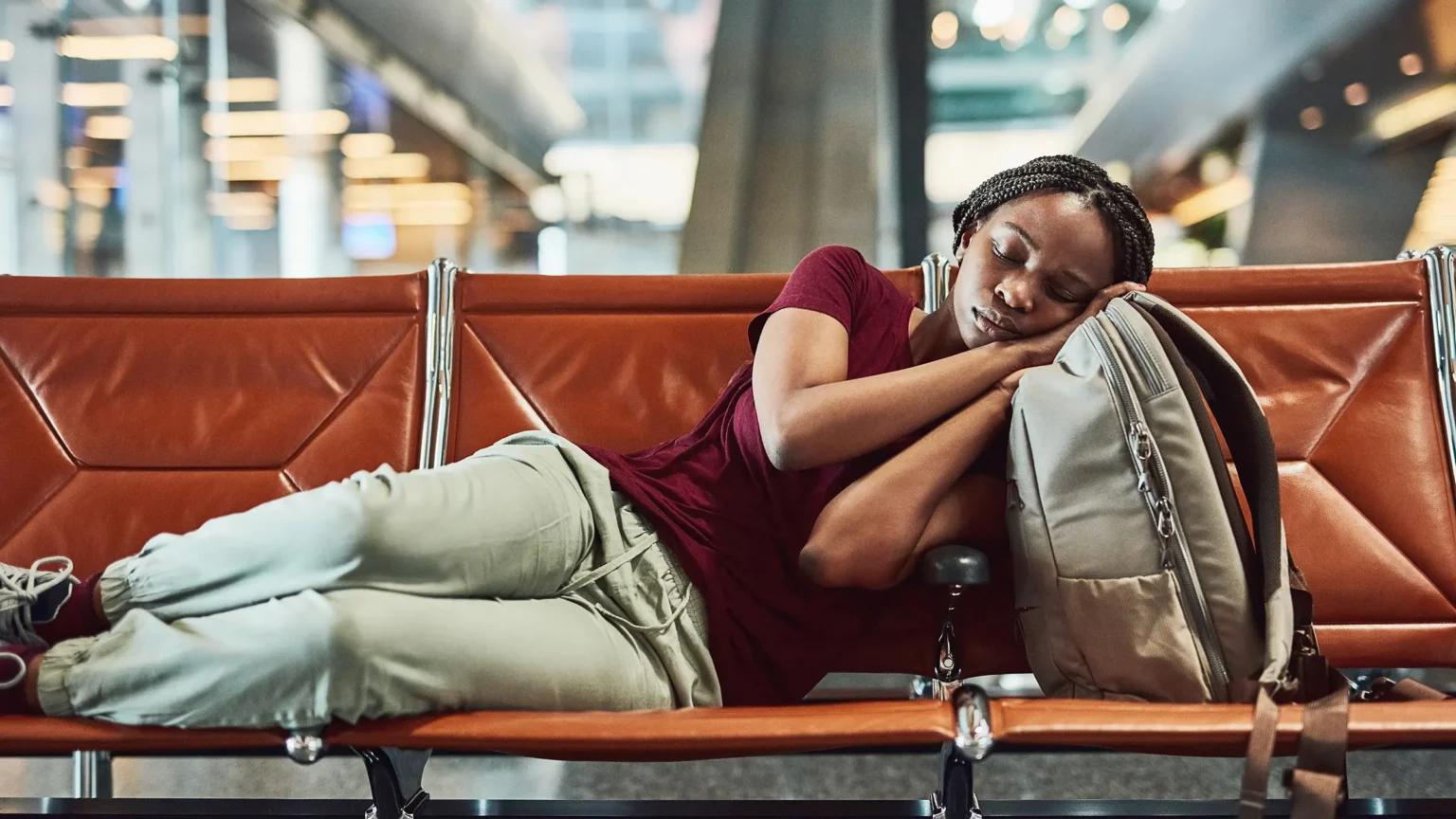
Nobody plans to sleep at an airport. It happens — a red-eye connection that leaves a six-hour gap, a flight cancellation that strands you until morning, a budget itinerary that made more sense on paper than it does at 1 a.m. in a deserted terminal. Whatever brought you there, the airport overnight is one of travel’s most universally dreaded experiences.
But here’s what frequent travelers know that occasional flyers don’t: sleeping at an airport doesn’t have to be miserable. With the right preparation, the right mindset, and knowledge of a few key strategies, you can get surprisingly decent rest — enough to arrive at your destination functional, if not fully refreshed.
This guide covers everything: how to find the best sleeping spots in any terminal, what gear makes the difference between a terrible night and a tolerable one, how to stay safe while you sleep, which airports are genuinely sleep-friendly, and what to do when the environment is working against you. By the end, you’ll have a complete system for surviving — and even managing — an overnight airport stay.
Why Airport Overnights Are So Hard (And Why They Don’t Have to Be)
The airport environment is engineered against sleep. Lighting is bright and constant — airports operate 24 hours and are designed to keep people alert, moving, and spending. Public address announcements cut through the silence at unpredictable intervals. Hard seating, deliberately armrest-divided to prevent lying down, lines every gate. Climate control swings between aggressively cold and inexplicably humid. Fellow stranded travelers, cleaning crews, and security personnel cycle through at all hours.
And yet people sleep in airports every single night — successfully. The difference between the traveler curled miserably on a plastic chair and the one who actually gets four hours of usable rest comes down almost entirely to preparation and knowledge. The airport isn’t going to become comfortable for you. You have to become prepared for the airport.
Step One: Assess Your Situation the Moment You Know You’re Staying
The first 15 minutes after you realize you’re spending the night at an airport are the most important. How you use that time determines everything that follows.
Find Out If You’re Airside or Landside
Airside means you’re past security, in the gates area. Landside means you’re in the public-access zone before security. This distinction matters enormously for overnight sleeping.
Airside is almost always preferable. It tends to be quieter after the last departures of the evening, it has fewer random members of the public walking through, and — critically — you don’t have to go through security again in the morning when you’re groggy and disoriented. If you’re airside, stay there. If you’re landside and your ticket allows re-entry, consider going through security immediately and claiming your spot before other stranded travelers get there first.
Some airports, however, close their airside sections overnight and move all passengers back through security into the public terminal. This typically happens at smaller regional airports and some international terminals that don’t operate 24 hours. Ask airport staff immediately if this is the case so you’re not relocated at 2 a.m. without warning.
Confirm the Airport Is Open All Night
Most major hub airports — Atlanta Hartsfield, Chicago O’Hare, LAX, Heathrow, Dubai, Singapore Changi — operate continuously. But mid-size and regional airports sometimes close entirely overnight, which means everyone gets moved out. If you’re at an airport you’re unfamiliar with, ask staff or check the airport’s website to confirm 24-hour operation. Finding this out at midnight rather than 3 a.m. gives you options.
Talk to Your Airline First
Before accepting that you’re simply stuck, speak to your airline. If your overnight was caused by a cancellation or a significant delay that is the airline’s fault — mechanical issues, crew problems, operational failures — you may be entitled to a hotel voucher. Airlines are not legally required to provide hotels for weather-related delays in the United States, but many will offer meal vouchers or hotel accommodation for controllable delays, particularly for passengers with elite status or those who ask firmly and politely at the counter.
Even if you don’t get a hotel, you may get meal vouchers, lounge access passes, or a confirmed rebooking that changes your departure time — all of which affect how you plan your night.
Finding the Best Sleeping Spots in Any Terminal
Once you know you’re staying, the next mission is location. Not all areas of an airport are equally sleep-friendly, and the best spots go fast.
The Golden Rule: Get Away from the Main Thoroughfare
The primary corridors, central halls, and food court areas of any airport are the worst places to try to sleep. They have the highest foot traffic, the loudest PA announcements, the brightest lighting, and the most cleaning activity. Your goal is to find a secondary gate area — a concourse with late-night or early-morning departures where seats are available, but traffic is low.
Walk the full concourse before settling. Look for:
- Gates at the far ends of concourses — These are often quieter, less trafficked, and have seating clusters that feel slightly removed from the main flow.
- Gates with early morning departures — If your flight is at 6 a.m. and the gate next to it departs at 5:45, there will be other passengers there, but it will be organized and relatively calm. Avoid gates with departures in the next 60–90 minutes.
- Carpeted areas — Some airports have carpeted sections near gates or in lounge-adjacent corridors. Carpet is significantly more comfortable than a hard floor and absorbs sound better. If you end up on the floor, carpet is a meaningful upgrade.
- Quieter concourses — In multi-concourse airports, some terminals are dramatically quieter overnight than others. At Atlanta Hartsfield, for example, international concourses see less overnight traffic than domestic ones. At LAX, terminals vary significantly in overnight noise levels.
Seating Types and What to Look For
Ideal overnight seating has three characteristics: it’s padded, it doesn’t have fixed armrests between every seat, and it faces away from the main walkway.
Best seating options:
- Padded bench seating without center armrests (increasingly rare but present in some newer terminals)
- Curved or pod-style seating is found in some modernized airports
- Charging station clusters that sometimes feature padded seating
- Rocking chairs (yes, some airports have them — Charlotte Douglas is famous for its rocking chairs)
Worst seating options:
- Standard plastic chairs with fixed armrests between every seat
- Metal benches near baggage claim or ground transportation
- Food court seating, which is actively uncomfortable and often cleaned aggressively overnight
If seating is uniformly terrible, the floor near your gate with your back against the wall is sometimes genuinely more comfortable than a torturous plastic chair. Lay your jacket down as padding, use your bag as a pillow, and accept that you’re floor-camping.
The Floor Strategy
Experienced airport sleepers know that the floor — done correctly — beats bad seating. Key floor sleeping spots:
- Carpeted corners near gates — Low foot traffic, some acoustic buffering, out of the cleaning path
- Behind seating rows — The space behind a row of gate seats, between the seats and the window, is often unused and provides some shelter from walking traffic
- Near windows during daylight/warmth — Window areas can be warm and sunlit in the morning, which helps with waking up
Avoid floor sleeping near: bathrooms (high traffic, odor, wet floors from cleaning), food vendors (noise, smell, bright lighting), and main corridors (cleaning machines, foot traffic).
The Gear That Changes Everything
The single biggest predictor of whether an airport overnight is survivable is whether you came prepared. If you’re planning an itinerary that involves an overnight gap, or if you’re a frequent traveler who occasionally gets stranded, keeping a few items in your carry-on permanently transforms the experience.
Eye Mask
Airport lighting does not dim. It does not respect your circadian rhythm. It is bright, fluorescent, and relentless. An eye mask is the single most impactful piece of sleep gear you can carry. A contoured sleep mask — one that cups slightly away from your eyes rather than pressing directly against your lids — is the most comfortable for extended wear. It costs almost nothing, weighs nothing, and the difference between trying to sleep under airport lighting with and without one is dramatic.
Earplugs or Noise-Canceling Headphones
PA announcements, cleaning machines, other passengers, crying children, the ambient roar of an airport that never fully quiets — all of this disappears with good ear protection. Foam earplugs are cheap, lightweight, and highly effective. Noise-canceling headphones are better but bulkier. If you already carry headphones for the flight, use them. Play white noise, rain sounds, or simply engage the noise cancellation without audio. The reduction in ambient noise materially improves your ability to fall and stay asleep.
Neck Pillow
A quality neck pillow serves double duty: it supports your head when you’re sitting upright in unavoidable fixed-seat situations, and it makes floor sleeping significantly more comfortable as a compact head pillow. Inflatable neck pillows pack down to almost nothing and are worth carrying if overnight travel is any part of your regular itinerary.
Packable Layer or Travel Blanket
Airports are cold. Not uniformly, not predictably, but reliably cold enough that sleeping without an extra layer is uncomfortable. Climate control systems that work fine when terminals are full of moving, heat-generating passengers are often overpowered when applied to a quiet terminal with 30 sleeping travelers. Pack a light packable jacket, a pashmina, or a compact travel blanket. If you have none of these, a spare layer from your checked bag — if you have carry-on only — may be worth digging out.
Portable Battery Pack (Power Bank)
Two reasons: your phone is your alarm clock, and you should not sleep in an airport without an alarm set. A dead phone means no alarm, which means missing your flight. A charged power bank eliminates this risk. It also lets you charge away from crowded outlet areas, which means you don’t have to sleep in an uncomfortable position tethered to a wall outlet in a high-traffic zone.
Small Padlock
If your carry-on bag or backpack has zipper pulls that can be looped together, a small TSA padlock lets you secure the bag to your body or to the seat frame while you sleep. This isn’t foolproof — it’s a deterrent, not a vault — but it significantly reduces opportunistic theft risk. Loop the strap around your leg or arm before you close your eyes.
Staying Safe While You Sleep
Safety is the legitimate anxiety that keeps many travelers from sleeping at all in airports. The concern is real — airports are public spaces with variable security presence, and you are vulnerable when asleep. But with the right approach, the risk is manageable.
Keep Valuables on Your Body
Your passport, wallet, phone, and boarding pass should never be in a bag you’re not physically connected to while sleeping. Money belts, interior jacket pockets, or simply front trouser pockets with your hand resting over them are all better than any bag. This is the core rule, and it overrides convenience.
Use Your Bag as a Pillow or Anchor
Your carry-on should either be under your head (padding plus proximity), between your feet, or with the strap looped around your ankle or wrist. The goal is that any attempt to move the bag wakes you. You don’t need to be paranoid — most airport theft is opportunistic, targeting bags left unattended while travelers walk to the bathroom or leave to get food. Make your bag non-opportunistic.
Sleep Near Other People (Selectively)
Sleeping completely alone in a deserted corridor is both more vulnerable and lonelier than sleeping in a group area near other stranded travelers. Gate areas where other passengers are settled for the night provide informal mutual awareness — if something happens to someone in the group, others notice. Find a populated area, not an isolated one.
Tell Someone Where You Are
If you’re traveling alone, send a quick message to someone at home: which airport, which terminal, what time your flight departs. This is basic safety hygiene for solo travel in general, and it takes 30 seconds.
Set Multiple Alarms
Set three alarms: one an hour before you need to move, one 45 minutes before, and one 30 minutes before. Build in enough time to get from your sleeping spot to your gate, accounting for possible security re-entry if needed. Missing your flight because you overslept at the airport is a particular kind of expensive misery. Multiple alarms with buffer time eliminate this risk.
Airport Lounges: The Upgrade Worth Considering
If you have access to an airport lounge — through credit card benefits, elite airline status, day pass purchase, or Priority Pass membership — an overnight at an airport becomes a qualitatively different experience.
Most lounges have:
- Reclining chairs or dedicated rest areas
- Dimmed lighting in rest sections
- Showers (invaluable for overnight stays)
- Quieter environments with limited PA announcements
- Food, drinks, and Wi-Fi
- Staff presence for a sense of security
Priority Pass is the most widely useful lounge access program. It’s included with several premium travel credit cards — the Chase Sapphire Reserve, American Express Platinum, and Capital One Venture X, among the most popular. A Priority Pass membership gives you access to over 1,300 lounges worldwide, including many at airports where airline-specific lounges would otherwise be inaccessible.
If you don’t have a lounge membership, day passes are available at many lounges for $40–$75. For an overnight stay where you’d otherwise be miserable on a plastic chair, $50 for shower access, reclining seating, food, and quiet is often worth it without hesitation.
Some airports also have dedicated rest zones or sleep pods — pay-per-use facilities within the terminal. Minute Suites operates at Atlanta, Charlotte, Dallas-Fort Worth, Philadelphia, and Minneapolis airports, offering private rooms with a daybed for around $40–$50 per hour. Napcabs operate at Munich and Berlin airports. GoSleep pods are found at Helsinki, Abu Dhabi, and a handful of other international airports. These aren’t luxurious, but they offer privacy, darkness, and a flat surface — which, at 3 a.m. in an airport, feels extraordinary.
The World’s Most Sleep-Friendly Airports
Some airports have invested in passenger comfort in ways that make overnight stays genuinely manageable. If your itinerary gives you routing options, these are worth knowing about.
Singapore Changi Airport
Changi is consistently ranked the world’s best airport, and overnight sleeping is one of the reasons. It has dedicated rest areas with reclining chairs, free in-terminal hotels for long layover passengers on certain airlines, a rooftop swimming pool, a cinema, a butterfly garden, and 24-hour food options. The terminal is designed with passenger well-being as a genuine priority, not an afterthought.
Incheon International Airport (Seoul)
Incheon has dedicated sleeping zones with cots and blankets available free of charge, 24-hour shower facilities, free cultural experiences, and transit hotels within the terminal complex. It’s a benchmark for how airports can treat overnight transit passengers with actual dignity.
Doha Hamad International Airport
Hamad has sleeping pods, 24-hour food service, an indoor tropical garden, and a remarkable art collection to wander during insomnia. The lounge options are among the best in the world for premium passengers.
Amsterdam Schiphol
Schiphol has sleep cabins for rent, comfortable seating throughout the terminal, a 24-hour pharmacy and food options, and one of the calmer overnight environments among major European hubs. It also has an annexe of the Rijksmuseum within the terminal — genuinely — for when sleep fails, and you need something else to do at 4 a.m.
Helsinki Airport
Helsinki’s airport has GoSleep pods available for rental, quiet zones throughout the terminal, and an overall design sensibility that prioritizes calm over commercial noise.
The Airports to Avoid Overnight (If You Have a Choice)
Just as some airports excel at overnight hospitality, others are legendarily bad. If routing flexibility exists, these are worth routing around for overnight stays:
Los Angeles International (LAX) — Notoriously uncomfortable for overnight stays. Seating is limited and often armrest-divided, some terminals close partially overnight, and the Tom Bradley International Terminal — while improved — remains crowded and loud.
Paris Charles de Gaulle (CDG) — Security arrangements between terminals make overnight navigation complicated. Terminal 2 is particularly uncomfortable, with seating configurations that seem actively designed against rest. Service attitude toward sleeping passengers has historically been unwelcoming.
London Gatwick — Gates close and passengers are consolidated overnight into central areas, leading to crowded, noisy conditions in the small hours. The sleeping situation is consistently reported as among the worst of major European airports.
New York JFK — Terminal quality varies dramatically, but overnight sleeping is generally poor across most of them. Seating is limited, terminals are not particularly quiet overnight, and the airport’s ground transport situation creates persistent noise and activity.
Managing the Mental Game of an Airport Overnight
The practical logistics matter, but so does mindset. An airport overnight feels worse than it is when you resist it. It feels manageable — even occasionally interesting — when you accept it.
Reframe the time. You have five or six hours that are not going to be spent productively in any conventional sense. You can spend them in low-grade misery, or you can structure them deliberately: an hour of reading, two hours of attempted sleep, an hour of work or podcast catch-up, a shower if available, and a slow breakfast before the gate opens. Given that structure, an airport overnight becomes a strange pocket of unscheduled time in an otherwise over-scheduled life.
Keep expectations realistic. You are probably not going to get eight hours of quality sleep. You might get three or four. That’s enough to be functional. Adjust your expectations accordingly, and you’ll feel less disappointed when you wake up stiff and bleary-eyed.
Eat before you sleep. An empty stomach makes sleep harder and waking worse. Most 24-hour airports have at least one food option operating through the night — a vending machine at minimum, often a full café or restaurant in major hubs. A light meal before settling in stabilizes your blood sugar and makes rest easier.
Hydrate but manage it. Drink water, because airport air is extremely dehydrating. But be strategic about it — a full bladder at 3 a.m. when you’ve finally fallen asleep is its own misery. Drink moderately in the hour before sleep and use the bathroom immediately before settling in.
A Complete Overnight Airport Kit (What to Pack)
If you travel frequently enough that an overnight airport stay is a realistic possibility, consider keeping these items in your carry-on permanently:
- Contoured sleep mask — non-negotiable
- Foam earplugs — small, cheap, transformative
- Inflatable neck pillow — packable, versatile
- Packable down jacket or compact blanket — warmth is critical
- Portable power bank (fully charged) — for phone charging and alarm reliability
- Small TSA-approved padlock — for bag security
- Facial wipes — a freshness reset before sleep and after waking
- Toothbrush and travel toothpaste — morning dignity
- Small snack — nuts, protein bar, something that doesn’t require preparation
- Downloaded content — podcasts, shows, music for the hours you’re not sleeping
Total weight and volume: almost nothing. Total impact on the overnight experience: significant.
Final Thoughts: The Overnight Airport Is Survivable
The airport overnight is not comfortable. It’s not pleasant. Anyone who tells you otherwise either has lounge access or a very high pain threshold. But survivable is different from miserable, and manageable is different from awful.
The traveler who arrives at the overnight airport knowing where to go, carrying the right gear, with security habits already in place, and with realistic expectations about what the next six hours will look like — that traveler gets some sleep, catches their flight, and moves on. The traveler who arrives unprepared, resistant, and anxious about everything spends the same six hours acutely aware of every discomfort.
Prepare for the airport overnight the way you’d prepare for any uncomfortable-but-finite experience: with practicality, a degree of acceptance, and the knowledge that it ends with a boarding call.
Your flight departs in the morning. You’ll make it.
In another related article, Airport Dining Guide: How to Eat Well Without Overspending